
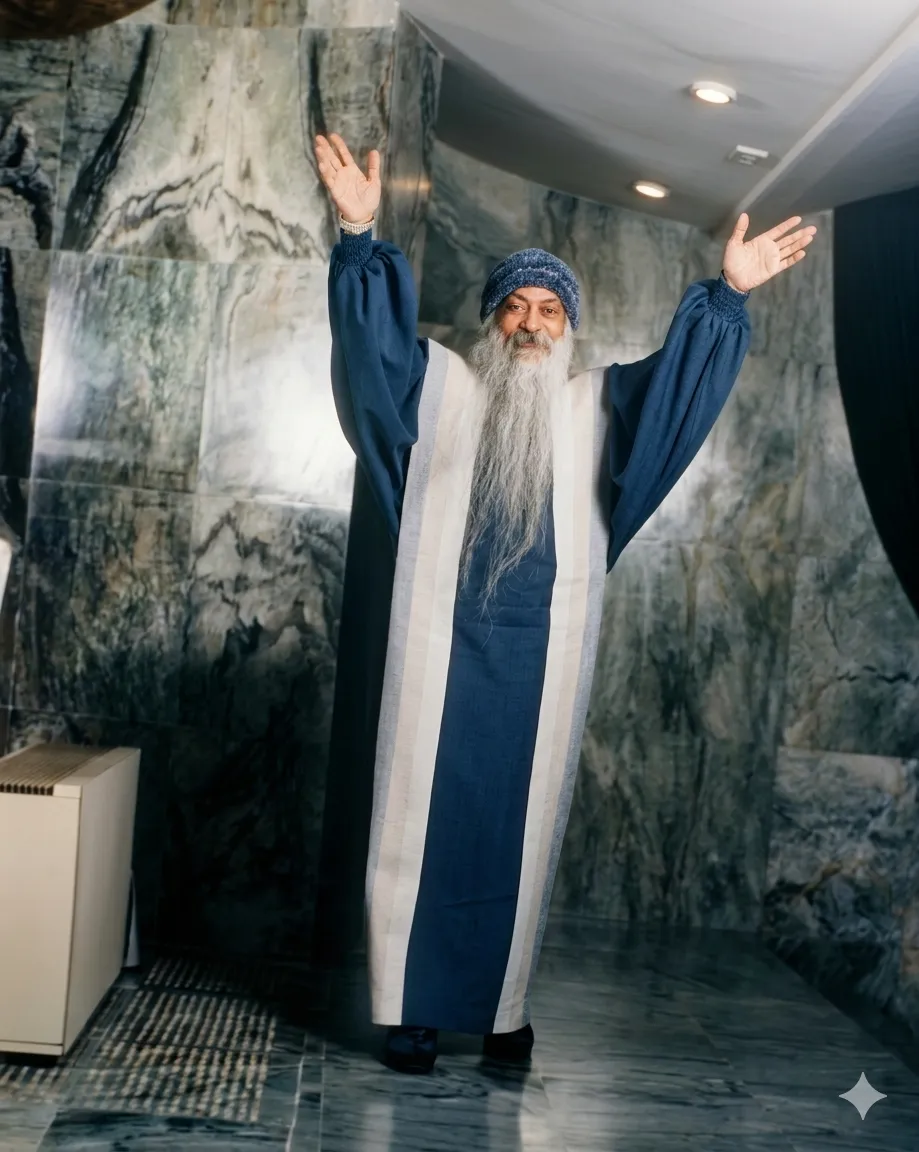
Awareness can feel like a gentle, happy drunkenness, but you stay awake inside, and it heals pain instead of hiding it.
From the Discourses
Passages where Osho speaks to this question — each links to the complete discourse.
Beloved Osho, modest though my experience of awareness is, when it is happening I feel intoxicated. It is a far more subtle, but headier drunkenness than anything that makes one unconscious. Is this a case of illusion or a case of divine wine?
You may have heard about sleepwalkers who get up in the middle of the night and without waking, with open eyes, without stumbling, reach directly to the kitchen, find the fridge, open it, eat anything to their heart's content, and in the day they are dieting! And the doctor is puzzled and they themselves are puzzled -- "What is the matter? The more I diet the more my weight is going up." And there are almost ten percent of people capable of somnambulism. They can walk in their sleep, they can do things, and in the morning they will be disturbed: "Who has done this?" And not just ordinary people; there are cases on record of very great geniuses. Madame Curie, one of the first women ever to receive a Nobel Prize, was struggling for three years to solve a mathematical problem, and was becoming almost hopeless. Every angle, every…
A friend has asked: Osho, you said that an act done in unconsciousness is sin. But emotion, too, brings a kind of unconsciousness. Please clarify.
There is a big difference between one unconsciousness and another. One kind happens in sleep—then you know nothing. Another comes from drinking—again, you know nothing. A third kind comes from bhav, the devotional mood: you are utterly absorbed, yet fully aware. When you dance, lost in song, the dance is there, the total immersion is there; and within, like a lamp, awareness is aglow—knowing, seeing, witnessing. If in your bhav an unconsciousness like drunkenness appears, understand that you have missed. Then know that your bhav has turned into mere wine. In prayer, “unconsciousness” only means this: you are so absorbed that “I am” does not arise; no word is formed that says “I am.” Yet whatever is happening, you are the witness of it. In that witnessing there is no sense of I. And that witness is not the old “you”; you have dissolved. After your dissolving, your real inner…
Osho, Buddha speaks of awareness, of waking up, and you, in between, also speak of merriment, intoxication, wine, and absorption. While speaking on Buddha, why is it necessary to discuss the opposite? Please explain.
When there is no vision, things look opposite. When there is vision, not even a trace of opposition remains. What Buddha calls awareness, the Sufis have called “unconsciousness”—a drunken swoon. What Buddha calls apramāda—heedfulness—devotees have called “wine.” There is not an inch of distance between Buddha’s sayings and Omar Khayyam. What Buddha called a temple, Omar Khayyam called a tavern. Buddha has not been understood, nor has Omar Khayyam. People thought Omar Khayyam was praising wine. Kuch apni karāmat dikha, ai Saki, Jo khol de āṅkh, vo pila, ai Saki. Hoshiyār ko dīwānā banāyā bhī to kyā? Dīwāne ko hoshiyār banā, ai Saki. You are already unconscious. You have already drunk the wine of the world. Someone has drunk the wine of wealth and is unconscious in wealth. Someone has drunk the wine of position and is unconscious in status. Someone has drunk the wine of fame. Those who couldn’t…
Osho, yesterday you said that when anger is watched consciously, it dissolves. But why is it that when sexual desire arises, even in awareness its intensity persists? Why is it so?
There is no entanglement in the breath. If you try to practice on anger… Anger is not happening every moment; it happens sometimes. And when it happens, it happens with such intensity that you are already going deep into it; so much is at stake in those moments that you may think, “We will look into awareness later; first let’s settle this now.” Lust is very deep, because existence has made it so deep; life depends on it. If lust were so easy that you decided and were freed, perhaps you would not even have been born—because many before you would have become free, and the possibility of your being would have been almost nil. But your parents, and their parents, did not become free; therefore you are. You too will not get free so easily, because your children are also to be—they are waiting: “Do not run away midway.”…
Osho, you sit in the tavern and, every morning and evening, you pour brimming goblet after goblet of wine. I do get intoxicated by your wine, but I don’t lose consciousness. What should I do?
That is why even a Sufi like Omar Khayyam has been misunderstood. Whatever notion you have about Omar Khayyam is wrong. The wine he spoke of is not the wine sold in taverns. The beloved he praised is not flesh-and-bone. He called the Beloved—God. And he called wine—devotion. Fitzgerald, who first translated Omar Khayyam into English, because of whom Omar became world-famous, did not understand him. Fitzgerald thought wine meant wine. He was a Western man. He took two plus two to be four. He took “wine” as wine and “beloved” as beloved. The subtle intention of the Sufis fell into a great misunderstanding. On the basis of Fitzgerald’s version the whole world translated him, and the mistake spread everywhere. Today taverns are named “Omar Khayyam.” Nothing could be more foolish. Temples should bear Omar Khayyam’s name—not taverns. Because the tavern he spoke of is of another kind. There is…