
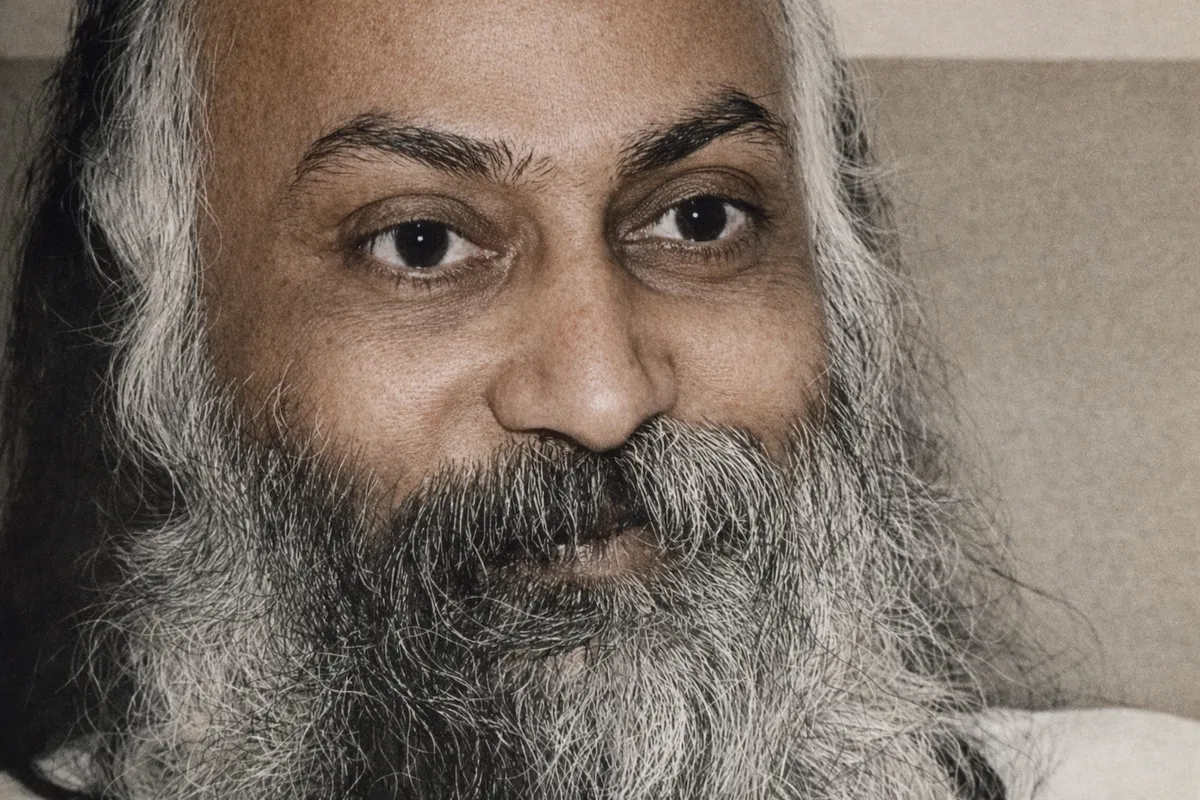
It may feel like drug sleep, but with him it's an awake, loving quiet where your busy thoughts stop and you rest in shared silence.
From the Discourses
Passages where Osho speaks to this question — each links to the complete discourse.
Beloved master, I just had a general anesthetic. The space was so familiar -- like being in lecture or darshan. Is this what you are doing -- anesthetizing us so that you can operate?
Deva Kanta, anesthesia I don't use, but I have my own ways of making you unconscious so that I can operate. In the first place, you are already unconscious enough; just a little bit of flickering consciousness sometimes you have. I have to prevent that! No anesthesia is needed for that. A man who had just undergone a very complicated operation kept complaining about a bump on his head and a terrible headache. Since his operation had been an intestinal one, there was no earthly reason why he should be complaining of a headache. Finally his nurse, fearing that the man might be suffering from some postoperative shock, spoke to the doctor about it. "Don't worry about a thing, nurse," the doctor assured her. "He really does have a bump on his head. About halfway through the operation we ran out of anesthetic." And I don't have any anesthesia with…
A friend has asked: Osho, is the samadhi attained when consciousness is lost a state of swoon? Sri Ramakrishna Paramhansa would lie for days as if near death!
In the West they have invented new ways: even blows are not enough; so they set up many lights, rapidly changing, deafening sound, assorted dances and songs; a completely deranged atmosphere is created. After an hour in that derangement one feels: ah, there is some life, some experience of living! We have died so much that unless the blow is enormous, there is no experience of life. Soft tones we cannot hear at all. Yet the natural tones of life are all soft. We cannot hear the night’s silence, nor the heart’s own beat. Have you ever heard the sound of your blood’s flow? It is very soft; you cannot hear it; but there is a sound. Buckminster Fuller wrote that for the first time he went into a building—a scientific laboratory—completely soundproof, where no sound from outside could enter. Inside he began hearing two kinds of sounds. He asked…
Osho, before discussing the process of entering a conscious death, I would like to ask: what is the difference between stupor and awakening? What do we call the state of unconsciousness? In other words, in wakefulness and in unconsciousness, what is the state of the jivatma’s consciousness?
Religion is a search for attention; so, in their own way, are gambling, battle, hunting. The man who enters the forest to hunt a lion is also seeking attention; so is the yogi in a cave striving at the ajna chakra. The search may be noble or ignoble, desirable or undesirable, successful or futile—but the underlying hunger is one. Attention means: the knowing power within me becomes fully manifest—no part left potential or dormant. Whatever capacity to know I carry turns from potential into actual. In the moment a person is fully awake, in that very moment he fully is. Awakening and being happen together. Think of a seed: the tree is hidden in the seed, but only potentially. The seed can die without becoming a tree; the tree is not a necessity, only a possibility. When the tree manifests, it is the seed in its expressed form. Sleep is…
Beloved Osho, while I was at rajneeshpuram, it was discovered I had cancer. My anguish was that I would get lost in an unconscious death and not find the way back to you. I am boundlessly grateful that your presence and grace have helped in healing me. The other day, I had food poisoning -- and again, the anguish. It was easy to be identified with the body in physical pain. I hear that doctors give morphine to dying patients to relieve the discomfort. Beloved master, please speak on meditation at the point of death. Is it possible to meditate under medication? And what about the consciousness
You have asked what happens to those people who die in coma, in unconsciousness, under some anesthesia. In fact -- whether you are in a coma or under anesthesia, or in an accident, a sudden death -- everybody except those who have realized themselves becomes unconscious before death. So it is not a question of only a small group dying in coma, dying under anesthesia, dying in unconsciousness on a surgeon's table or in an accident. Everybody dies unconscious. As death comes closer -- and when I say as death comes closer, I mean as your life starts slipping out of your body, getting ready to enter into another womb -- nature has an inbuilt program. The person becomes unconscious, because it is the greatest surgery that is happening. His whole being has to be taken from his body, in which it has lived, identified, for seventy or eighty years.…
Osho, many times while listening to you I begin to cry, and I don’t even notice when my tears have dried and I have begun to soar, intoxicated with bliss! Please explain this state.
Pradeep Chaitanya! This is not a “state,” it is good fortune. Don’t try to understand it; live it. Usually we want to understand things that are problems. By understanding problems, we hope to solve them. This is not a problem. It is the first footfall of samadhi. The first wave of samadhi drawing near. The first fragrance filling your nostrils. Don’t turn it into a problem. Don’t attempt to understand it. The moment you try, the happening will be obstructed; the flow will stop. Whenever we sit to understand, the intellect steps in. The happening is in the heart; the understanding will be in the intellect. And the moment the intellect intrudes, the heart contracts. The heart is very sensitive. Thought, intellect, logic, analysis, explanation—these it cannot bear; it closes. Love arises in your life, and someone asks you, “What is love? First explain.” If you start explaining, know this…