
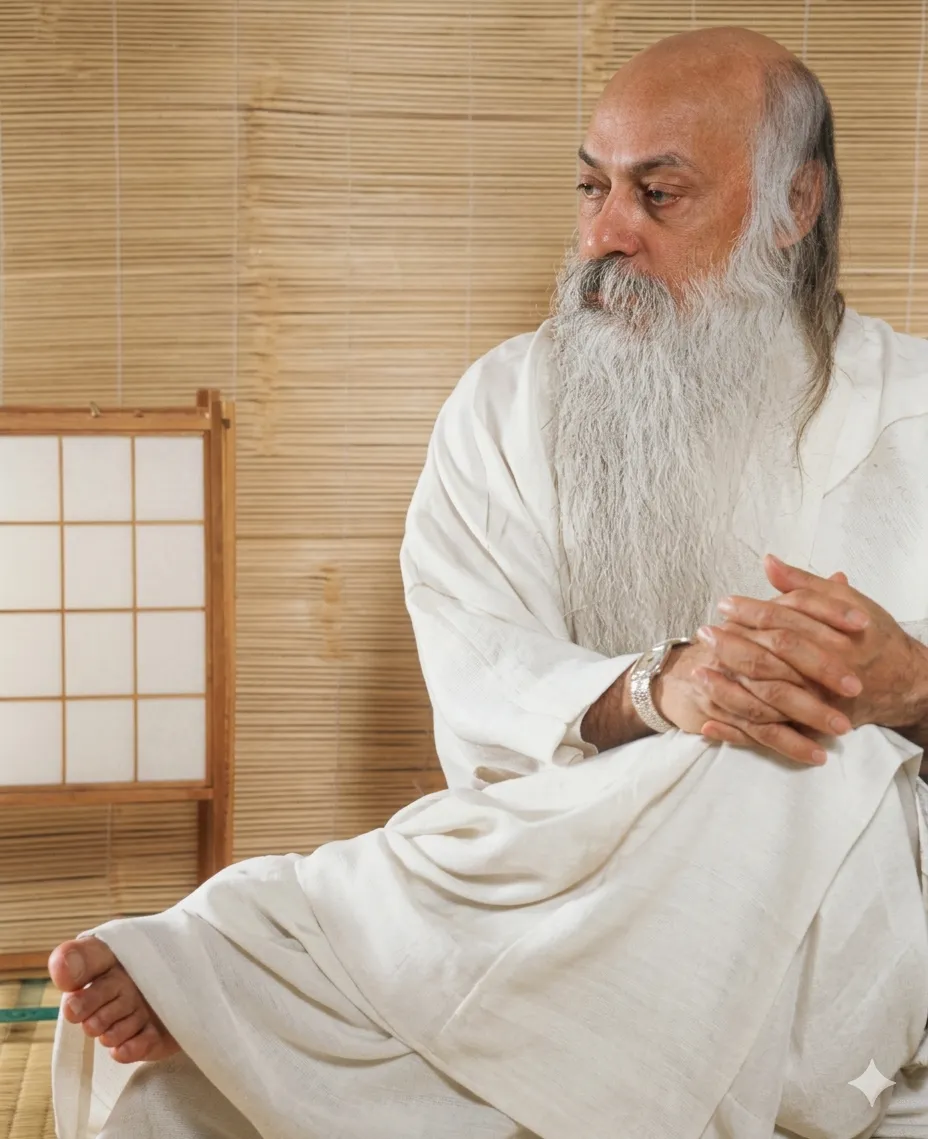
If reading makes you proud, it’s bad food; if it leaves you humble and quiet inside, it’s okay—otherwise keep your mind open and empty so truth can come.
From the Discourses
Passages where Osho speaks to this question — each links to the complete discourse.
You have asked in passing: what if one reads good literature? You ask—if one reads good literature, will that be right nourishment or not? Because to watch films is bad nourishment; to read trashy literature is bad nourishment. But if one reads good literature?
If someone concludes, “The soul exists, therefore what is there to gain?” he will ruin his life. This is mere talk—borrowed logic. You have heard others say the soul is within; then you have concluded, “If it is within, what is there to gain?” This is your trick to avoid awakening. In that sentence are two people’s conclusions, not one. “The soul is”—this belongs to Mahavira, to Buddha, to Krishna. “Then what is there to gain?”—this belongs to you. If the first is also yours, then there is no problem. If the first is another’s, you cannot draw your conclusion from someone else’s experience. Your experience will give your conclusion; another’s cannot give it to you. So you are using a device. You are tacking on your half to someone else’s half—only to show that you do not wish to wake up from your sleep. You want life to go…
आपने पूछा है बीच में कि अच्छा साहित्य पढ़ें तो? आप पूछते हैं--अच्छा साहित्य पढ़ें तो वह सम्यक आहार होगा कि नहीं? क्योंकि फिल्म देखें तो बुरा आहार है। कोई रद्दी साहित्य पढ़ें तो बुरा आहार है। अच्छा साहित्य पढ़ें तो?
तो अगर कोई यह सोच ले कि आत्मा तो है ही, इसलिए पाना क्या है? तो जीवन नष्ट कर लेगा। यह केवल बातचीत थी, सुन लिया कि आत्मा तो है ही, इसलिए पाना क्या है? यह केवल एक लाजिकल कनक्लूजन था। सुन लिया कि लोग कहते हैं आत्मा भीतर है। जब यह सुन लिया, तो हमने सोचा कि फिर पाना क्या है? पाना क्या है, यह हमारा निष्कर्ष है। यह हमारी तरकीब है बचने की। और वह दूसरे का निष्कर्ष है कि आत्मा है। आत्मा है, यह दूसरे का निष्कर्ष है। …
Question: BELOVED OSHO, YOU SAY THAT MIND'S SUBSTANCE IS MEMORY AND INFORMATION. DOES READING THEREFORE INFLATE AND INVIGORATE THE MIND? ... Prose is logical, poetry is illogical. Prose is linear, it moves in a straight line. Poetry is not linear, it is circular, it moves in circles. Prose is for ordinary things and ordinary experiences. There are experiences which cannot be expressed in prose. Those experiences need poetry. Poetry means a more liquid form. Poetry means a more singing, dancing, celebrating form. All great scriptures are poetry; even if they are written in prose they are poetry. Poetry can be written in prose and prose can be written in poetry. So it is not a question only of linguistic form -- it is a question of its very essence. So when you read the Koran, don't read it -- sing it!
Question: ABANDON POISONED FOOD. DON'T BE CONSISTENT. DON'T MAKE WICKED JOKES. DON'T WAIT FOR AN OPPORTUNITY. DON'T STRIKE AT THE HEART. DON'T TRANSFER THE COW'S LOAD TO THE BULL. DON'T BACK THE FAVORITE. DON'T HAVE WRONG VIEWS. DON'T FALL FOR THE CELESTIAL DEMON. The first sutra: According to the mystic traditions of the East, all that you think you are is nothing but food. Your body is food, your mind is food, your soul is food. Beyond the soul there is certainly something which is not food. That something is known as anatta, no-self. It is utter emptiness. Buddha calls it shunya, the void. It is pure space. It contains nothing but itself; it is contentless consciousness. While the content persists, the food persists. By "food" is meant that which is ingested from the outside. The body needs physical food; without it, it will start withering away.
Osho, if reading and listening do not bring knowledge, then what is the need for reading and listening? And besides, you yourself have been reading and listening for so long! What is the difference there?
Yes. In truth, life is woven of great opposites. And it is true that by reading and understanding, by listening, knowledge does not simply arrive. If the awareness remains alive in you that reading and listening alone do not bring knowledge, then reading and listening can become a means to invite knowledge within—provided that awareness stays clear that by these alone knowledge does not come. But if the notion takes hold that reading and listening themselves give knowledge, then knowledge will never dawn in you. Reading will not be a means; it will become a hindrance. Now, on the surface these things look reversed. If it is firmly clear to you what reading can and cannot give, you can even gain something through reading—because then you won’t cling to the reading. It is already clear to you that nothing final is obtained by reading. Then you won’t clutch at listening…
प्रश्न: ओशो, पढ़ने और सुनने से ज्ञान नहीं होता है तो फिर पढ़ने और सुनने की जरूरत क्या है? और उसके बाद, आप स्वयं इतने समय तक अभी पढ़ा और सुना ही तो रहे हैं! उसमें भेद क्या है?
हां, असल में जिंदगी बड़ी विरोधी चीजों से बनी है। और यह बात सच है कि पढ़ने-समझने से, सुनने से, ज्ञान नहीं आ जाता है। अगर यह बोध बना रहे कि पढ़ने और सुनने से ही ज्ञान नहीं आ जाता है, तो पढ़ना-सुनना भी तुम्हारे भीतर ज्ञान को लाने के लिए निमित्त बन सकता है--अगर यह बोध बना रहे कि इससे ही ज्ञान नहीं आ जाता है। और अगर यह खयाल हो जाए कि पढ़ना-सुनना ही ज्ञान दे देता है, तो तुम्हारे भीतर कभी ज्ञान नहीं आएगा। यह निमित्त नहीं बनेगा, यह बाधा बन जाएगी। अब ये बातें उलटी दिखती हैं ऊपर से। अगर तुम्हें पक्का स्पष्ट है यह कि क्या पढ़ने से मिलेगा, तो तुम्हें पढ़ने से भी कुछ मिल सकता है। क्योंकि तब तुम पढ़ने को नहीं पकड़ लोगे, क्योंकि वह तो तुम्हें स्पष्ट ही है कि पढ़ने से कुछ नहीं मिलता। तब तुम सुनने को नहीं पकड़ लोगे; तब तुम सोचोगे, समझोगे, खोजोगे; वह तुम्हारी जारी रहेगी खोज। और तब पढ़ना भी एक निमित्त बन सकता है तुम्हारी खोज का।
Osho, I am not saying we shouldn’t read the Upanishads or the Gita, am I?
Why would I say that the Gita and the Upanishads should not be read! I would not even say that so‑called forbidden books should not be read. I would say: read those too. How could I be opposed to reading? How could I be opposed to learning? My point is only this: read them as books, not as scripture. Do not read them as sacred, holy texts; read them as books. They are people’s experiences—understand them. But remember, their experience does not become your experience by reading. Their realization, their knowing does not become your knowing by reading. If this is kept in mind, what harm is there in reading? By all means, read. It is beneficial. These are the memories of humankind; certainly look into them—but with utter impartiality. A Hindu can hardly read the Quran properly. A Muslim can hardly read the Gita properly. He cannot. As long…
पूछा है कि ओशो, मैं ऐसा तो नहीं कहना चाहता हूं कि हमें उपनिषद या गीता नहीं पढ़नी चाहिए?
मैं क्यों कहूंगा कि गीता और उपनिषद नहीं पढ़नी चाहिए! मैं तो यह भी न कहूंगा कि जो ऐसी किताबें हैं जो वर्जित हैं, वे भी न पढ़नी चाहिए। मैं तो कहूंगा, वे भी पढ़नी चाहिए। पढ़ने से मेरा क्या विरोध हो सकता है? सीखने से मेरा क्या विरोध हो सकता है? मेरा कहना तो केवल इतना है कि किताब की भांति पढ़नी चाहिए, ग्रंथ और शास्त्र की भांति नहीं। कोई सैक्रेड ग्रंथ, कोई पवित्र ग्रंथ की भांति नहीं पढ़नी चाहिए; किताब की भांति पढ़नी चाहिए। अनुभव हैं लोगों के, समझने चाहिए। लेकिन यह ध्यान रखना चाहिए कि उनका अनुभव आपका अनुभव नहीं बन जाता है पढ़ने से। उनकी प्रतीति, उनका ज्ञान आपका ज्ञान नहीं बन जाता है पढ़ने से। यह ध्यान रहे तो पढ़ने में क्या बुराई है? जरूर पढ़नी चाहिए। हित है। मनुष्य-जाति की स्मृतियां हैं, उन्हें जरूर देखनी चाहिए। लेकिन अत्यंत निष्पक्ष भाव से।