
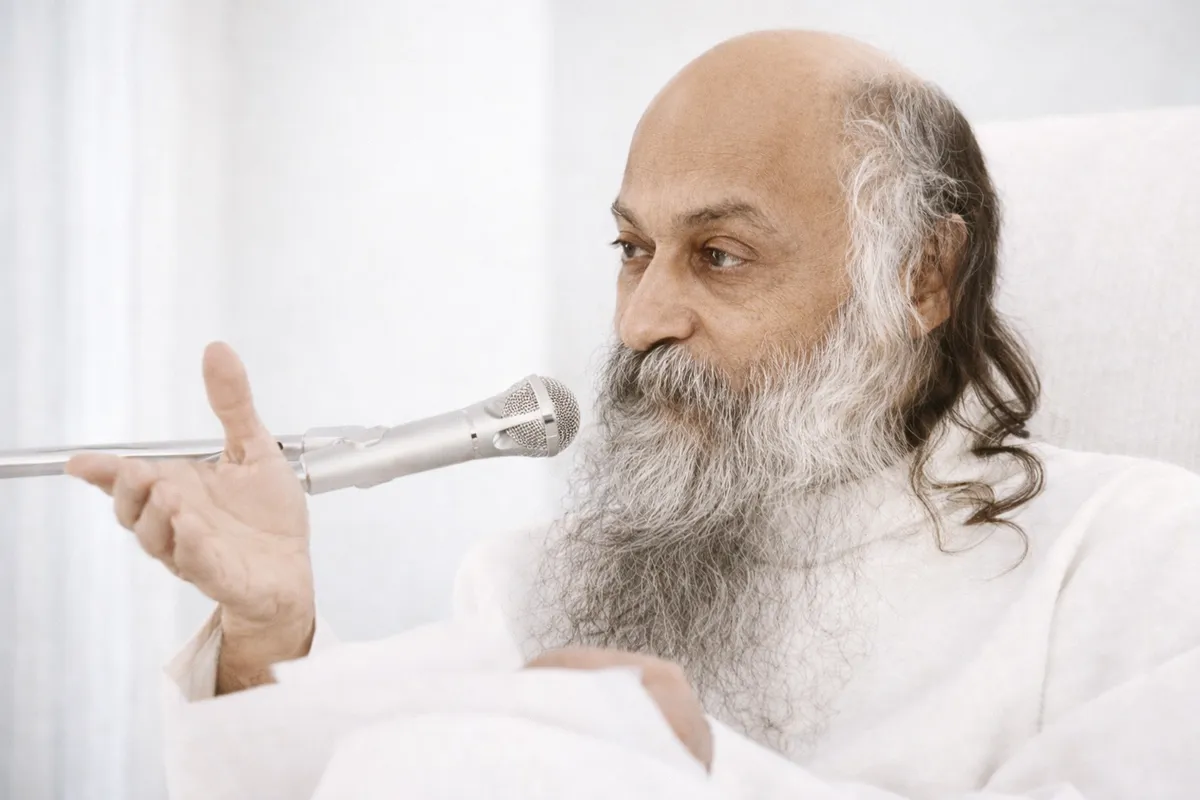
He picks the clearest example, no matter where it’s from, and modern topics often need Western references.
From the Discourses
Passages where Osho speaks to this question — each links to the complete discourse.
Osho, when you give examples, why do you draw them from Western literature?
No, no—there are several reasons. The examples I give are not chosen with the idea of whether they are Indian or Western. I choose an example according to the point I am trying to explain. If the example happens to be Western, and you can suggest an equally apt one from India, I’m open—do you see my point? I use an example to clarify something; where it comes from doesn’t concern me. For me there is no West, no India, no East— the whole world is one. To make something clear, I use whatever is the most fitting, the most excellent. If someone tells me there are better Indian examples than the one I used, let them tell me—I will gladly use those. And when I do give an Indian example, it’s because, for that purpose, it is the best; otherwise I don’t use it. Look at any example I…
प्रश्न: ओशो, आप उदारहण देते हैं तो पश्चिम के साहित्य के क्यों देते हैं?
नहीं-नहीं, बहुत बातें हैं। जो उदाहरण मैं देता हूं वह इस खयाल से नहीं देता कि भारत का है कि पश्चिम का है। जो उदाहरण मैं देता हूं वह जिस बात को मैं समझा रहा हूं उससे देता हूं। वैसा उदाहरण जो मैंने दिया अगर पश्चिम का है, तू अगर भारत में से वैसा उदारहरण बता दे तो मैं समझूं। मेरा मतलब समझे न? यानी मैं कोई बात समझाने के लिए कोई उदाहरण दे रहा हूं, ऊं, अब वह कहां से है इससे मुझे कोई प्रयोजन नहीं। मेरे लिए कोई न पश्चिम है, न कोई भारत है, न पूरब है। मेरे लिए तो सारी दुनिया एक है। मुझे जो बात समझानी है उस बात को समझाने के लिए जो श्रेष्ठतम हो सकता है वह मैं कहता हूं। अगर कोई मुझसे कहे कि भारत में इससे ज्यादा श्रेष्ठतम उदाहरण हैं इसके मुकाबले, तो वह मुझे बताए। …
While talking about wisdom, insights, and enlightenment, you often say 'we in the east'. Please explain the meaning of this phrase.
THE EAST HAS NOTHING TO DO WITH THE EAST. The East is just symbolic of the inner space, of the inner world of consciousness. East is symbolic of religion, West is symbolic of science. So even if in the East a person attains to a scientific attitude, he becomes Western. He may live in the East, he may be born in the East -- that doesn't matter. Or, whenever a person attains to religious consciousness -- he may be born in the West, it makes no difference -- he begins to be a part of the East. Jesus, Francis, Eckhart, Boehme, Wittgenstein, even Henry Thoreau, Emerson, Swedenborg -- they are all Eastern. The East is symbolic, always remember. I am not concerned with geography. So whenever I say 'we in the East', I mean all who have come to know the inner reality. And whenever I say 'you in the…
Beloved Osho, as you were talking about indian and western sannyasins, I felt what you were saying was true -- sometimes the indians are too much of the heart. It is hard to say no to them, yet you cannot say yes to their expectations and theories. They are deaf. Will you please explain why this is so?
You have to be alert not to allow the heart to start overpowering your reason, just as you have to be alert that your reason does not overpower your heart. Their functions are separate. Reason should function in the world of objects, and the heart should function in the world of human consciousness. And the moment they overlap, there is going to be a certain kind of mess. And whenever you feel it, that the man is so loving, how to say no to him? don't be worried. It has been my whole life's difficulty -- because everybody in India is so full of knowledge, and all that knowledge is simply holy cow dung, there is nothing in it. But these people are good, this is the problem. The people are good: very generous, very loving, very helpful. Only their hearts have overrun their heads, so whatsoever they are saying...…
Eastern intelligence is lagging far behind but those who are intelligent in the East are certainly influenced by them. Then there is no difference between the East and the West. The question is, are you intelligent enough to drop believing, are you intelligent enough to search on your own without any prejudice, without being a Hindu or a Mohammedan or a Christian? I simply don't give them any catechism to cling to, I don't give them any discipline. I don't say to them, "This has to be done and this has not to be done." My whole approach is different. I simply explain to them how you can be in a peaceful, non-tense, blissful state of mind and out of that state of mind it is impossible to do anything wrong. So you will be decisive in what you want to do.
Osho, last night you said that the mind cannot do two things together -- that is, thinking and witnessing. It seems then that witnessing is a mental faculty and an act of the mind. Is it so? Please explain. Is there anything like partial witnessing and total witnessing?
WITNESSING is not a mental activity; thinking is a mental activity. Rather, it would be better to say that thinking is mind. When the mind is not, when the mind is absent, when the mind has disappeared, only then do you have witnessing. It is something behind the mind. Zen Buddhism uses mind in two ways: the ordinary mind means thinking; then Mind with a capital "M" means the Mind behind thinking. Consciousness is behind the mind; consciousness comes through the mind. If mind is in a state of thinking, it becomes opaque, non-transparent, just like a clouded sky -- you cannot see the sky. When the clouds are not, you can see the sky. When thinking is not there, then you can feel the witnessing. It is the pure sky behind. So when I said that you cannot do two things, I meant either you can think or you…