
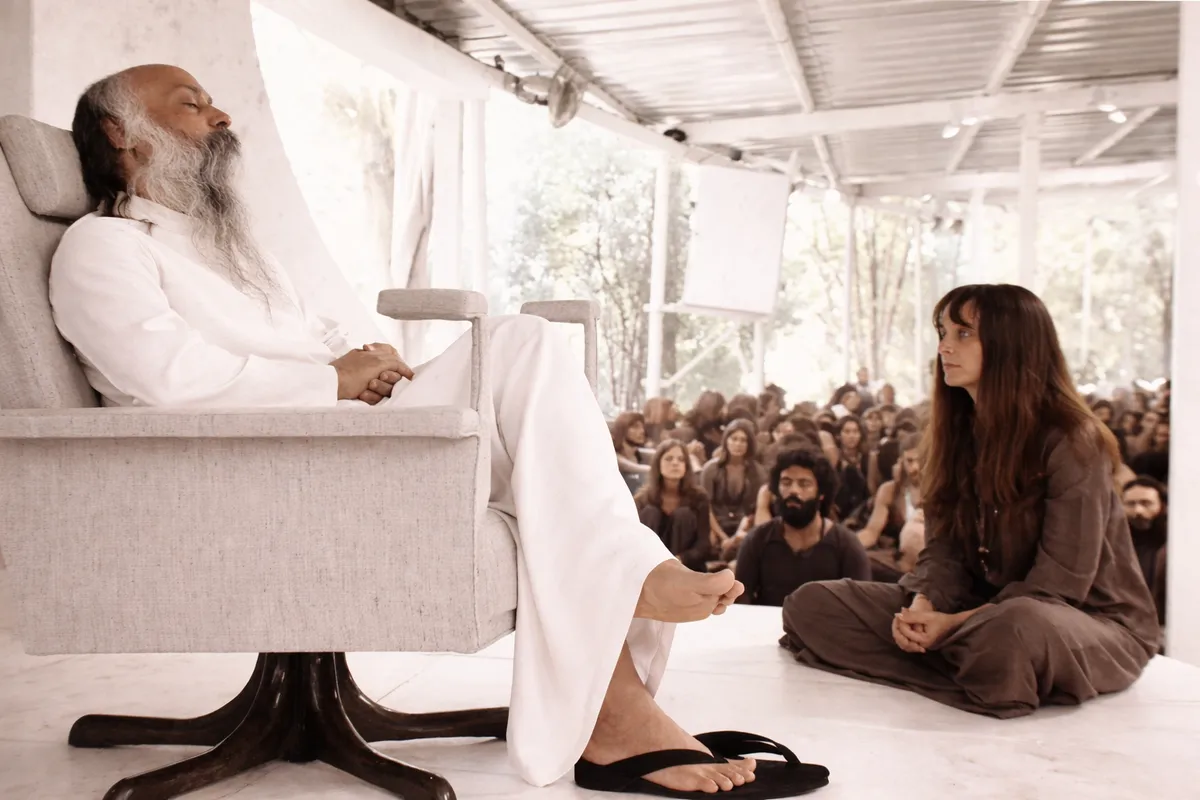
Pay full attention to whatever you’re doing, as if your life depends on it, and your awareness will grow by itself.
From the Discourses
Passages where Osho speaks to this question — each links to the complete discourse.
Osho, we feel that to penetrate and transform the deeper layers of the unconscious only through awareness is difficult and not enough. What else should one do other than the practice of awareness? Please explain more about the practical dimensions on this matter.
Silence is energy. Brahmacharya is energy. Not to be angry is energy. But this is not suppression. If you suppress anger, you have used energy again. Don't suppress -- observe and follow. don't fight -- just move backwards with the anger. This is the purest method of awareness. But certain other things can be used. For beginners certain devices are possible. So I will talk about three devices. One type of device is based on body awareness. Forget anger, forget sex -- they are difficult problems. And when you are in them, you become so mad that you cannot meditate. When you are angry you cannot meditate; you cannot even think about meditation. You are just mad. So forget it; it is difficult. Then use your own body as a device for awareness. Buddha has said that when you walk, walk consciously. When you breathe, breathe consciously. The Buddhist method…
Question: BELOVED MASTER, ARE YOU A BLACK MAGICIAN OR A WHITE MAGICIAN? Prem Tussir, I am an orange one. The third question: BELOVED MASTER, HOW TO BECOME MORE AWARE? Pankaj, by becoming more aware, one BECOMES more aware. There is no other method to it. It is a simple process. Whatsoever you are doing, do it with such consciousness as if it is a question of life and death; as if a sword is hanging over you. There is an ancient story in India: A great sage sent his chief disciple to the court of King Janak to learn something which was missing in the young man. The young man said, "If you can't teach me, how can this man, this Janak, teach it to me? You are a great sage, he is only a king. What does he know about meditation and awareness?
Beloved Osho, I have no idea about what `right awareness' is. How to judge that I am going in the right direction?
There is no right awareness because there is no possibility of wrong awareness. Awareness is right. So first, drop the wrong question. Once you are asking a wrong question to yourself you cannot get the right answer. Don't ask what is right awareness. Simply ask what is awareness. Your question gives the fallacious impression that you know what awareness is, that the only thing that you don't know is, what is right awareness and what is not right awareness. Erase that fallacy completely from your mind. Awareness is simple, very innocent. Everyone has it, so it is not a question of achievement. One wrong question leads to another wrong question: first you ask what right awareness is, then you ask how to achieve it. You already have it. When you see the sunset, are you not aware? When you see a roseflower, are you not aware? You are aware of…
Osho, you say that if there is awareness, then how are the two to be brought into harmony?
That is precisely the practice of active meditation: awareness. Awareness is the very means of going into emptiness in relation to all actions, to the movements of the mind as well. For example, if you lie there for half an hour—what will you do? In that half hour, whatever thoughts are moving in your mind, you are to be simply aware of them. Simply a witness—what else will you do? Just become a witness. Keep silently watching; let them move. But obstacles arise in our seeing. We become absorbed. We fail to remain a witness. We don’t even notice when we have become one with those very thoughts. That sense of awareness fades; a kind of stupor, a moorchha, comes in. A thought comes, a memory arises, and we stop being the watcher. We become part of that thought and of its flow. That is moorchha. And the opposite is…
Mahavira has called apramad—vigilance, awareness, continuous wakefulness—the basis of practice. A friend asks: how can we bring this awareness into our conduct while doing our tasks—in the office, in the shop, while working? If attention remains on awareness, how will the work get done? While engaged in work, what is the place of awareness, and can this itself be a sadhana?
Take attention also as delight. Do not make it a restlessness. Let it not become a burden on your head that “I must work attentively.” Do not load it with strain and effort; let it grow lightly, support it. Whenever the remembrance arises, do it consciously. If you forget, do not worry. When remembrance returns, begin again to do it consciously. If you decide, “Now I will do my work consciously,” you will not be able to do it today itself; it may take years. To keep awareness even for a moment is difficult. You will decide to walk consciously; you will not be able to take even two steps before awareness has gone elsewhere and the feet have started walking elsewhere. Do not be anxious about that; do not repent. Heedlessness is the habit of countless lives; there is no reason to be distressed. We ourselves have cultivated unawareness—whom…