
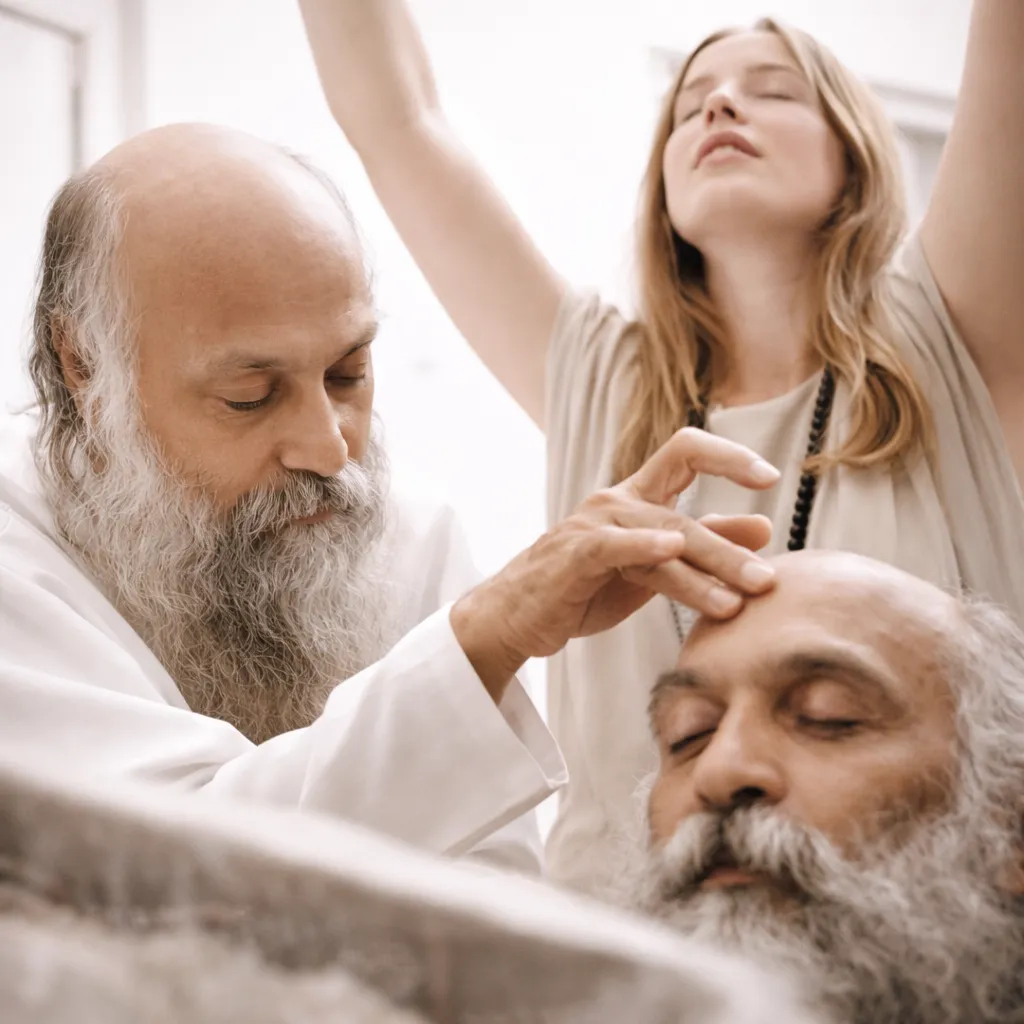
Watch your belly gently rise and fall with each breath, and whenever thoughts come, softly return to that movement.
From the Discourses
Passages where Osho speaks to this question — each links to the complete discourse.
So should one meditate by simply watching that? Make the breath itself the meditation. The breath goes down, comes up. I say this only to explain. Its going up, its going down—“it went up, it went down”—that becomes a thought. Going and coming is its action; put the whole focus on that action. In a little while you will find you have become thought-free. Because the mind cannot do two things at once. Focus cannot be in two places at the same time.
And that is why it happens that if right now a man comes and stands with a knife at your chest, your thinking stops instantly—because the entire focus goes to the knife. A second later the thought will arise: what should I do to save myself? But for that one second the whole consciousness breaks from the old sequence, because the shock is so great that the fixed pattern shatters at once and you are startled, standing alert. You are driving a car and suddenly a child comes in front; you slam the brakes. For one second the focus will break completely from thought—within focus there will remain only the car and the child. Not even the thought will remain that the child came and might die—no, not even that. That comes later, as an after-effect. Later the thought will arise: the child could have died, this could have happened.…
And relax the body as well, so that the body does not hinder you in any way, so there is no strain. Whoever wishes to lie down may lie down right now. Leave the body loose as well. The eyes are closed; the body has been left loose. Whoever wants to lie down should lie down quietly. Now take your attention to the breath. Look within: breath is going in, coming out. Watch the breath. As soon as you begin to watch the breath, you will be standing at that place, at that door from which meditation opens. Begin to watch the breath—this breath has gone in. It is a very subtle thing; if you watch within carefully, it will begin to be seen. To be seen means it will begin to be felt: breath is going in, breath is coming out.
How is one to watch breath when it is not seen but felt?
Watching need not be a seeing, it can be a feeling. In fact it has to be a feeling because how can you see your breath? You feel it, the touch of it. When the breath moves through the passage, you feel the touch of it. The whole thing is not a question of seeing. The thing is to be alert that it is going in, that it has reached to the very innermost core of your being, that now it has stopped; that now it is coming back. The ebb and the tide: now it has gone out, moved completely out, stopped; then again moving back. The whole circle of it -- coming in, going out, coming in, going out -- one has to be aware. If you feel it, that is awareness -- but one should not miss feeling it. If you can do it every day for…
How are we to watch the processes of inhaling and exhaling in meditation?
Hold the spine erect. Do not allow it to bend. The body is in a state of natural balance when the backbone is held erect. In that position the gravitational pull of the earth has a uniform effect on the body and it is easy to free oneself from its attraction. When the force of gravity is at its minimum the body does not interfere in one's becoming empty, in one's becoming devoid of thoughts. Hold the backbone erect, without tension or rigidity in the body. Allow the body to relax as if it were hung on the spine like a piece of cloth on a peg. Relax the body completely and then breathe slowly and deeply. The inhaling and the exhaling will move the naval center up and down. Continue to watch this movement. It isn't necessary to concentrate on it, just watch it. Be a witness to it.…
Beloved Osho, would you please tell us more about what the sufis call "adab"? Is it a "tariqa"... A method that extends beyond the physical presence of the master, becoming part of the innermost being of the disciple and reflecting, in every action of his daily?
Radha Mohammed, yes, adab is a tariqa, a method. It is the beginning of something very immense, of something utterly incomprehensible to the intellect. It is the first step of a great eternal pilgrimage. To be with the Master is simply a lesson in how to be with God. That's why down the ages the Master has been called "God". It is very symbolic, it is a metaphor. The word "metaphor" is beautiful. Meta means beyond, phor means going: that which takes you beyond. The Master is a metaphor -- he takes you beyond himself. He is just a beginning, a jumping-board. To be with the Master is nothing but a discipline in how to be with God. God is not visible, the Master is visible; it is easier to learn from the visible and then move to the invisible. Have you looked into children's books? We have to make…