
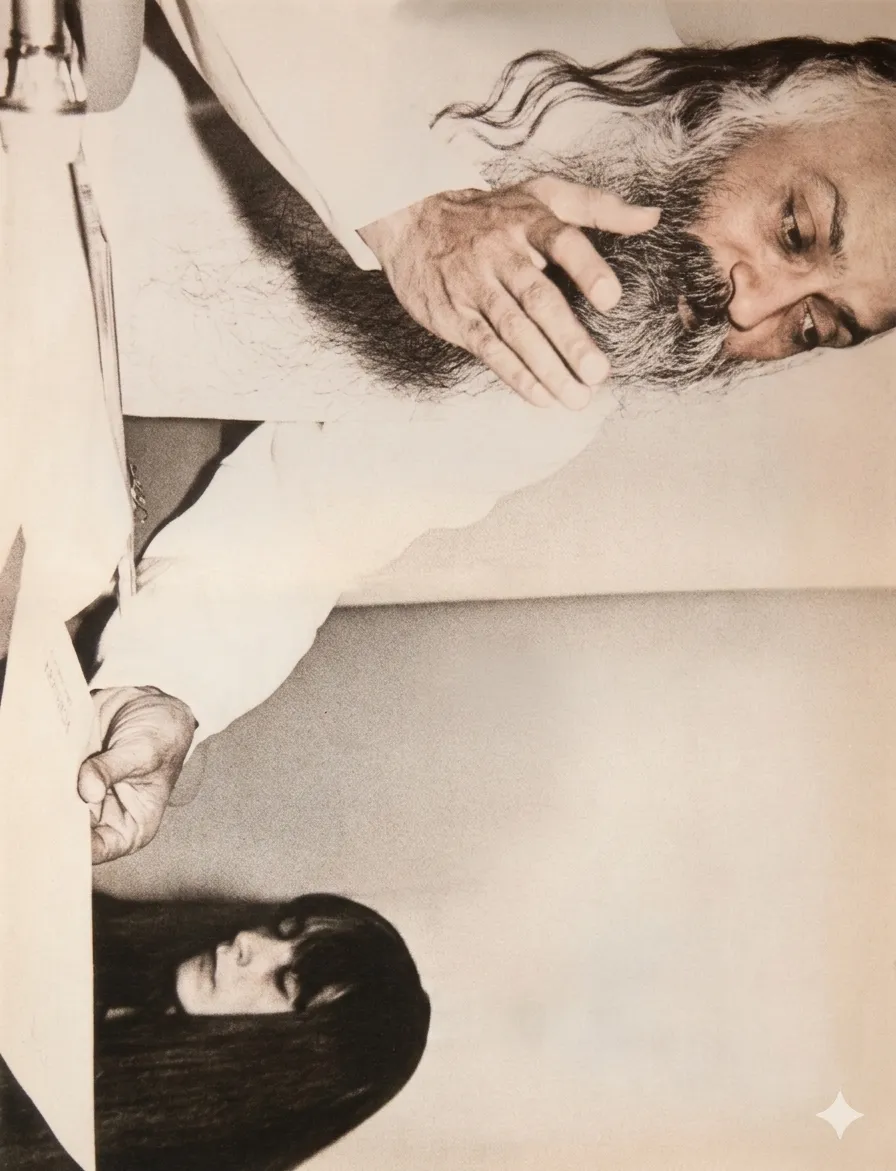
Pick what truly helps: if clear seeing makes you quiet, just watch; if you’re still restless, admit it and meditate with any method that returns you to the silent watcher.
From the Discourses
Passages where Osho speaks to this question — each links to the complete discourse.
Osho, on the one hand you inspire seekers to practice meditation, and on the other hand you say that all meditative practices are a Gorakh-dhanda. This puts the seeker in a dilemma. How should he decide what is right for him?
“Gorakh-dhanda” is a very significant word—it is connected to Gorakhnath. Whenever someone gets overly entangled in techniques and rituals, we say, “Don’t get into Gorakh-dhanda.” Gorakh discovered the greatest number of methods of meditation. After Patanjali, Gorakh’s name is unforgettable. He found great experiments in meditation. Certainly, through the experiments of meditation people have arrived; but meditation is for those for whom understanding alone is not sufficient—it is a complement; whatever deficiency remains in understanding, meditation completes. No one knows the soul through meditation; but through meditation you become so quiet that in that quietness becoming a witness becomes easy. When you know, you will know only through Ashtavakra’s path. Consider: someone is afflicted with fever, lying ill, delirious, and he says, “How can I attain samadhi?” What will we do? Will we give him some method of samadhi? We will say, first let the fever be cured. He may…
Osho, before beginning practice we read in books that a seeker has such-and-such experiences, that this or that will happen, may happen. So when I prepare to practice on my own and I try to see where these colors show up—white, green, blue—and I sit right at the start to imagine them, even before a thought-free state arrives, don’t all these imaginations that we are taught become an obstacle to entering meditation?
In truth, for me there is no wrong and right. There are two paths and two kinds of people. And in each person both kinds of aspects exist. The complexity is great. Therefore for the masculine mind—not man, the masculine psyche—the positive path becomes easier, immediately easier, because there is aggression, a drive to conquer, to achieve, to grasp. The feminine mind is negativity, receptivity—let it come. It is not an attack but a waiting. So in those centuries where the masculine predominated—as in the past centuries, where woman had no influence—those were centuries of means, of methods. In the coming days woman is slowly becoming influential, and in the West, where woman has become very influential, a Krishnamurti-like view can have influence, because negativity has increased. But this is such a wavering matter—it wavers daily. Whatever of the two seems right to you, each person should decide within. If…
In 1969 followers of the Maharishi Mahesh Yogi invited Osho to talk to them. This was the first occasion on which Osho addressed a western audience, and the first time he talked publicly at length in English. The discourse has been published in OTI January 1 & 16, 1991; and February 1, 1991. Osho: Really, there can be no method as far as meditation is concerned. Meditation is not a method. Through technique, through method, you cannot go beyond mind. When you leave all methods, all techniques, you transcend mind. So meditation itself is not a method. Truth cannot be achieved through method. Method is our own invention. We, who are ignorant, have achieved knowledge through methods constructed, created, projected, in our ignorance. Through method you can achieve a sort of self-hypnosis, a sort of auto-hypnosis. Any method, whatsoever it's name, can only give you an illusory kind of peace.
Osho, can the ultimate state not be attained through continuous witnessing and without meditation? And when only witnessing remains, how does one become free of that too?
Begin with action—and go to non-action. Begin with meditation—and go to samadhi. Start in shallow waters, then slowly go deeper… then into the bottomless depths. Do not hurry. Gently, step by step… But you seem to be in a hurry. The question is quite extraordinary: “Can the ultimate state be attained through continuous witnessing and without meditation?” And then: “And when only witnessing remains, how to be free of that too?” You are in a great rush! Witnessing has not happened yet. Meditation has not happened yet. Meditation hasn’t even begun; theoretically you have adopted the notion: it would be good if witnessing were accomplished—without meditation. If it had happened, you would not be asking. It has not happened. Yet you go further: “If witnessing is accomplished—without meditation—then how to be free of that?” Not such haste. If you leap like this, you will break your hands and feet. The…
Osho, if there were only one single method of sadhana in your ashram, wouldn’t it be more convenient for seekers?
These are two styles: either you support yourself—and then there is no need of another. Fine; the matter is finished. Support was the whole issue, and you supported yourself. Have you noticed: a mother’s love is strongest for the child who is the weakest. This is exactly the opposite of economics. But economics and the scripture of love are opposite. According to economics, love should be for the strongest, the most intelligent, the most skilled. No—mother knows the strong, the intelligent, the skilled will manage for themselves. They have no need. It is the weak who are less intelligent, who are more likely to stray, who may fall—the mother takes care of them. It often happens that the sick child becomes dearest to the mother—more than the healthy ones. The experience of God comes to those who stagger in helplessness. That is why in the religions of Buddha and Mahavira…