
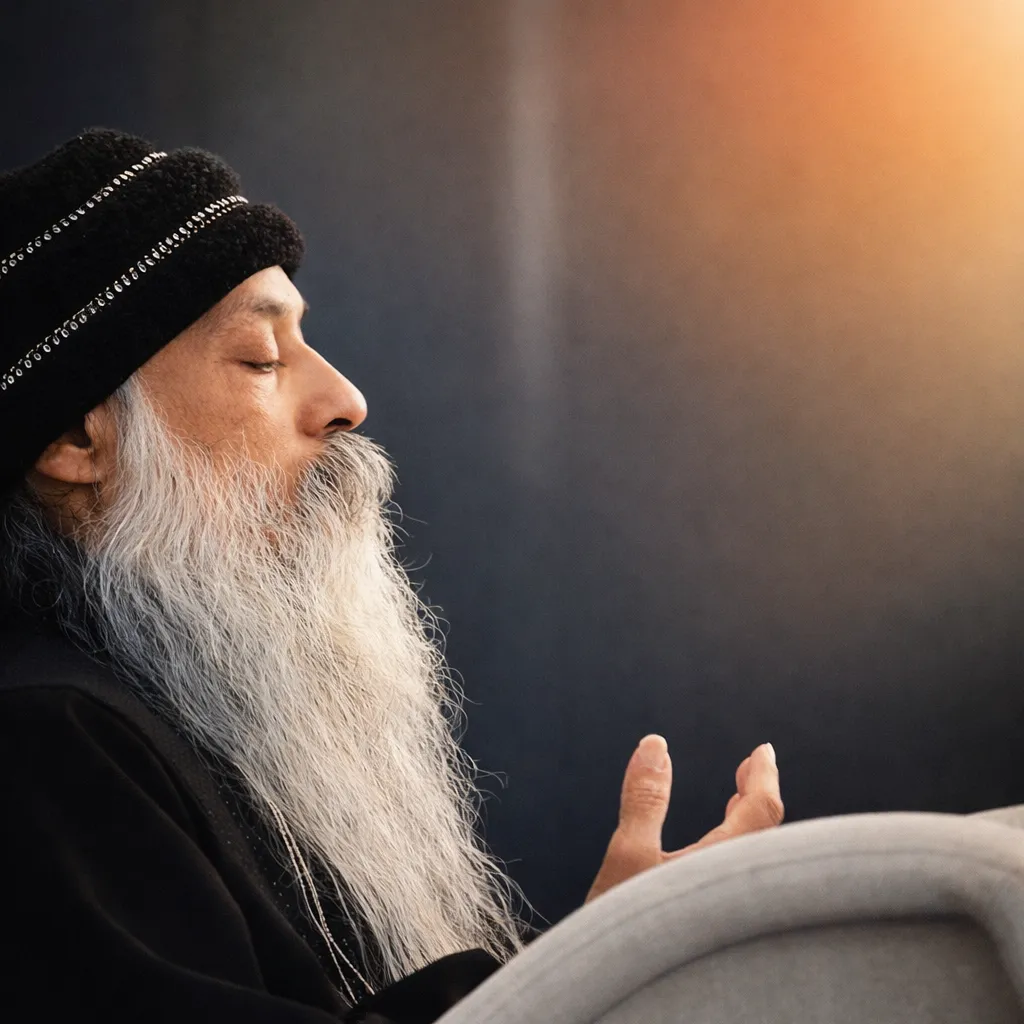
Hypnosis makes you sleepy so someone can plant ideas, but Osho's meditation keeps you wide awake with breathing, movement, and asking who you are, so you become more aware, not less.
From the Discourses
Passages where Osho speaks to this question — each links to the complete discourse.
Osho, how is your meditation different from auto-suggestions and hypnosis? And if it is different, how? Please clarify.
It is not different from auto-hypnosis and hypnosis; it is more. As far as auto-hypnosis goes, the path of meditation goes along with it, on the same road. But where auto-hypnosis stops, this path goes beyond. And because of that going-beyond, even in the stretch where it runs alongside hypnosis there remains a fundamental difference. The very basis of hypnosis is that your conscious mind goes to sleep. To become stupefied, to fall into a trance, is hypnosis. The process of hypnotic suggestion takes you into drowsiness. The more drowsy you become, the more sleep-like you become, the more you can be hypnotized. Then in that hypnotic state anything can be made to happen through you, because your discrimination is asleep. In this process of meditation you are not to go into trance; in fact, you cannot—because the whole process is active. That is why a hypnotist will lay you…
A friend has asked: Osho, if through meditation or spiritual practice one can conquer death, does not the same state occur in sleep? And if it does, why can’t death be conquered through sleep?
But meditation and hypnosis are not the same. Understand me carefully. I said: up to this point it is hypnosis, mesmerism—so long as we are manufacturing suggestions. When the manufacturing of suggestions stops and you awaken—where awareness begins—there meditation begins. Where witnessing begins, meditation begins. And the reason for this hypnosis is that you have fallen into a reverse hypnosis. In scientific language, this is not hypnosis but de-hypnosis. Not mesmerism, but the breaking of mesmerism. We are the ones mesmerized—but we don’t know it. In life we have become hypnotized, and we have no idea how many kinds of hypnotic trances we have taken on, by how many devices we have produced them. A large part of our life is hypnosis. And when we want to be hypnotized, we don’t notice what we are doing. For example… we live like this all our lives. If we became aware of…
Another friend has asked: What is the difference between meditation and samadhi?
Remember, there is none other than the Divine all around—inside and out, only that One is. He is in the sky, in the earth, in the winds, everywhere—inside and out, only the Divine is. When we were not, He was; when we will not be, He will be. The wave rises and subsides; the ocean is eternal. Remember, recognize: this ocean of bliss and light all around is the Divine. This inner existence of bliss, this inner light, is the Divine. Other than the Divine, there is nothing. Everything other than the Divine is untrue. Only the Divine is truth. Remember, remember. Recognize, recognize—this is the doorway to Him; this is the path to Him. Only bliss, only light, only the Divine. All around, only He is—within as well, without as well. Be submerged, become one. That which you have been seeking for lives upon lives—this is that place. That…
Another friend has asked in this regard: Osho, between Maharishi Mahesh Yogi’s Transcendental Meditation—his bhavātīt dhyān—and my meditation, is there similarity or any difference?
There is absolutely no similarity. Not just a difference—there is opposition, a fundamental contrast. What is being called “transcendental meditation” is simple mantra-yoga, name-chanting. If you repeat any word inside the mind, a stupor arises, hypnosis arises, sleep arises, and you get lost in deep sleep. Unconsciousness can come from it—and does. The process of meditation taught by Maharishi Mahesh Yogi is like a tranquilizer, like a sleep-inducing drug. The process I call meditation is like an activator—something that awakens, that breaks unconsciousness. Because in the three stages you exert yourself so much—your blood circulation increases, the oxygen in your body increases, your bodily activity increases, the dormant energy within you awakens—that sleep becomes impossible. In these three stages you are so active, and inwardly you must remain totally aware, a witness, to whatever is happening. When you are breathing, you are a witness to the breath; when you are…
Another friend asks: is this matter of meditation the same as autohypnosis?
This meditation agrees with autohypnosis to a large extent, but at the last point it parts company. It is largely linked with hypnosis; its first three stages, except the witnessing part of it, belong to hypnosis as such. The witnessing, which is needed throughout its practice, the awareness on the part of the meditator that breath is in and out, that the body is shaking and spinning, that he is a watcher on the hill -- this witnessing has nothing to do with hypnosis. This is the difference. And the difference is fundamental, basic. But the rest of it is a process of hypnosis. The process of hypnosis is very significant; linked with witnessing, it becomes meditation. But hypnosis separated from witnessing becomes unconsciousness. You will become unconscious, if you use hypnosis alone. And you will be awakened if you use witnessing with hypnosis. So the difference between the two…