
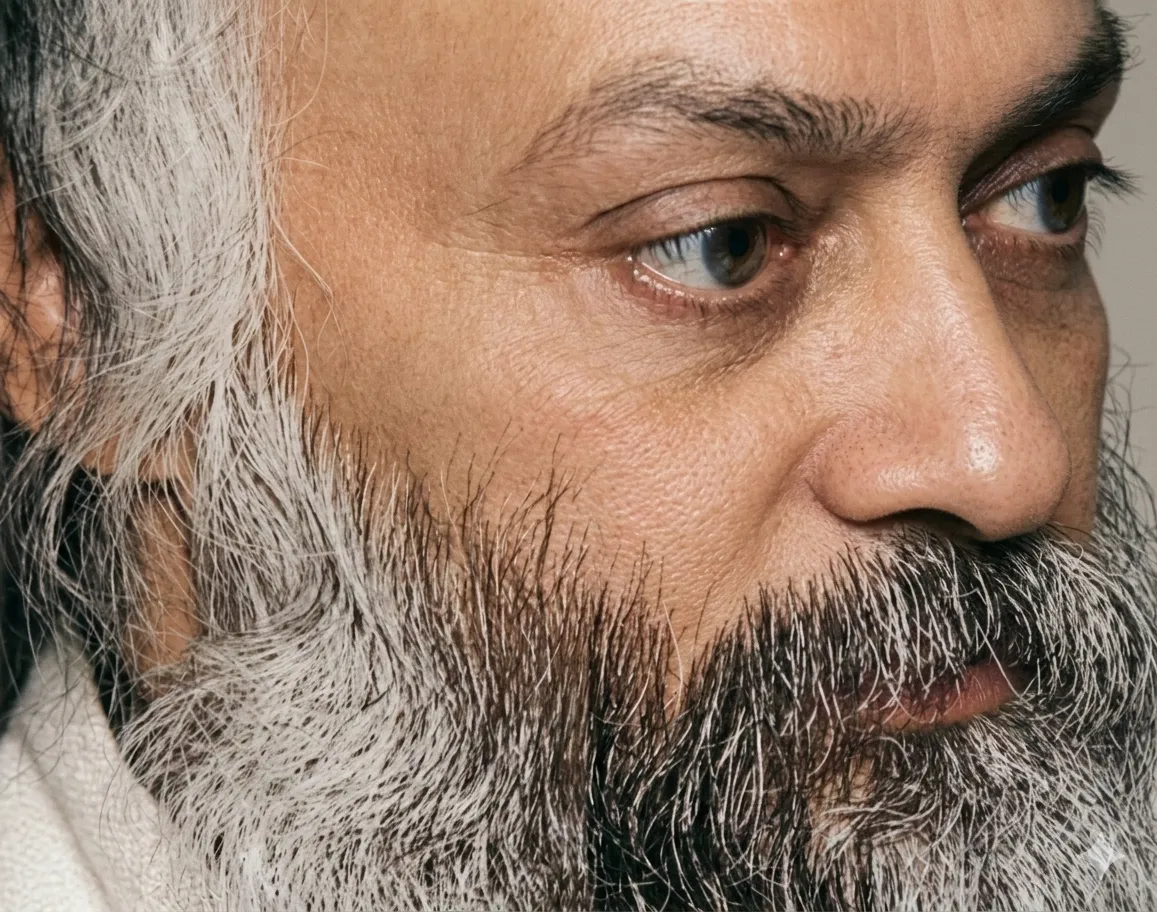
According to Osho, enlightenment is an inner alchemy: a fresh, otherworldly grace, a luminous presence, and an overflowing silence that floods others' hearts. You gain a new heart and become love itself—radiating, sharing, showering like starlight—rather than loving someone. Its beauty is perceived by those in trust; the body is incidental to the spiritual reality.
It feels like being so peaceful and full of love that it quietly spreads to everyone around you, no matter how you look on the outside.
From the Discourses
Passages where Osho speaks to this question — each links to the complete discourse.
Question: BELOVED OSHO, HOW DO YOU EXPERIENCE YOUR ENLIGHTENMENT? Milarepa, enlightenment is not an experience. Experience always divides the experiencer from itself. But enlightenment knows no duality; hence it is not an experience but simply experiencing. It may not be right language; in fact, it cannot be right language because the linguist will not understand what you mean by `experiencing'. One has to know it. But some effort can be made; some indications and hints can be given. When you are in love, is it an experience? Is it objective? Is it separate from you? Is it something that you can exhibit? Is it something for which you can give some evidence, proof, argument? No, love simply knows itself. It is self-evident. It needs no proof and no witnesses. It needs no evidence, no arguments, no philosophy. Enlightenment goes even deeper than the reaches of love.
Beloved Osho, what is enlightenment? Have the experience and the idea of enlightenment evolved with time?
So nirvana is just like darkness. The light is put off and your reality is all there, with all its beauty, benediction, blessing. But there is no word in English to translate nirvana. Jainas use the word moksha. Moksha means absolute freedom, ultimate freedom, freedom from all fetters. And the biggest fetter is the ego. Other fetters are just parts of the ego: greed, lust, ambition, anger. All that is thought to be sin in other religions, in Jainism is thought only to be a fetter. But the root, the main root of the whole tree of your slavery, is the ego. So cut the main root and all other roots will die of their own accord. Don't bother to cut small roots, branches, leaves, because they will come again. Cut the main root and the whole tree will die. And when all your fetters fall, what remains? The unfettered…
When one becomes empty of all thoughts, empty of all plannings, empty of all desires, what transformation will happen in one's outer life and one's inner life? How will he behave? How will he see things? How will he live in the world? Please say.
IT depends, it depends on the individual. There cannot be any dogmatic statement about it because each individual is so unique. When Basho becomes enlightened he starts singing poetry, poems; Buddha has never done that. When Krishna becomes enlightened he starts dancing, singing; Mahavir has never done that. When Mahavir becomes enlightened he keeps silence for many years, remains absolutely silent, not a ripple is allowed; Meera has not done that. When she becomes enlightened, she dances from village to village, she sings the glory of God. It is very difficult to make a dogmatic statement. There have been people who renounced life when they became enlightened and went to the Himalayas, moved as far away from the society as possible. There have been people who became enlightened and came back to the world, even if they had been in the Himalayas, and started living with people again. There have…
Question: BELOVED MASTER, WHAT DOES ENLIGHTENMENT FEEL LIKE? Prem Geetam, enlightenment is not a thought nor a feeling. In fact, enlightenment is not an experience at all. When all experiences have disappeared and the mirror of consciousness is left without any content, utterly empty; no object to see, to think about, to feel; when there is no content around you; the pure witness remains -- that is the state of enlightenment. It is difficult, almost impossible, to describe it. If you say it feels blissful, it gives a wrong meaning to it -- because bliss is something contrary to misery and enlightenment is not contrary to anything. It is not even silence, because silence has meaning only when there is sound; without the contrast of sound there is no experience of silence. And there is no sound, there is no noise.
Osho, what is the most significant thing about enlightenment?
People want definite answers to believe in: this way or that. Either be a Catholic or be a communist, but be clear. People want clarity because they are so confused, and this man brings all these seven categories; now their confusion is worse, they are even more confounded. First you were at least aware that you were confused. Now you will not be aware to which category you belong: yes, no, yes -- no both, neither yes nor no, or indescribable. Mahavira could not create a world religion for the simple reason that perhaps he had the deepest penetration into reality. If you ask about his enlightenment, he will answer in seven sentences. You will not be able to come to any conclusion -- and I feel this is something tremendously valuable. Why this urge to come to a conclusion? If existence is a continuum, an ongoing process -- never…