
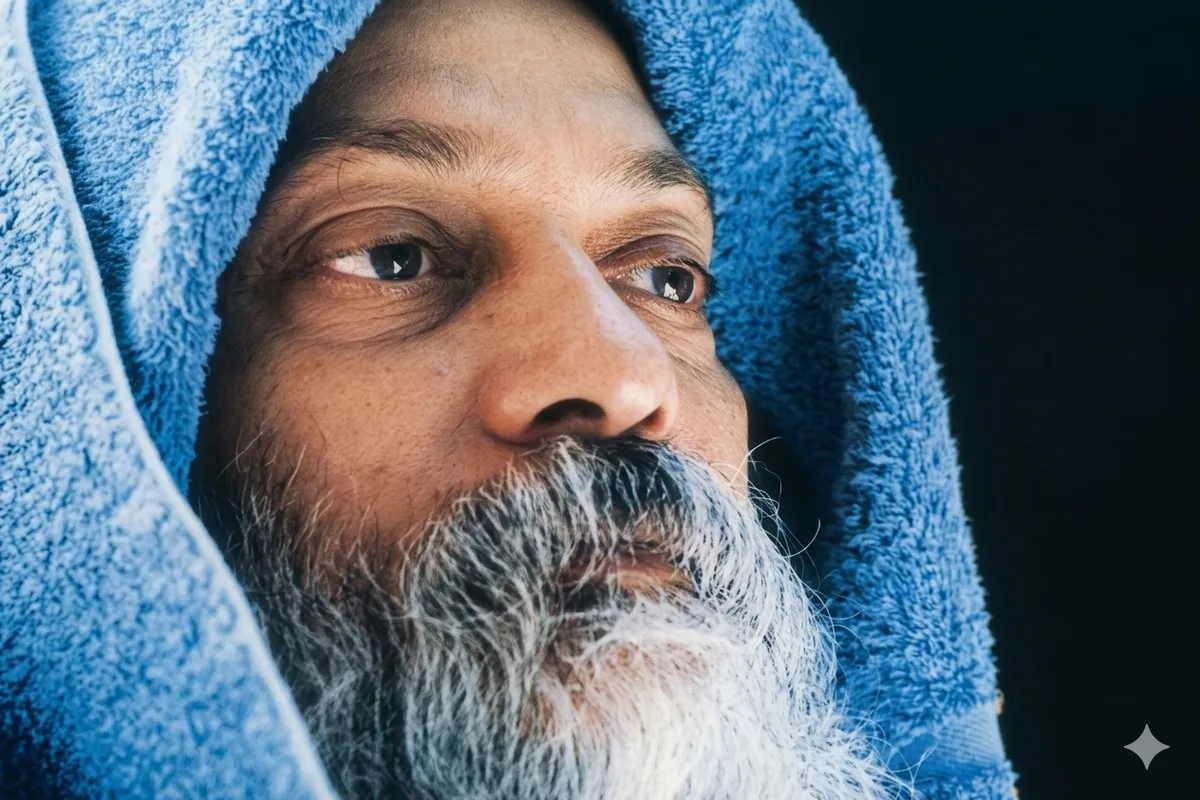
See clearly that what you’re clutching is just a stone, not a diamond, and it will fall from your hand on its own.
From the Discourses
Passages where Osho speaks to this question — each links to the complete discourse.
Another friend has asked: How do you differentiate among compassion, nonviolence, pity, and love? Don’t they all mean the same?
Pity does not bring revolution; that is why revolution has not come to India. Pity rather blocks revolution. Because pity gives a beggar two coins, but it does not go in search of why beggars are produced in the first place. And when the beggar gets two coins, he too feels relief. He too does not reach that limit where he grabs the donor by the neck and says, “We will not take this charity. First you pick our pockets and then you give us alms. First you make us beggars and then you arrive to give us charity. First you suck our blood and then you build hospitals for us where ‘blood donation’ is conducted. What kind of net is this?” No, pity does not allow even this to happen. Pity becomes a consolation. And the poor feel that the rich are so “pitiful.” Nothing has shielded the rich…
एक और मित्र ने पूछा है कि आप करुणा, अहिंसा, दया, प्रेम इन सबमें क्या फर्क करते हैं? ये तो सब एक ही अर्थ रखते हैं?
दया क्रांति नहीं लाती, इसलिए भारत में क्रांति नहीं आ सकी। दया बल्कि क्रांति को रोकती है। क्योंकि दया भिखमंगे को दो पैसे दे देती है, लेकिन भिखमंगा क्यों पैदा होता है, इसकी तलाश में नहीं जाती। और भिखमंगे को दो पैसे मिल जाते हैं, तो भिखमंगा भी राहत अनुभव करता है। वह भी उस सीमा पर नहीं पहुंच पाता कि दान देने वाले की गर्दन पकड़ ले और कहे कि यह दान नहीं लेंगे; क्योंकि पहले हमारी जेब काटते हो और फिर हमको दान देते हो। वह कहेगा कि पहले हमें भिखमंगा बना देते हो और फिर दान देने आ जाते हो। वह कहेगा किपहले तो हमें चूस लेते हो हमारे खून को और फिर हमारे लिए अस्पतालें बना देते हो, जिनमें खून का दान चल रहा है। यह जाल कैसा है?
Beloved Osho, I am seeing a certain helplessness arising in me. It is a feeling that I had feared and always tried to avoid in the past. Yet, as it begins to overwhelm me, it brings a sense of freedom I have seldom, if ever, experienced before. Beloved master, does this helplessness have something to do with what you call "let-go"?
The rabbi finished quickly -- rabbis are very efficient people -- and he came in his Cadillac, but the bishop was still in the confession booth. It has a small window, and the bishop or the pope or anybody who is representing God is on one side, and on the other side, the person who confesses. A device that the person does not feel awkward, embarrassed; he is not seen by the priest. But there was a long queue. So from the other side, the rabbi entered the cabin and said to the bishop, "It is getting late, and I don't see that you will be able to finish till Judgment Day! Because the queue is so long... and you don't seem to be very efficient. You don't know business." The bishop said, "I am doing it as quickly as possible, but these idiots are such that they don't confess…
Beloved Osho, I have heard you say, "let go -- no effort is needed." but I am afraid of letting go because then I slip into my old patterns. Please comment.
It is one of the difficulties. Letting go, one can slip into old patterns, old conditionings. Still, take the risk. The fear has some validity; you can fall back into your old patterns. But don't be afraid, just remain watchful; and meanwhile, if it happens that way.... It is not necessarily so that it will happen to everybody, to fall into old patterns. Only those friends who have forced themselves into the new discipline will find it happening, that if they let go they will become their old selves. But it will be good, because that will show you that whatever you were thinking you had become, you have not become. It was just an enforced, controlled, suppressed, inhibited phenomenon. Letting go will make it clear to you. So it is going to help both kinds of people. Those who have grown up into the new lifestyle by letting go,…
Beloved Osho, recently I heard you say that transcendence of life's misery and confusion can occur by either a let-go of life or by fight -- as long as either is done with totality. Mahavira's way was fight, and yours is let-go. Could you say more about let-go and its relationship to intelligence and responsibility? I don't have this understanding, and my life seems to be an odd mixture of let-go and fight. Let-go seems more natural, and fight seems more responsible.
He was standing there just to see her for the last time. It was enough for him that she was happy and healthy -- and he would wait. If his love has any power, she will come back. There was tremendous trust in him. He had seen the love, the same flame that was burning in his heart, in the eyes of Laila too. Laila was also searching and looking all around from the camel she was riding. She knew Majnu must be waiting somewhere on the way, and then she saw him hiding under a tree in its thick foliage. For a moment, without a single word or gesture, they were one; and then the caravan passed. But for Majnu time stopped then and there. He remained standing by the side of the tree waiting and waiting. It is said years passed. Laila came, but came a little late.…
Osho, for rest the bird that flies in the infinite sky makes a small grass nest. And for rest man first found caves, then built huts and houses. And today you are beginning to speak of resting in the anhad. Osho, please be gracious and explain to us what this “resting in the anhad” is.
Recently a Protestant family from America came to Mother Teresa and asked to adopt a child—they had none. They were given a form, the first point of which was that a child can be adopted only if you are Catholic. The Protestant family was astonished: “We are Christians; you are Christians. The only difference is that we are Protestant and you are Catholic. No big difference. We accept the same Bible and the same Jesus—you and we. A few paltry differences. And you are devoted to the service of humankind—what difference does it make to you?” But no: even a Protestant Christian family was not given the right to adopt. These are frauds. On the surface the talk is lofty. These orphanages and widow homes and service to the destitute are nothing but propaganda for Catholic Christianity—so that the number of Catholics in the world may increase. In olden times…
पहला प्रश्न: ओशो, विश्राम के लिए अनंत आकाश में उड़ने वाला पक्षी घास का छोटा सा घोसला बनाता है। और विश्राम के लिए आदमी ने पहले गुफा खोजी, और फिर झोपड़ा और मकान बनाया। और आप आज अनहद में बिसराम की चर्चा शुरू कर रहे हैं। ओशो, यह अनहद में बिसराम क्या है, यह हमें समझाने की कृपा करें।
अभी एक प्रोटेस्टेंट परिवार ने अमरीका से आकर मदर टेरेसा से प्रार्थना की कि हम एक बच्चे को गोद लेना चाहते हैं, हमारा कोई बच्चा नहीं है। तो उन्हें फार्म दिया गया भरने को, जिस फार्म में पहली बात यह थी कि बच्चा तभी गोद मिल सकता है, जब आप कैथलिक ईसाई हों। वह प्रोटेस्टेंट परिवार तो हैरान हुआ। उसने कहा, ईसाई हम भी हैं; ईसाई तुम भी हो। थोड़ा सा फर्क है कि हम प्रोटेस्टेंट हैं, तुम कैथलिक हो। कोई भारी फर्क नहीं। वही बाइबिल मानते हैं हम, वही जीसस; वही तुम वही हम। थोड़े कुछ दो कौड़ी के भेद हैं। और तुम तो मनुष्य-जाति की सेवा में तत्पर हो। तुम्हें क्या फर्क पड़ता है?