
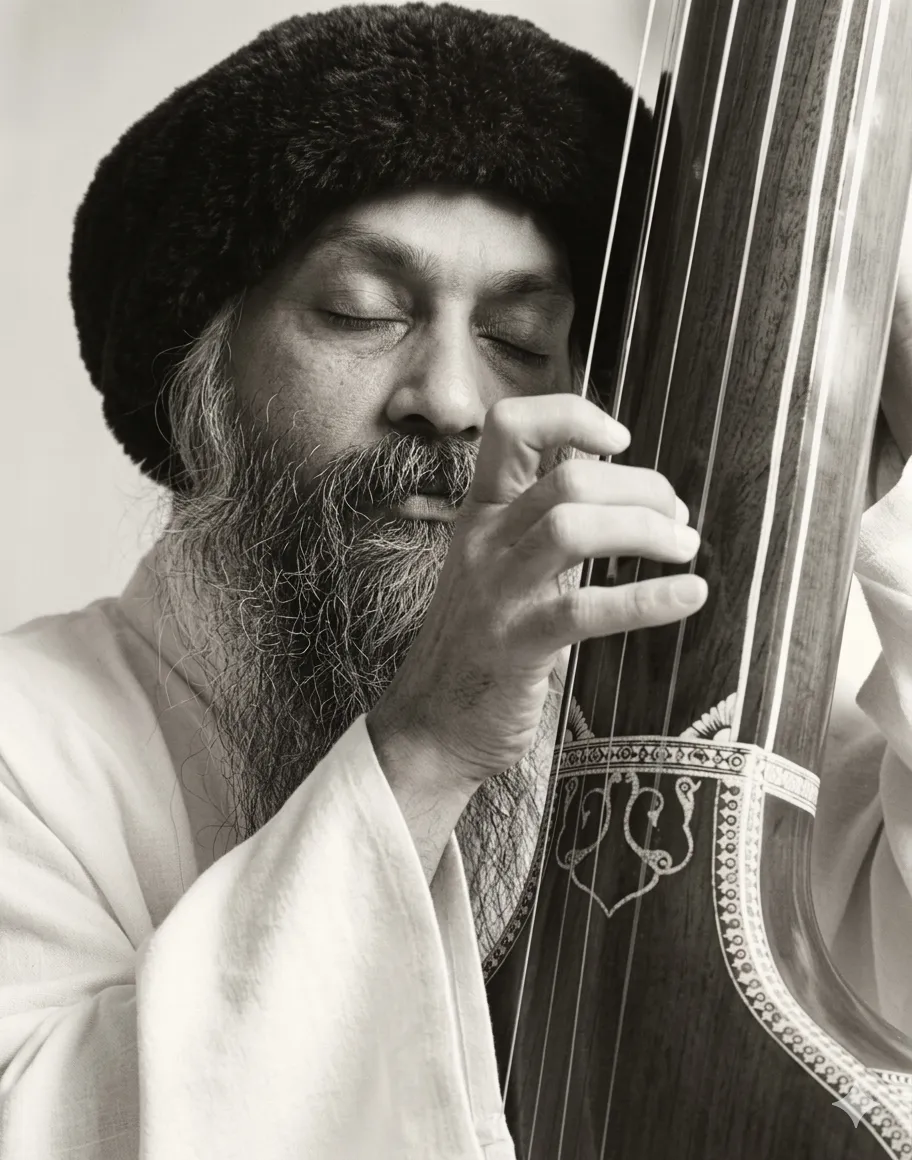
According to Osho, the urge to occupy the mind is the nonmeditative mind’s escape from oneself. Don’t fill it; learn aloneness, not loneliness. If a crutch is needed, use one meaningless sound, e.g., "hoo," only on the outgoing breath, keeping the incoming breath empty so the mind isn’t fed. Let boredom arise, then drop even the sound. This discharges tensions (sex, anger) and opens silence.
Don’t keep your mind busy; if needed, quietly say a meaningless "hoo" as you breathe out, keep the in-breath empty, and soon drop even that to rest in quiet.
From the Discourses
Passages where Osho speaks to this question — each links to the complete discourse.
Question: when I meditate I usually repeat a mantra or a namokar, but the mind remains restless. How can one best occupy one's mind while meditating?
Mind itself means projection, so unless you transcend the mind, whatever you come to experience is projection. Mind is the projecting mechanism. If you experience any visions of light, of bliss, even of the divine, these are all projections. Unless you come to a total stopping of the mind you are not beyond projections; you are projecting. When mind ceases, only then are you beyond the danger. When there is no experience, no visions, nothing objective -- the consciousness remaining as a pure mirror with nothing reflected in it -- only then are you beyond the danger of projections. Projections are of two types. One type of projection will lead you to more and more projection. It is a positive projection; you can never go beyond it. The other type of projection is negative. It is a projection, but it helps you to go beyond projections. In meditation you use…
In 1969 followers of the Maharishi Mahesh Yogi invited Osho to talk to them. This was the first occasion on which Osho addressed a western audience, and the first time he talked publicly at length in English. The discourse has been published in OTI January 1 & 16, 1991; and February 1, 1991. Osho: Really, there can be no method as far as meditation is concerned. Meditation is not a method. Through technique, through method, you cannot go beyond mind. When you leave all methods, all techniques, you transcend mind. So meditation itself is not a method. Truth cannot be achieved through method. Method is our own invention. We, who are ignorant, have achieved knowledge through methods constructed, created, projected, in our ignorance. Through method you can achieve a sort of self-hypnosis, a sort of auto-hypnosis. Any method, whatsoever it's name, can only give you an illusory kind of peace.
Question: MASTER LU-TSU SAID: THE TWO MISTAKES OF INDOLENCE AND DISTRACTION MUST BE COMBATED BY QUIET WORK THAT IS CARRIED ON DAILY WITHOUT INTERRUPTION; THEN SUCCESS WILL CERTAINLY BE ACHIEVED. IF ONE IS NOT SEATED IN MEDITATION, ONE WILL OFTEN BE DISTRACTED WITHOUT NOTICING IT. TO BECOME CONSCIOUS OF THE DISTRACTION IS THE MECHANISM BY WHICH TO DO AWAY WITH DISTRACTION. INDOLENCE OF WHICH MAN IS CONSCIOUS, AND INDOLENCE OF WHICH MAN IS UNCONSCIOUS, ARE A THOUSAND MILES APART. UNCONSCIOUS INDOLENCE IS REAL INDOLENCE; CONSCIOUS INDOLENCE IS NOT COMPLETE INDOLENCE, BECAUSE THERE IS STILL SOME CLARITY IN IT. DISTRACTION COMES FROM LETTING THE MIND WANDER ABOUT; INDOLENCE COMES FROM THE MIND 'S NOT YET BEING PURE. DISTRACTION IS MUCH EASIER TO CORRECT THAN INDOLENCE.
Osho, please explain how I can meditate over something without using my mind.
Meditation has nothing to do with mind; meditation simply means a state of no-mind. The functioning of the mind is the only disturbance in meditation. If you are trying to achieve meditation THROUGH mind you are bound to fail, doomed to fail. You are trying to achieve the impossible. A Zen initiate was meditating for years and whenever he would come to his Master, whatsoever experience he would bring to the Master, the Master would simply reject: "It is all nonsense. You go back and meditate again." One day the Master came to the but of the disciple -- he was sitting in a Buddha posture. The Master shook him and told him, "What are you doing here? If we needed stone Buddhas we have many in the temple! Just by sitting like a stone Buddha you will not attain to meditation. Do what I have been telling you to…
Live the emptiness... because whatsoever you do can never be greater than you. Whatsoever the mind is going to do is going to be part of the mind. Mm? It is going to be a game. Once you start feeling empty there is no need to do anything on your own. Let emptiness be lived, and things start happening. Not that you do them -- they happen. Emptiness is hard in the beginning, because one starts feeling a little depressed, sad, with nothing to do. For the whole life we have been occupied with this and that, improving ourselves, reaching for, achieving, some goal... excitement, misery, failure, success -- but one is occupied. Then suddenly one feels emptiness settling -- nothing to do, nowhere to go, nowhere to hide; no ambition that can give one excitement and can create fever.