
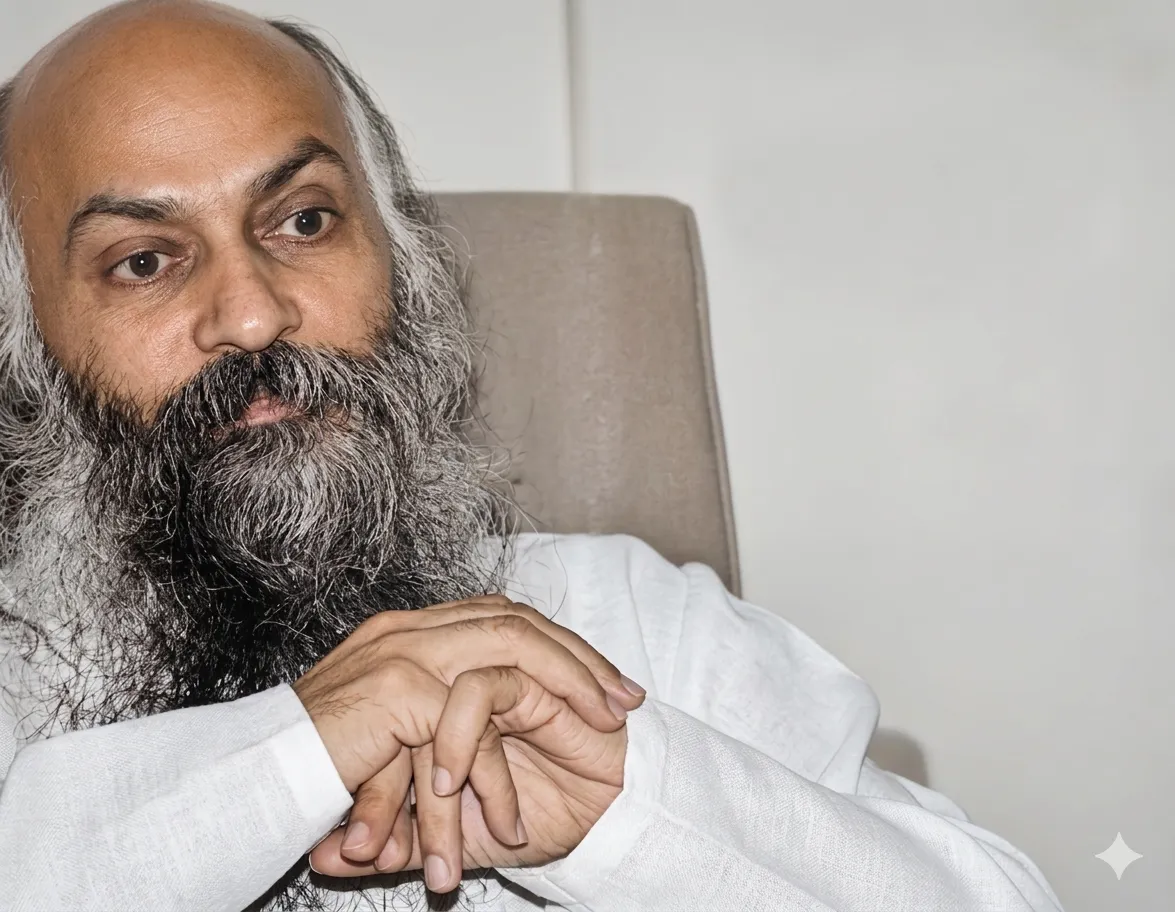
According to Osho, meditation is a non-action because it cannot be produced, seized, or forced; it happens when you stop obstructing it. Like sleep or sunlight entering a room, your role is only to make outer arrangements—quiet, ease, watchfulness—and open the 'door' by removing mental hindrances. There is no technique to ‘do’ meditation; you simply allow it to come.
You don’t do meditation; you clear the clutter and wait, and it comes on its own—like sleep when the lights are off and the bed is ready.
From the Discourses
Passages where Osho speaks to this question — each links to the complete discourse.
A friend has asked: he cannot understand how meditation is a non-action, because whatever we do will be an action—how can it be a non-action?
Much confusion arises because of human language. In language we take many non-actions to be actions. We say, “So-and-so took birth.” Hearing it, it sounds as if he had to do something to be born—as if birth were an action. We say, “So-and-so died,” and it sounds as if he had to do something to die. We say, “Someone fell asleep,” and it sounds as if he had to do something to sleep. Sleep is not an action, death is not an action, birth is not an action—but in language they become verbs. You too say, “I slept last night.” But if someone asks you, “How did you sleep? What is the act of sleeping?” you will be in difficulty. You have slept many times, but you cannot tell what the act of sleeping is, how you slept. You might say you arranged the pillows, made the bed, darkened the…
Meditation is always passive; the very essence of it is passive. It cannot be active because the very nature of it is non-doing. If you are doing something, your very doing disturbs the whole thing; your very doing, your very "activeness," creates the disturbance. Non-doing is meditation, but when I say non-doing is meditation I do not mean that you need not do anything. Even to achieve this non-doing, one has to do much. But this doing is not meditation. It is only a stepping stone, only a jumping board. All "doing" is just a jumping board, not meditation. You are just on the door, on the steps.... The door is non-doing, but to reach the non-doing state of mind one has to do much. But one should not confuse this doing with meditation. Life energy works in contradictions. Life exists as a dialectic: it is not a simple movement.
So first: now, when we sit for meditation—our entire language is the language of doing. We even say, We will do meditation. It is wrong to say, for there is no possibility of doing in meditation. But our entire language—human language—is the language of doing; we have no language for non-doing. In Japan, about a hundred and fifty years ago, there was a great monastery, a vast ashram. Some five hundred bhikshus practiced there. The emperor became eager to see it and went. The ashram spread far and wide in the forest; cottages were scattered. The head monk began to show them: In this cottage our monks cook; in this cottage they study; in this cottage they sing—here they do this, there they do that; here they bathe. In the middle stood a large building—the monk said nothing about it.
Thought and meditation are in diametrically opposite directions. The former moves outward; the latter, inward. Thought is the way to know the other; meditation, the way to know the self. But thought is generally taken for meditation. This is a very serious and widespread mistake and I want to caution you against this fundamental error. Meditation means becoming actionless. Meditation is not action but a state of being. It is being steady in one's own self. In action we come into contact with the outside world; in inaction, with ourselves. When we are not doing anything we become aware of what we are, but we are constantly involved in different activities and do not know ourselves. We do not even remember that we exist. We are deeply preoccupied. At least the body rests but the mind does not rest at all. Awake, we think;p asleep, we dream.
In 1969 followers of the Maharishi Mahesh Yogi invited Osho to talk to them. This was the first occasion on which Osho addressed a western audience, and the first time he talked publicly at length in English. The discourse has been published in OTI January 1 & 16, 1991; and February 1, 1991. Osho: Really, there can be no method as far as meditation is concerned. Meditation is not a method. Through technique, through method, you cannot go beyond mind. When you leave all methods, all techniques, you transcend mind. So meditation itself is not a method. Truth cannot be achieved through method. Method is our own invention. We, who are ignorant, have achieved knowledge through methods constructed, created, projected, in our ignorance. Through method you can achieve a sort of self-hypnosis, a sort of auto-hypnosis. Any method, whatsoever it's name, can only give you an illusory kind of peace.