
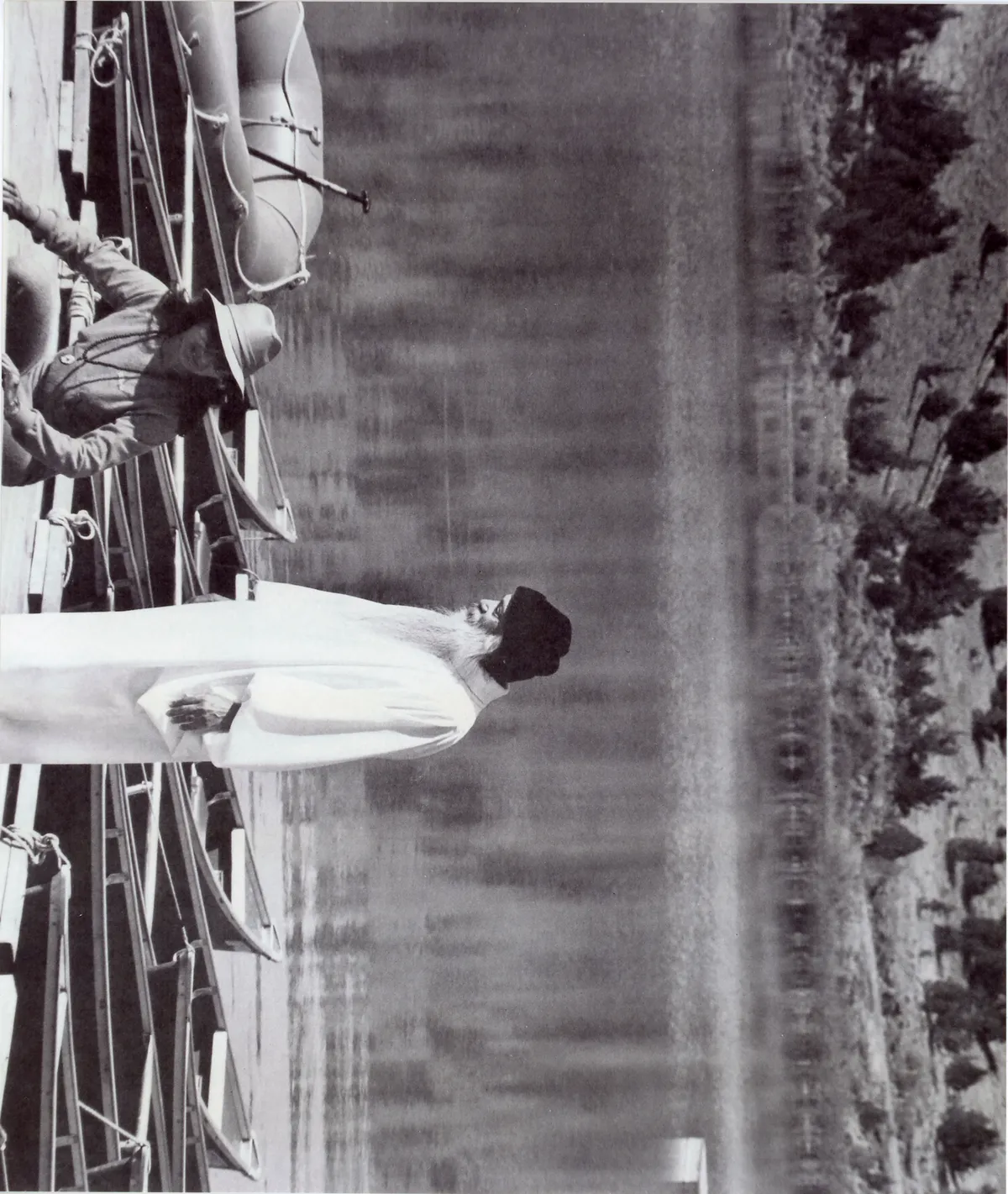
The real you stays after you die; only the masks and labels fall off, and you can drop those masks now to feel free.
From the Discourses
Passages where Osho speaks to this question — each links to the complete discourse.
Question: BELOVED OSHO, WHEN I DIE, DOES MY INDIVIDUALITY REMAIN? Yes, your individuality remains, but your personality disappears -- and you have to understand the difference between the two. The personality is something that is given by the society, by the religion, by education, by your profession. You have got a certain personality. That will be gone because it is a social product. But you were born with an individuality of your own. With death, you will be taking your individuality with you. Everything else that you have earned on the way will be taken back; it does not belong to you. Your degrees, your prizes, your awards, your Nobel prizes, your prestige, your reputation -- everything will be dropped. That I call your personality. But you have an individuality -- innocent, just the way you were born... utterly clean, a tabula rasa, nothing written on you, no name, nameless.
Beloved Osho, does the being, or self, in the person die with the death of the person; or does it live beyond death in another body?
Parents teach children that there is a God -- and they know nothing of God. They tell their children that there is heaven and there is hell -- and they know nothing of heaven and hell. I have heard: it happened one day in New York, in New York's biggest church, that as the cardinal came in he found a young man, and he was puzzled whether he was a hippie or Jesus Christ. He looked like Jesus Christ, but you don't find Jesus Christ like this! He must be a hippie. The cardinal was afraid because Jesus was not his own experience -- he could not recognize him. He went close to him and asked, "Who are you?" And the young man said, "You can't recognize me? And daily you pray to me, `My Lord, Jesus Christ,' and now I have come and you have some nerve to ask…
I am confused about the difference between surrender and following my inner light. It seems that when I want to surrender, I am afraid to be responsible for myself, and when I want to follow my inner light, I'm afraid of what you will ask of me in surrender.
You have to be absolutely clear about it: if you already have the inner light there is no need for any surrender, because surrender is only going to help you to bring the inner light. If you have it already, then forget all about surrender. But... you don't have it. Just to avoid surrender you imagine that you have it. If you have it, you have it. Then the question of surrender does not arise. You don't have it. You only have inner darkness, no inner light. So when you go in you find darkness; then you start thinking of surrender. When you start thinking of surrender then you become afraid -- because the ego comes in. It is not the inner light that is hindering you. Inner light never hinders anybody. Let me say it in this way: if you surrender, it is a help to the inner light;…
Beloved Osho, I am always touched when you speak of each of us having a unique individuality, but I think I am often confusing personality with individuality. Is this individuality something genetic, unique to each incarnation, or is it the essence which moves with us through incarnations? Beloved Osho, can you say something which will help us come to know our individuality?
I was being shown around a Christian theological college where they train missionaries. It is the biggest institution in Asia for training Christian missionaries and ministers and priests and bishops. I was surprised... I had to stand outside the door with the vice-chancellor who was showing me around. A professor was teaching the students, when you are delivering a sermon in the church, how you should stand, how you should look at the audience, where you should speak loudly and where you should speak almost in a whisper, where you should raise your hand, what gesture should be used at a particular point, where you should beat on the table... I was horrified. I could not believe that this is religion. I said to the vice-chancellor, "If this is making Christian missionaries who are going to convert people into Christians..." I asked him, "Do you think Jesus had gone through…
Osho, you said last night that those who have become void, valley-like, do not react but they respond, and that the responses of these different enlightened ones will be different -- that the valley will reecho in its own unique and individual way. Now a question arises whether those who become absolutely void, nothingness, still have a personality and individuality. If so, then please explain how this becomes possible.
THIS is one of the paradoxes of spiritual life: the more one dissolves into the Divine, the more unique one becomes. The dissolution is not of the individuality but of the self. The dissolution is not of the uniqueness but of the ego. The more you are an ego, the more you are like others, because everyone is an egoist. The ego is the most ordinary thing in the world. Everyone is an egoist; even a newborn child is an egoist -- a perfect egoist. So it is not anyone's achievement; it is not extraordinary. Really, it can be said that to be just ordinary is the most extraordinary thing possible because no one feels just ordinary. So to feel oneself extraordinary is just the most ordinary thing. Everyone feels like that! So ego is not something unique. If you have an ego, it is not something unique. Really, egolessness…