
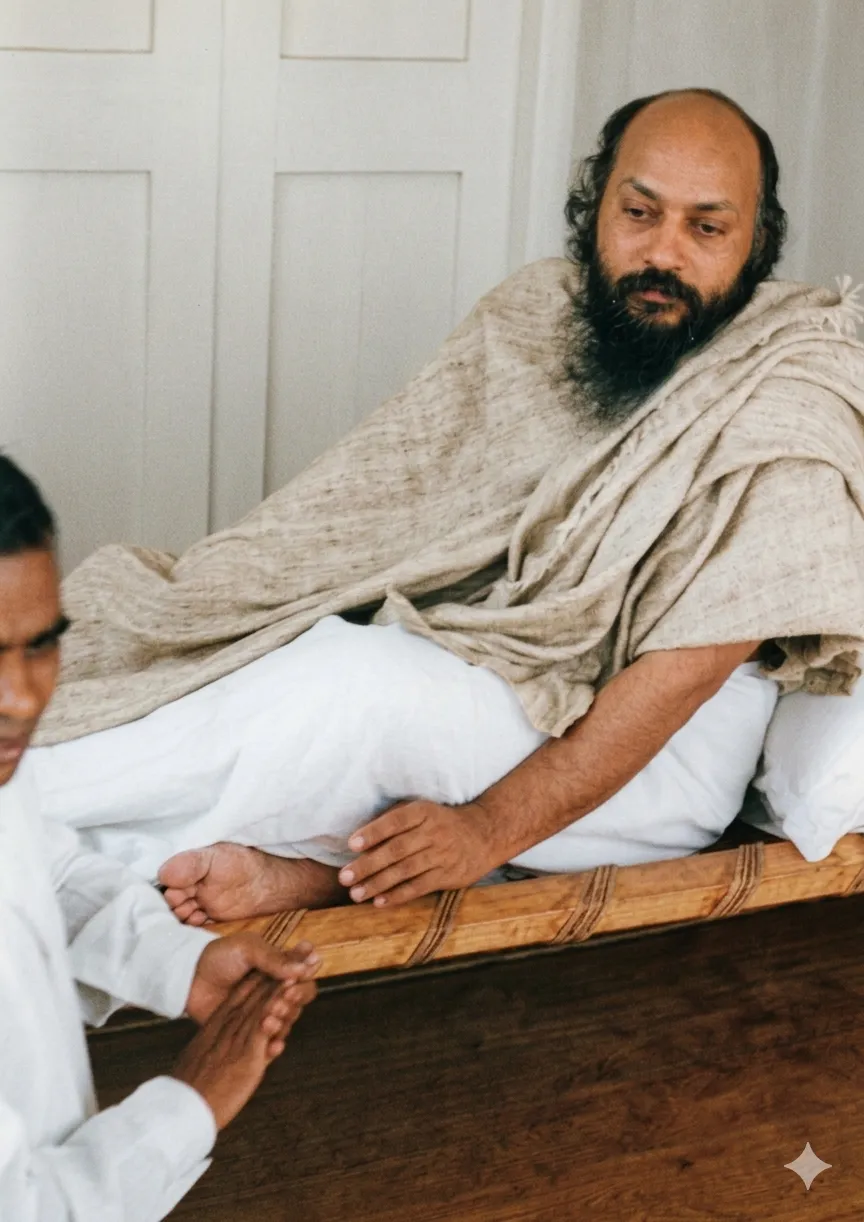
No—quiet is the treasure; strong activity is just a way to spend your fidgets so real stillness can happen.
From the Discourses
Passages where Osho speaks to this question — each links to the complete discourse.
Osho, in the final stage of active meditation a quietness comes, yet a kind of sadness surrounds me. You say to celebrate—how can one celebrate in this sadness, and how to dance?
The day a society forgets how to dance, that day the society becomes sick. The indigenous people in the forests dance—and their health is of another order! They dance late into the night, under the stars, beneath the open sky. They dance like the stars themselves. They fall asleep tired—but in that tiredness there is no heaviness; there is a lightness in it. Then in the morning, when such a person wakes, his awakening is different from yours. You hardly sleep at all. Even in sleep you go on dreaming; even in sleep you keep the whole business of waking life going. You continue the same nightmares you saw while awake—same market, same friends, same enemies, the same hocus-pocus. You keep tossing and turning; even your sleep is not a peaceful event. Ask the forest-dwellers, “Did you dream?” You will rarely find one who says, “Yes, once in my life…
THE HUMAN MIND IS EFFORT-ORIENTED, action-oriented, obsessed with activity -- because the more active you are, the more your ego can be fulfilled, the more you can say 'I'. All activity is basically food for your egoistic personality. Meditation is not an effort, it is not an activity. Rather, it is a deep surrender. It is to be in nonactivity. Basically, just to be is meditation -- not doing anything, not desiring anything, not hankering to go somewhere; just being here and now, simply being here and now. That's what I call meditation. But it is very difficult to conceive. Even to contemplate it is difficult. The mind cannot conceive of anything that is not an effort. The very language of the mind, the very framework, the very structure, is based on effort: to do something, to achieve something, to go somewhere.
Your activity must be exhausted. Whatever you can do, you must be allowed to do. Whatsoever you can do you must be pushed to do it to the very point where you, yourself, cry, "Now I cannot do anything; everything has been done. Now nothing is possible; no effort is possible. I am exhausted." Then I say, "Now, just drop!" This dropping can be communicated. You are on the verge, you are ready to drop; now you can understand the language of passivity. Before this, you could not understand. You were too full of activity. You have never been to the extreme point of activity. Things can be dropped only from the extreme, never from the middle. You cannot drop it. You can drop sex - if you have been totally in it, you can just drop it; otherwise not.
Osho, so far I have listened to many of your discourses and gone through many books, especially those on sadhana—I liked them very much. And in the meditation camp, the directions you gave at the beginning were also to the effect that the mind’s sankalpa–vikalpa should not arise—that there be a resolve in the mind to be the master of inaction, the master of the void, something like that. Now, the practice taught here involves a great deal of action, so it seems to me there may be some contradiction...
It may seem so; there is no contradiction. In fact, we cannot help breaking things into two parts. We look at things by splitting them into two opposing halves. We say: this is darkness, and that is light. But in life, darkness and light are not two things. In life they are the gradations of one and the same thing—degrees of one thing, not two. Yes, degrees of the same thing. What we call light is the dense degree of that very thing; what we call darkness is its rarefied degree. Darkness and light are not two hostile opposites. In the same way, action and nonaction are not enemies. Travel from either side and you arrive at the same place, because deep down the two are one. So when I say nonaction—the path of nonaction—if one can drop all action and become inactive, and drop all thought and become thought-free,…
When the deep meaning of things is not understood the mind's essential peace is disturbed to no avail.
THE WAY IS PERFECT LIKE VAST SPACE WHERE NOTHING IS LACKING AND NOTHING IS IN EXCESS. INDEED, IT IS DUE TO OUR CHOOSING TO ACCEPT OR REJECT THAT WE DO NOT SEE THE TRUE NATURE OF THINGS. LIVE NEITHER IN THE ENTANGLEMENTS OF OUTER THINGS, NOR IN INNER FEELINGS OF EMPTINESS. BE SERENE WITHOUT STRIVING ACTIVITY IN THE ONENESS OF THINGS AND SUCH ERRONEOUS VIEWS WILL DISAPPEAR BY THEMSELVES. WHEN YOU TRY TO STOP ACTIVITY TO ACHIEVE PASSIVITY YOUR VERY EFFORT FILLS YOU WITH ACTIVITY. AS LONG AS YOU REMAIN IN ONE EXTREME OR THE OTHER YOU WILL NEVER KNOW ONENESS. THOSE WHO DO NOT LIVE IN THE SINGLE WAY FAIL IN BOTH ACTIVITY AND PASSIVITY, ASSERTION AND DENIAL. Logic will say something absolutely different. Logic will say, "Practice rest the whole day, so in the night you can rest beautifully." Mulla Nasruddin went to his doctor. Coughing, he entered.…