
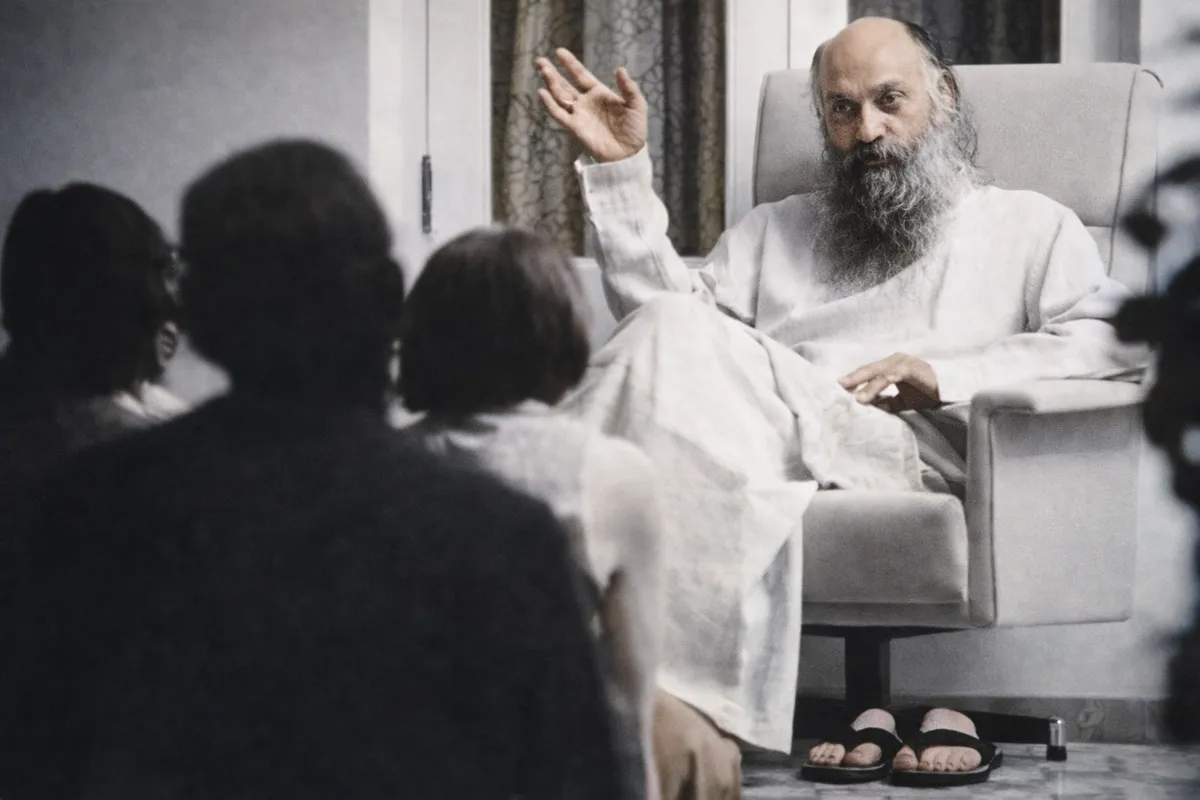
They don’t have babies after awakening; instead, they help people wake up and be free from coming back again.
From the Discourses
Passages where Osho speaks to this question — each links to the complete discourse.
Osho, another question in the same vein. Can people like Buddha, Mahavira, and Christ bring about conception even after enlightenment? And why don’t they have intercourse again to give birth to a superior soul? And is conception only a possibility between two unenlightened persons?
But who inside that prison will understand? The inmates will say, “You’ve gone mad—come back home.” Home meaning your cell. And however much he speaks of moon, sun, flowers—they will understand nothing, for they have seen nothing but darkness and chains. It may be that, just as we are asking here today, those people also ask, “Can someone, after sitting on the prison wall, come back once to have a child? Or is it only those who have never climbed the wall who have children?” Our question is exactly like that. The world, the life, the Great Life that Buddha and Mahavira are seeing—we know nothing of it. We are shut inside this small prison of the body, carrying it around all our lives. We think this is the great life. So we think, “Bring more souls here—bring better souls.” Buddha and Mahavira are busy sending even the “bad” souls…
They are the individuals who are eager to free us from birth and death. We wish to bring someone on the earth while they wish to free someone from this earth. Mahavira and Buddha also wish to give birth some to place which is termed moksha. They wish to send us there where there is neither body, miseries nor anguish. They also are on the run to give you a new life, but they are not eager to give you a body. I shall narrate an event In the life ot Buddha which will explain this polnt to you. Buddha returns home after a period of twelve years. He had run away when Rahul was only one day old. He was now 12 years old. His mother was naturally dlspleased with Buddha and had told many things against Buddha to Rahul.
Osho, what are the factors that make a womb worthy of the descent of a higher soul, or only of an inferior one? What preparations are needed so that a noble soul can enter the womb? How should they be done? And what particular characteristics did the wombs in which Buddha, Mahavira, Krishna, and Christ were born have, compared to ordinary wombs?
There are many yogic postures that create specific pressures, many breathing processes that do the same, and many sound intonations that apply particular pressures. All of these support the child’s talent, health, capacities, and possibilities to manifest fully. So far, man keeps discovering countless troublesome things, but what is truly needed—that man discover his own future—very little search is happening there. Yet all this is entirely possible. As soon as a child enters the mother, glimpses of that child’s possibilities begin to arise in the mother. It is a two-way process. If the mother becomes angry during these days, the child will be prone to anger; and if an angry soul has entered, a mother who never used to be angry will find anger arising. This too is very indicative, and seeing such indications experiments can be made to transform that child’s anger from the seed itself. Even today there…
Why don’t the enlightened ones take birth again after enlightenment?
There is no need anymore. Birth is not without cause; birth is schooling. Life is an examination, a school. You come here because something is needed. We send a child to school to read and write, to understand; once he has passed all the exams, we don’t send him again. He has come home. There is no more need to send him. The Divine is home—call it Truth, Nirvana, Moksha—this world is the school. We are sent here so that we may test and assay ourselves on the touchstone, in the heat of pleasure and pain; so that we may pass through all kinds of bitter and sweet experiences and attain dispassion. To lose everything, to wander everywhere, to slip into far-off darknesses, into dark ravines—go as far from Truth as possible—and then return through awakening. A child is quiet, innocent; a saint too is quiet, innocent. But the saint’s…
And yet another way is possible. Out of Krishna’s sutra another way emerges. We can make persons so conscious—not by changing the body, but by changing awareness—that when a soul petitions them to become givers of birth, they can refuse; or, if needed, they can give birth. For thousands of years India experimented with this. There are hundreds of proofs. A whole science of this experiment was developed. If you have read the lives of Mahavira or Buddha, this land created an entire dream analysis—a science of dreams. Freud has only just begun to understand the signs of dreams—his understanding is still very infantile, not very deep. But the Jaina tradition says: when a Tirthankara enters a mother’s womb, these dreams—at these times—begin to come to that mother. They are the news that a soul of the rank of a Tirthankara wishes to enter that womb.