
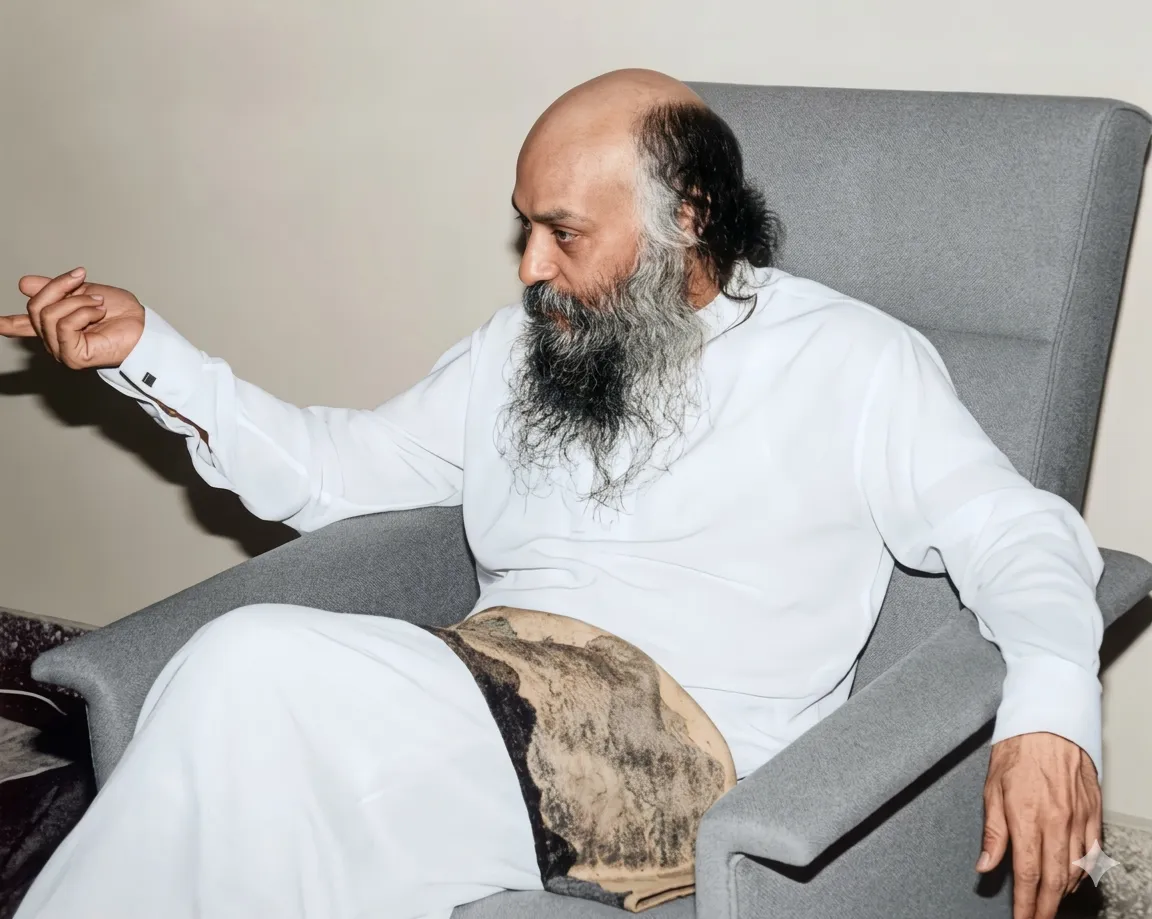
We’re all the same light inside, but outside we’re different colors, and that difference should be loved, not forced to match.
From the Discourses
Passages where Osho speaks to this question — each links to the complete discourse.
Question: OSHO, AREN'T ALL PEOPLE REALLY THE SAME? Sudarsho, ESSENTIALLY YES, BUT ACCIDENTALLY NO. At the center yes, on the circumference no. Essentially we are made of the same stuff called God, but on the circumference God comes in every shape and size, in every color, in every form. There is much difference And it is beautiful because if people were really the same, both at the center and on the circumference, the world would be a very boring place. But it is not a boring place. It is immensely interesting; it is immensely beautiful, rich. And the richness comes because of variety. No two persons are the same on the circumference, although everybody is the same at the center -- not only people but trees and rocks, they are also the same at the center. Call that center the soul and it will be easier for you to understand.
That which brings us together sets us apart
For them there is no short-cut. And all that is great belongs to that category. Only small things can be attained quickly. Coffee can be instant -- -- love cannot be. Instant love cannot be love. Instant simply means you are not even ready to pay the little patience for it. One should learn to be patient -- to be ready to wait with open doors, with a welcoming heart, but not in a hurry, not demanding, not forcing things. And the miracle, the paradox, is that the less you force things, the more quickly they happen. The more you force them, the longer it takes. Because meditation has to be learned -- and meditation only means stilling of the mind, the silencing of the mind -- you cannot be in a hurry. If you are in a hurry your mind will remain in a turmoil. You will be jumping…
Question: OSHO, ARE NOT DIFFERENT RACES OF MAN REALLY AND BASICALLY DIFFERENT? ... There are Jains in India who believe in absolute vegetarianism. I was born in a Jain family. In my childhood, even tomatoes were not brought in the house because of their color -- they look like meat. In fact, I don't know whether they look exactly like meat or not because I have never seen meat; not even now, I have not seen meat yet. Just the idea that meat must be red and the poor tomatoes also look red... My grand mother was very much against the poor tomatoes. I had not eaten tomatoes up to I was eighteen, and when for the first time I ate tomatoes I vomited immediately. I could not take it in, I had to throw it out; it was so repellent. Now I know there is no problem.
Osho, is the experience of the Divine different for each person?
Think of it like this: you go home from this garden, and your children say, “Tell us—what was the garden like?” A painter might tell you by making a painting: “It was like this.” A poet will write a poem—of the trees, of the winds passing through them, of the sun filtering between their leaves. Now a poem and a painting differ greatly. Or perhaps someone is a musician; he will not even write a poem—he will lift his vina. Why write? The winds passed through the trees and there was sound and resonance—he will reproduce that resonance on the vina. The colors in the trees he will translate into tones. The sun and shade he will pour into music. He will play the garden on his vina. Another will write a poem; another will render it on paper. The three expressions will differ. And if you look only at…
तीसरा प्रश्न: ओशो, क्या परमात्मा का अनुभव भी प्रत्येक का अलग-अलग होता है?
ऐसा ही समझो कि इस बगीचे से तुम गए घर, और किसी ने तुमसे कहा--तुम्हारे बच्चों ने कहा कि हमें भी तो कुछ बताओ कि बगीचा कैसा था? जो चित्रकार होगा, वह शायद चित्र बना कर बता देगा कि ऐसा था। जो कवि होगा, वह एक कविता लिखेगा--वृक्षों की, वृक्षों के बीच से गुजरती हवाओं की, वृक्षों के बीच-बीच से छनती सूरज की किरणों की, वह कविता लिखेगा। अब एक कविता में और एक चित्र में बड़ा फर्क है। या हो सकता है कोई संगीतज्ञ हो, वह कविता भी नहीं लिखेगा, वह अपनी वीणा उठा लेगा। क्यों लिखे कविता? हवाएं गुजरती थीं वृक्षों से और आवाज होती थी और नाद पैदा होता था, वह वीणा पर वही नाद पैदा कर देगा। रंग थे वृक्षों में, रंगों को वह ध्वनियों में बदल देगा। धूप-छांव थी, वह धूप-छांव को संगीत में उतार देगा। वह अपनी वीणा पर बजाएगा बगीचे को। कोई कविता में लिखेगा, कोई कागज पर उतारेगा।
Osho, but in that knowing, Maharaj-ji, can there not be sameness—that as another has known, I may know the same? And may that sameness become available to me.
If you look very closely, such sameness is possible only if I am exactly as the other was. Otherwise it can never be. See the full implications: when I am knowing, my whole personality, my total being, is knowing. Only if your whole personality is exactly as mine, could the event of our knowing be one and the same. And no two persons are ever the same. In fact, forget persons—that is a far-off matter. Pick up a stone from a Delhi street; search the whole earth and you will not find another exactly like it. Pluck a flower from a garden; comb all the forests and you will not find another just like it. Here, each and every thing has its own uniqueness. And that very uniqueness is its soul. In my view, this uniqueness is its soul. A machine has no soul, because a machine is not unique.…
प्रश्न: ओशो, लेकिन उस जानने में महाराज जी, समानता तो हो सकती है, जैसा दूसरे ने जाना, वैसा ही मैं जानूं। और समानता मुझे उपलब्ध हो जाए।
यह जो, अगर बहुत गौर से देखेंगे: यह समानता तभी हो सकती है जब कि जैसा दूसरा था, वैसा ही मैं हूं। अन्यथा यह कभी नहीं हो सकती। अगर इसके पूरे इंप्लीकेशंस को समझेंगे, तो जब मैं जान रहा हूं तो मेरा पूरा व्यक्तित्व, मेरा टोटल बीइंग जान रहा है। और मेरा पूरा व्यक्तित्व, और अगर ठीक आपका पूरा व्यक्तित्व बिलकुल वैसा हो, जैसा मेरा है; तो हम दोनों के जानने की घटना एक ही हो सकती है। और व्यक्ति कभी दो एक जैसे नहीं हैं। व्यक्ति तो बहुत दूर की बात है, एक पत्थर उठा लें दिल्ली की सड़क का, तो सारी जमीन पर खोजने से ठीक वैसा दूसरा पत्थर हम नहीं खोज सकते। एक फूल एक बगिया में से चुन लें, और सारे जंगल छान डालें तो दूसरा फूल वैसा हम नहीं चुन सकते। यहां एक-एक चीज का अपना अनूठा होना है। और यह अनूठा होना ही उसकी आत्मा है। मेरे हिसाब में यह जो अनूठापन है, यह उसकी आत्मा है।