
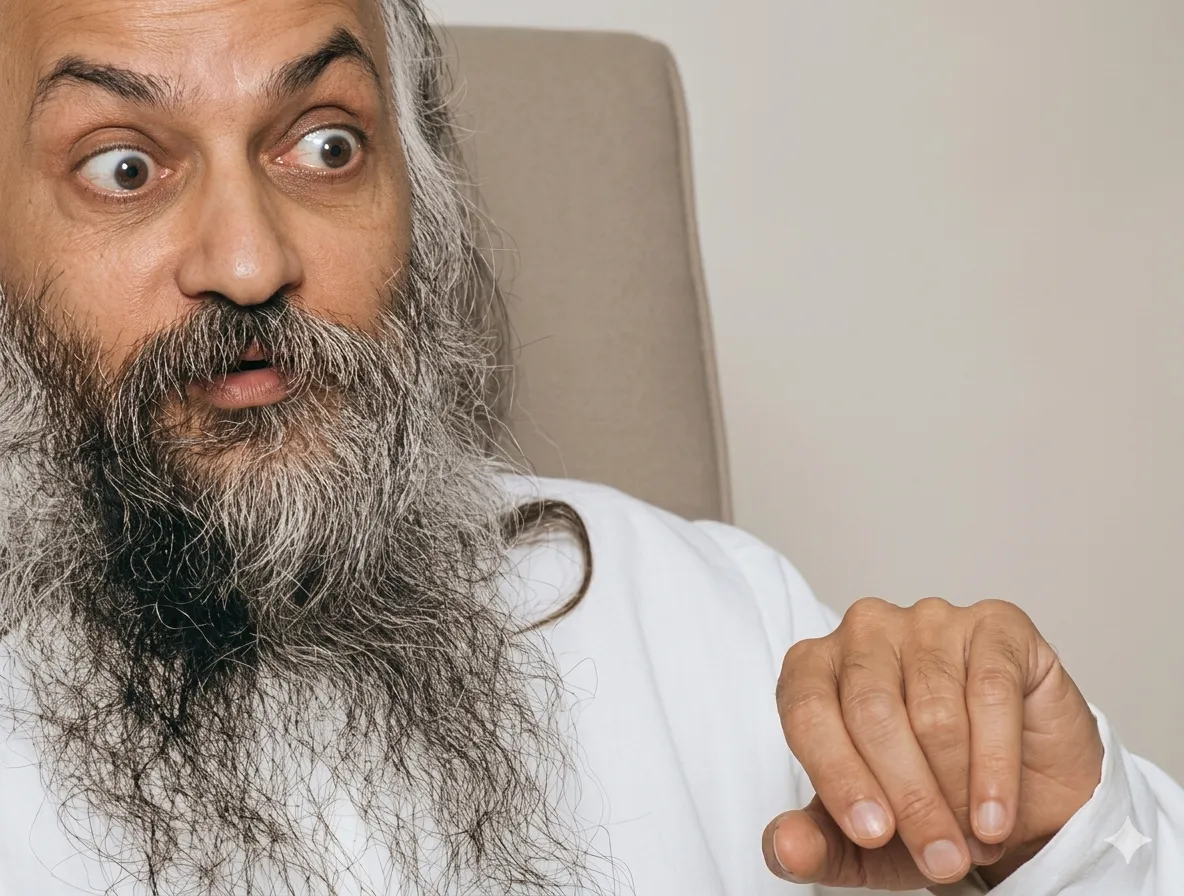
Osho's perspective on Favor and Disgrace
When Osho Spoke About Favor and Disgrace
Passages from the discourses where this theme comes alive.
"favour and disgrace cause one dismay, what we value and what we fear are as if within the self." what is meant by speaking thus of favour and disgrace? Disgrace is being in a low position (after the enjoyment of favour). The getting (of a favour) leads to the apprehension of losing it, and the losing of it leads to the fear of still greater calamity. This is what is meant by saying that favour and disgrace cause one dismay.
It is said that Benito Mussolini was passing by a cinema house one evening. Since the film has just started Mussolini went in unobserved. When, as usual, at the end of the picture, the audience stood up to hail Mussolini, whose picture appeared on the screen, Mussolini, naturally, was filled with pride. He asked the man beside him, "Does it fill you with joy to hail your President?" The man replied, "For your own good I advise you to stand up and hail the Dictator or you will find it very costly. It seems you are a stranger in Italy. You should know that it is impossible to live in this land without cheering Mussolini." Another incident I remember is about Churchill. He was on his way to address the Parliament when his car failed. He hailed a cab, but the driver said he could not take him because he…
Verse (Sanskrit): Chapter 13 : Part 1 Praise And Blame Favour and disgrace cause one dismay; what we value and what we fear are as if within the self. What is meant by speaking thus of favour and disgrace? Disgrace is being in a low position (after the enjoyment of favour). The getting (of a favour) leads to the apprehension of losing it, and the losing of it leads to the fear of still greater calamity. This is what is meant by saying that favour and disgrace cause one dismay. Transliteration: Chapter 13 : Part 1 Praise And Blame Favour and disgrace cause one dismay; what we value and what we fear are as if within the self. What is meant by speaking thus of favour and disgrace? Disgrace is being in a low position (after the enjoyment of favour).
‘हम जिसे मूल्यवान समझते हैं और जिससे भयभीत होते हैं, वे दोनों ही हमारे स्वयं के भीतर मौजूद हैं।’ हम जिसे मूल्यवान समझते हैं और जिससे भयभीत होते हैं!
Another sannyasin friend said, ‘Osho is supremely compassionate,’ ‘Then why this distinction in the sharing of compassion—that only a chosen few receive the prasad of his ambrosial words?’ And hearing that very remark, I was reminded of my own unworthiness and backwardness. And I have begun to fear that perhaps for this very reason Osho may, in his own way, throw me out. Kindly be gracious enough to dispel our doubts and fears.
- “I am special; hence I was chosen.” Then you have gone astray. You miss at the very threshold. - “By grace alone I, unworthy, have been chosen.” Then you are on the right path. The Sufi mystic Junayd used to say in his daily prayer, “I am amazed—there is no worthiness in me, and yet I live. I have earned nothing, and this supremely blessed life has been given to me. I am amazed, for there is no reason why such peace should shower upon me. Where people burn in such restlessness, why does this peace rain on me?” There was a strange line in his prayer: “O God, I cannot believe You are just. You must be partial toward me—showering so much on one so unworthy.” And that was his worthiness. To see oneself as unworthy is worthiness on the path of the spirit. The day you take…
Osho, in the general feeling about the ego, it seems as if one is an egoist or egoless. One moment it feels there is ego; the next moment it feels egoless.
Yes, yes, that’s how it goes. That’s how it goes. In fact, all our thinking is in degrees. It’s like this: at 98 degrees we say, “This person is perfectly fine,” and at 99 degrees we say, “There’s a fever.” 98 is also a “fever,” but it is the normal fever. At 99 it becomes abnormal. Then when it returns to 98, we say, “All right, normal again.” There is still fever—meaning the same fever that everyone has. As long as it is where everyone else’s is, we call it normal; just a little this side or that, and trouble starts. It is the same with the ego. It is our fever. As long as it is at the same degree as in everyone, we say, “He is perfectly humble, a good man.” If, compared to us, his degree goes to 99, we say, “He seems very egoistic.” If it…
प्रश्न: ओशो, ईगो की जो जनरल भावना है न, उससे ऐसा लगता है कि ईगोइस्ट है कि ईगोलेस है। एक क्षण लगता है कि ईगो है, दूसरे क्षण में लगता है कि ईगोलेस है।
… ऐसा ही चल रहा है। असल में, हमारा तो सारा जो सोचना-विचारना है, वह डिग्रीज का होता है। वह ऐसा होता है: अट्ठानबे डिग्री पर बुखार है तो हम कहते हैं, बिलकुल ठीक है यह आदमी; और निन्यानबे डिग्री पर बुखार होता है तो हम कहते हैं, बुखार है। अट्ठानबे डिग्री भी बुखार है, लेकिन वह नॉर्मल बुखार है। निन्यानबे डिग्री में वह एबनॉर्मल हो जाता है। फिर अट्ठानबे हो जाता है तो हम कहते हैं, बिलकुल ठीक है, नॉर्मल हो गया। अभी भी बुखार है, मतलब उतना बुखार है जितना सबको है। सबसे जरा इधर-उधर होता है तो गड़बड़ हो जाता है। वैसा ही हमारा ईगो को मामला है। …
What is meant by favor and disgrace?
definitionProfound Quotes on Favor and Disgrace
Explore our structured collection of meaning-mapped quotes regarding Favor and Disgrace.