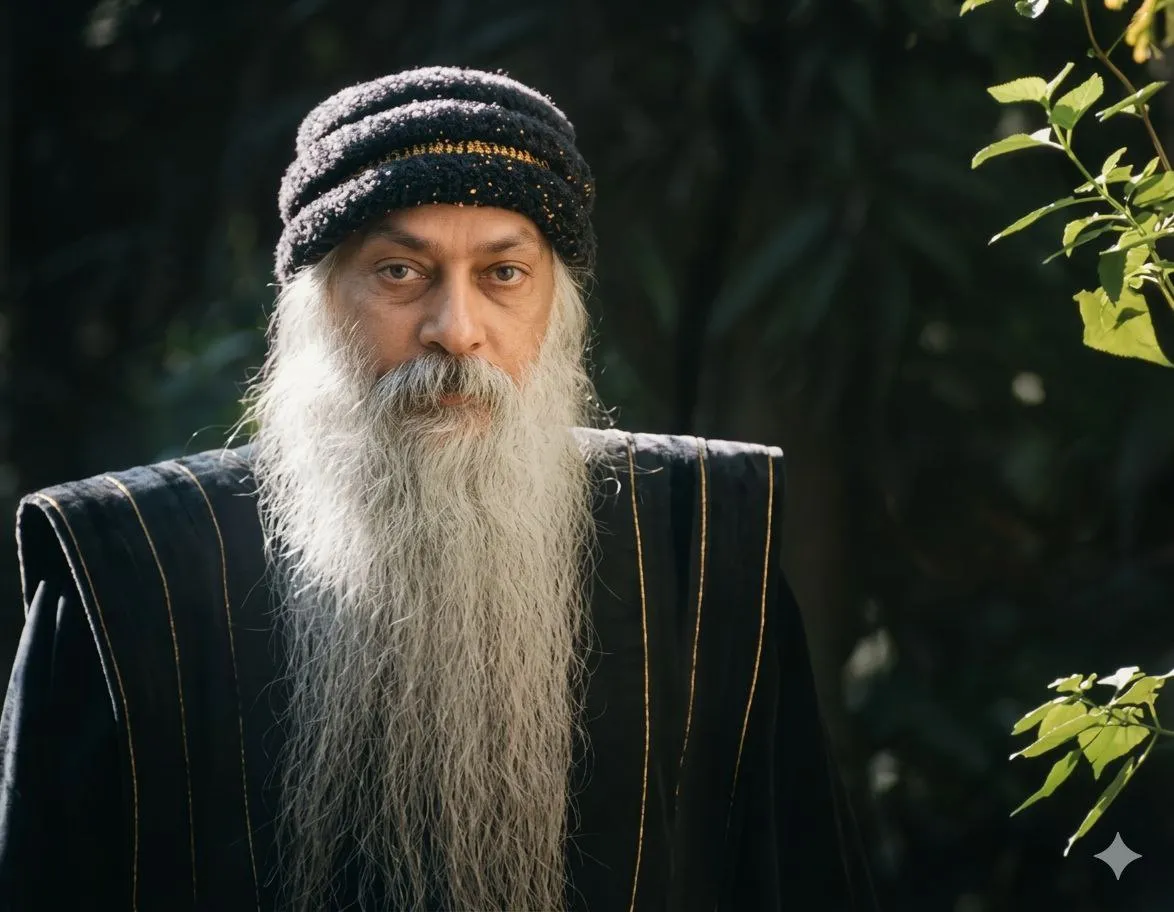
Browse an extensive collection of Osho's most profound quotes, curated semantically by topic and discourse source. Uncover transformative wisdom organized dynamically for deep contemplation.
In the quest for the Divine, let a singular, all-consuming desire overshadow every other longing; as inner oneness blossoms, relinquish even that last yearning, for in the embrace of emptiness, the eternal essence unveils itself.
In the spirit of Osho's wisdom, the essence of existence reveals that what we often deem as golden rules are simply gilded maxims crafted by the powerful, masking the vibrant, living truth that thrives in our own awareness and intelligence.
Fatigue is not the absence of energy but a sign that our senses, the gateways of awareness, have grown weary; by turning inward and embracing our true essence, we can let these tired doors rest, allowing the vibrant energy within to rise and flourish.
In the essence of Osho's thought, spirituality transcends geography, revealing that true sacredness lies not in holy sites like Kaaba or Kashi, but in the heart's surrender and awareness, where love and consciousness unlock the divine within us.
Indulging in passions and suppressing them alike stem from ignorance, yet through vigilant, non-reactive awareness, one can simply observe desires as they arise—transforming lust, anger, and greed into pathways for authentic self-knowledge beyond societal facades.
In the journey of a sadhak, one embraces the path of shreyas—seeking the ultimate good through initial trials, while the senses resist; unlike the preyarthi, who pursues fleeting pleasures and finds only suffering, the true seeker finds bliss in the depth of commitment.
Self-conquest emerges not from conflict or suppression, but from the illuminating power of awareness, where ignorance fades and self-knowledge reveals the harmony within, guiding one toward true mastery without the burdens of an inner enemy.
Osho teaches that a birthday holds no intrinsic significance; rather, when time fades into awareness, every moment radiates the same bliss and silence, revealing that true celebration arises from our presence, transcending mere dates and milestones.
Embracing the role of an instrument reveals the ego's illusions, much like Rama's self-discovery in Ramlila; as we act with intention, our doing transforms into being, allowing the Divine to flow through us and awaken our true essence.
The Supreme transcends fixed forms and names, eluding the mind's grasp; it is not an idea to be understood but an experience to be savored in silence, love, and awareness—where dropping conceptual seeking allows the nameless to unveil itself.
In the dance of samyama, where disciplined nurturing of the seed unfolds, enlightenment emerges as an indescribable flowering, a moment that may blossom through steadfast practice or the profound surrender to the Master, igniting the inner flame beyond the confines of ego.
In the tapestry of existence, as Osho would suggest, meaning emerges only when we embrace the interconnectedness of all things; isolated fragments deceive, while a holistic view reveals the spontaneous harmony of life, inviting us to dissolve the illusion of separation and flow with the essence of reality.
Saffron robes, far from defining a sannyasin, serve as a mindful aid, their vibrant hues reflecting the stimulating energy of red while fostering a tranquil sensuality, guiding one's inner journey towards a meditative existence without aggression.
In the spirit of Osho's wisdom, life reveals itself as a dance between affirmation and negation, where neither path is superior; instead, the journey hinges on the disciple's temperament, inviting each to embrace existence's inherent duality.
Embodying Osho's wisdom, purushartha emerges as the vibrant expression of conscious choice in the present, allowing us to shape our destinies, while prarabdha unfolds the tapestry of past decisions; each mindful choice sows the seeds of a transformed future.
Feminine consciousness, as Osho might suggest, serves as the nurturing womb of spirituality, where it not only carries and protects the seeds of masculine initiation but also breathes life into traditions, ensuring that wisdom flourishes through devotion, patience, and the sustaining force of women across generations.
Disappointment arises not from the world, which remains neutral, but from our egoic hopes and demands; by surrendering to the flow of existence, we align with its inner order, allowing joy and effortless victories to emerge naturally.
Embodying the essence of Sangham, one finds profound surrender not just to a master, but to the living tapestry of fellow seekers; it is in this humble bowing to the collective that ego dissolves, love deepens, and true awakening unfolds.
Embracing our imperfections evokes a thirst for growth, transforming life's stagnation into a vibrant journey, akin to a river flowing toward the ocean; this initial dissatisfaction ignites a divine quest, aligning us with our true essence.
In the light of Osho's wisdom, true non-doing emerges not from effort but from a profound awareness of the illusory 'doer'; as we recognize our essence as the divine flute—inseparable from the ocean's waves—actions flow effortlessly, liberated from the weight of 'I am doing.'
Osho reveals that varying levels of consciousness shape our perspectives, with each voice offering only a fragment of truth; embracing these differences allows us to honor partial insights while evolving toward a more unified awareness where contradictions harmonize into clarity.
In the essence of Osho's teachings, a master embodies an egoless conduit—a 'hollow bamboo'—allowing divine healing to flow effortlessly, while a psychotherapist, though skilled in surface techniques, engages only with the mind's layers, often missing the profound depths of existence.
Embracing manhood as an open-ended journey rather than a fixed identity, Osho invites us to recognize that we are born as pure potential, where each thought and action shapes our essence, urging us to consciously craft our own paths in freedom.
Engaging with alcohol merely satisfies fleeting desires and dulls the pain, while true awakening lies in the water of life—awareness and meditation—encouraging us to seek joy within and embrace self-reliance, free from the distractions of forgetfulness.
In the depths of profound relaxation, the urge to dissolve into the cosmos emerges not as a desire for escape, but as an invitation to spiritual liberation, where the thinning ego and blossoming desirelessness beckon us to embrace existence itself, transcending fear and surrendering to the bliss of being.
Embracing the essence of Osho's teachings, true awareness of publicity transforms it from mere spectacle into a compassionate dialogue, where one speaks as a living truth, nurturing understanding and inviting diverse perspectives with love and clarity.
Embracing Osho's wisdom, the ideal meditation posture emerges as one that fosters comfort and ease, allowing the body to dissolve into stillness, where true awareness blossoms unencumbered by distraction or strain, inviting profound inner exploration.
Embracing the essence of Osho's wisdom, one finds that a woman's choice of art over motherhood is not only natural but a celebration of creativity, where the true spirit flourishes in self-expression rather than in imposed roles that bind her to societal expectations.
Mahatmas, having renounced worldly pursuits, often find themselves ensnared by anxiety and doubt, seeking solace in the very flesh they proclaim to transcend; their indulgence in food becomes a bittersweet reminder of the human struggle between spirit and body.
In the dance of conceptual thought, the mind weaves labels that transform the vibrant garden of life into a barren desert, feeding the ego’s dualities of desire and aversion; true freedom emerges not through theorizing, but in the stillness of pure awareness, where craving and hatred dissolve effortlessly.
In the embrace of Krishna's vision, as Osho might suggest, the ephemeral images and projections give way to a boundless ocean of consciousness, revealing a blissful, formless presence that transcends the fleeting nature of perception and unites all existence.
In the stillness of sobriety, where the mind's craving for 'more' fades, we discover that true fulfillment lies not in external pursuits but in the profound inquiry of self, allowing silence and awareness to blossom in the present moment.
Ascension, often glorified as a heavenly ascent by various traditions, is seen by Osho as a life-denying illusion; true spirituality thrives in the vibrant chaos of earthly existence, where the authenticity of artists, rebels, and lovers flourishes beyond sterile ideals.
In the dance of free will, Krishna’s invitation to Arjuna, Do as you wish, serves as a profound test of the ego, revealing that true liberation lies in surrendering the illusion of choice, allowing divine action to unfold effortlessly beyond the confines of the self.
In the blissful pain that arises from deep love, especially for a master, there lies a ripened longing for oneness; this sweet, ecstatic ache invites us to celebrate, transforming our sorrow into song and dance, ultimately dissolving the separate self and opening the doorway to the divine.
Connecting with your inner child invites the essence of innocence into your being, allowing the Divine to reveal your true self, while challenging the adult mind's grasp and ego's false security, ultimately paving the way for a profound transformation and a sense of oneness.
Osho might suggest that while the spark of scientific genius is a unique karmic gift, the societal structures that provide employment often fail to harmonize with such brilliance, leading to a dissonance that stifles potential and compels talented individuals to seek opportunities elsewhere.
Prejudice, often rooted in envy of perceived intelligence and success, mirrors a deeper existential fear; as Osho suggests, true liberation from such hatred requires transcending material values and embracing a higher understanding of human worth.
Inclusiveness blossoms from the courage to embrace vulnerability, inviting connection with friends rather than focusing on adversaries; as we recognize the shared essence within, our consciousness expands, allowing even the most challenging relationships to be met with genuine acceptance.
Embracing the essence of Osho's philosophy, one discovers that true normalcy is not a fabricated ideal but a natural state of being; by shedding the weight of societal pretenses and habitual conditioning, our authentic selves effortlessly emerge.
The lotus, with its unwavering essence that remains unchanged through every stage of growth, mirrors our own journey; whether we are spiritually dormant or illuminated, true enlightenment is simply the awakening to our eternal nature.
Embracing the paradox of 'creative indifference,' one finds that true creativity, akin to love, invigorates existence, while indifference dulls the spirit, rendering life a mere shadow; in this dance, awakening to the vibrant flow of being transforms each moment into a sacred act.
Sex serves as a biological release valve, dissipating energy and easing tension that we mistakenly elevate to 'great experiences'; yet, true transformation unfolds through deeper avenues, with intercourse merely a technique lacking intrinsic depth.
In Osho's view, true fame transcends public recognition, resting instead in the profound connections forged along the spiritual path, where his only celebrated Swiss is Pragyan, a testament to the transformative bonds that illuminate the journey.
In the dance of spiritual growth, pushing only reveals the ego's interference; true transformation blossoms when we cease our meddling, embracing a state of relaxed witnessing that allows energy to flow freely, fostering awareness and trust in the organic unfolding of our inner journey.
Divine remembrance blossoms not through forced contemplation, but in the presence of a divinely intoxicated soul, where a single glance can evoke profound longing; surrender the ego, and trust will effortlessly awaken, leading you to the Sadguru.
Embracing the essence of Osho's wisdom, true intelligence blossoms not from borrowed concepts but from the richness of direct experience; it is in living authentically that we awaken our inner truth, transcending the confines of mere intellectualism.
In the spirit of Osho, true security lies not in external circumstances but in the authentic inquiries we pose to ourselves; only by exploring our immediate experiences can we uncover responses that resonate with our deepest truths.
True help emerges from the depths of self-transformation; only when one is aflame with authenticity and awareness can their presence illuminate the path for others, for guidance rooted in genuine experience transcends mere advice and intention.
In the spirit of Osho, true spiritual teachers challenge the pedantry of pandits, recognizing that mere repetition of borrowed wisdom obscures genuine awakening; they urge seekers to transcend echoing others and embody the essence of scripture through their own profound experiences.
The navel center, an inherent essence untouched by external influences, awaits discovery, while the heart and head evolve through cultural experiences; thus, we must nurture our emotions and intellect, yet turn inward to unveil the eternal ground of our being, as Osho suggests.
Osho illuminates the peril of fanaticism, where the primal instinct for belonging drowns out the whispers of true intelligence, leading individuals to forsake personal inquiry in favor of the comforting certainties offered by rigid belief systems and collective identities.
Embracing the essence of the present, Osho reminds us that the here and now is not merely attainable but the sole reality; as we shed the burdens of worry and planning, we uncover a vibrant existence where each moment blossoms into the next with effortless grace.
In the essence of Osho's wisdom, true transformation lies not in changing the chaos of the world around us, but in cultivating an inner harmony that allows even the harshest sounds to resonate as a symphony, inviting us to embrace life’s melody with open hearts.
Embracing life’s challenges, rather than fleeing from them, ignites our spiritual awakening, revealing that true peace and understanding emerge not in avoidance but through the transformative friction of existence, where the soul truly comes alive.
In the spirit of Osho's teachings, the socialization of women, framed as public property by Marx and Engels, merely recasts the patriarchal illusion of ownership; true relationships, he suggests, flourish in love and freedom, recognizing women as sovereign beings beyond mere possession.
Fashion serves as a vibrant canvas for teenagers, allowing them to express the tumultuous shifts within, echoing Osho's belief in embracing change as a path to self-discovery; rather than stifling their creative exploration, we should guide it towards constructive outlets.
In the dance of existence, knowledge and devotion intertwine, with knowledge illuminating the shadows of ignorance while devotion nurtures the soul, together forming the wings that elevate us towards the divine.
In the dance of existence, a soulmate emerges as the rare harmonization of two souls, transcending the physical to embody unio mystica; yet, in the quest for such profound connection, one must first turn inward, allowing a master to awaken the seven energy centers, transforming love into a meditative journey toward the true self.
Embracing yes embodies a profound acceptance of existence, inviting us to dissolve the ego and bloom into oneness, while no confines us in the isolation of resistance, obscuring the path to true meditation and spiritual freedom.
Embodying the essence of Osho's teachings, the Way of the White Clouds invites us to embrace a rootless, purposeless journey, where surrendering to the flow of existence reveals a timeless state of no-mind, free from goals and the burdens of separation.
True friendliness blossoms from a deep awareness and genuine authenticity, transcending biological ties and expectations; it embodies a boundless, non-possessive presence that, once cultivated through inner transformation, radiates unwavering compassion to all.
Human existence unfolds as a dynamic journey of becoming, where each individual blooms from seed to flower; in shedding ego and overcoming inertia, we answer our destiny's call, transcending limitations to embrace the vastness of our cosmic potential.
When the present stirs old wounds, the repressed pain emerges, revealing its medicinal nature; bathed in the light of awareness and love, healing begins, while shielding it with ego only deepens the suffering, underscoring the transformative power of a true guide.
True rejuvenation lies not in lengthening life but in embracing the art of dying, where the acceptance of death dissolves fear, allowing us to immerse ourselves fully in each moment, restoring vitality and infusing our existence with genuine meaning.
Osho beautifully illuminates that true introversion is not mere withdrawal into indifference, but rather a harmonious dance between the inner and outer worlds, where shutting doors to life stifles our essence, urging us instead to embrace a balanced flow that transcends divisive labels.
In the spirit of Osho's teachings, the human mind stands poised to embrace a harmonious synthesis of philosophy and poetry, where the once-divided realms of logic and spirituality, like intimate enemies, intertwine to create a vibrant wholeness that transcends historical divides.
Osho suggests that while attire like orange robes serves as a psychotherapeutic tool to disrupt ingrained mental patterns and reshape identity, true spirituality transcends these external shifts, rendering them unnecessary once one has awakened to their essence.
Embracing Osho's wisdom, it's clear that children thrive on honest, straightforward sex education; truth nurtures trust and understanding, while deception fosters suspicion and shame, ultimately empowering them to embrace their sexuality without fear or guilt.
Osho teaches that the struggle with enforcing rules arises not from the authority itself but from our unconscious desire to dominate, which breeds fear and rigidity; embracing awareness allows us to guide with fluidity and egolessness, transforming the role into a mirror for spiritual growth.
Veneration, often misconstrued as mere external displays or hierarchical symbols, reveals its true essence in the absence of such illusions; genuine reverence flourishes within a conscious heart, untouched by the ego's longing for validation through status.
In the essence of Osho's philosophy, juice embodies the divine raso vai saha, a profound taste of reality that transcends mere doctrine; it is the ultimate experience that reveals the depth of existence, inviting us to savor the richness of life itself.
In the spirit of Osho's wisdom, the significance of a birthday, be it February 29th or any other day, lies not in the arbitrary markings of time, but in the profound celebration of our existence and the awareness we cultivate within it.
In the crucible of survival, where resources dwindle, outward actions may mirror one another—self-sacrifice included—yet it is the depth of consciousness that distinguishes the awakened, who embraces life’s eternal flow, from the unawakened, bound by despair and conditioning; thus, true discernment lies not in behavior but in the essence of awareness that imbues each act with profound meaning.
In the journey through the gunasthanas, once one reaches the thirteenth, the ascent to the fourteenth—ultimate liberation—becomes inevitable, unless, driven by profound compassion, one chooses to remain in form, illuminating the path for others like a guiding light in the darkness.
In the dance of existence, Osho illuminates that the distinction between good and evil emerges from values rather than appearances; true goodness nurtures freedom and potential, while evil thrives on control and the illusion of promised liberation.
In the luminous bardo, where life's dream dissolves and the body and mind fade, a clear gap emerges; guided by a master, one can embrace this moment with awareness, transcending death's illusion and consciously entering the next cycle of existence.
In the spirit of Osho's teachings, embracing a pause before responding allows unconscious reactivity to fade, revealing the essence of clarity and nurturing a deeper understanding, where anger and confusion dissolve into the wisdom of mindful awareness.
In a playful nod reminiscent of Osho's teachings, the quip “Give him a paper with ‘PTO’ on both sides” unveils how our minds and culture ensnare us in ceaseless cycles of busyness, inviting us to awaken to our true selves through laughter and presence.
In the moment of the 'aha experience,' when the unknowable shatters our concepts, we encounter a thought-free shock that echoes Osho's insight: true realization comes not from past knowledge or effort, but as a grace-filled revelation that leaves us in incredulous wonder, much like Janaka's astonished recognition of the Self.
In the dance of existence, truth, beauty, and goodness emerge not as divine traits but as our human lenses through which we glimpse the infinite; the intellect seeks truth, the heart embraces beauty, and action manifests goodness, revealing the limitations of our perception rather than the essence of the divine.
In the dance of existence, will and surrender emerge as two distinct yet intertwined paths; while will embodies the assertive I do, surrender reveals a profound acceptance, where the ego dissolves and life unfolds effortlessly, guiding us toward the same ultimate truth.
In the embrace of limbo, where the ego's urge to escape fades, surrendering to the in-between allows identity to dissolve like ice into water, leading to a profound transformation that unveils the divine essence of our true selves.
In the stillness where the doer dissolves and the ego recedes, one discovers that true action emerges effortlessly from surrender, transforming the self into a vessel for the Divine, where rightness flows naturally from emptiness.
In the spirit of Osho, every moment unfolds as a vibrant tapestry of meditations, silence, and love, igniting awakening and fostering a heart-to-heart transmission that transcends boundaries, cultivating a global celebration of awareness that nourishes consciousness and dismantles divisive politics.
Insensitivity emerges as a learned survival tactic, where childhood suppression of our innate sensitivity to appease authority leads to walls that shield us from vulnerability; yet, by recognizing this conditioning and courageously embracing our feelings, we can reclaim the innocent joy of being alive, allowing awareness to dissolve our defenses and restore our authentic selves.
The dark night of the soul encapsulates our collective unconsciousness, where the ego blinds us to our true essence; yet, through the gentle art of nonjudgmental witnessing, the shadows dissolve, unveiling the radiant awareness of our interconnected being.
In the stillness of turning inwards, one finds that true awareness arises not from the chase of desires, but from the profound recognition that reality, in its eternal presence, has always been within, waiting to be discovered in the silence of our being.
In the dance of desire, the yearning for gratification masks itself as a condition for happiness, weaving pain into the fabric of joy; true fulfillment lies in embracing unconditional well-being, where contentment flows effortlessly, freeing us from the relentless chase of fleeting relief.
In the dance of evolution, genetic engineering emerges as a natural progression, often misunderstood as a violation of nature; it holds the potential to enhance our bodies and minds, yet true transformation arises only when these advancements are harmonized with awakened consciousness, where science refines the instrument, and love, meditation, and awareness compose the symphony of life.
In the dance between emptiness and fullness, Osho reveals that Buddha and Shankara, while seemingly at odds, compassionately guide seekers through their distinct paths, illustrating that their contrasting teachings are not contradictions but essential lessons for clarity and growth.
Osho beautifully illustrates that one cannot pursue both Sankhya and Yoga simultaneously without risking stagnation; instead, he urges seekers to align with their true nature—embracing the path of action if extroverted, or the path of knowledge if introverted—to find clarity and purpose.
Unawareness manifests as a deep identification with the mind, where thoughts and emotions obscure our true selves; yet, through the lens of awareness, we learn to witness these fleeting states with detachment, embracing the truth that this too shall pass.
Embracing conscious simplicity, Osho teaches that true happiness, peace, and joy lie in the choices we make; prioritize paths that nurture your inner ease, avoiding the allure of struggle that sacrifices serenity for fleeting gain.
Beginninglessness reveals the eternal essence of reality, transcending the confines of time and thought; only by embracing the stillness of the present can one experience this profound insight that sings in silence, beyond the grasp of the mind.
Embracing the essence of Osho's wisdom, one recognizes that life’s fluidity makes absolute rules obsolete; true spiritual growth flourishes through personal exploration and the freedom to deviate from prescribed paths, rather than through rigid doctrines.
In the spirit of Osho's philosophy, genuine discussion transcends the confines of rigid conclusions, inviting us into a boundless exploration where inquiry flourishes and silence embraces the vastness of truth beyond certainty.
In a world where hollow national pride breeds rejection, true respect emerges not from slogans or caste, but from the courageous shedding of nationalist ego, embracing the oneness of our shared humanity, as Osho might suggest.
Cruelty, stemming from our deep-seated fear of mortality, transforms us into preemptive aggressors, yet it dissolves when we awaken to the eternal within, allowing urgency to yield to trust and aggression to blossom into compassion.
In the spirit of Osho's teachings, the emergence of the 'new woman' transcends traditional suffering, as science offers liberation through the contraceptive pill, alleviating not only the burdens of menstruation but also revealing the hidden emotional rhythms shared by all.
One tap — creates your free account, or signs you back in.
Already have an account? Login here
New here? Create a free account
Enter your account email and we'll send you a link to choose a new password.
Remembered it? Back to login