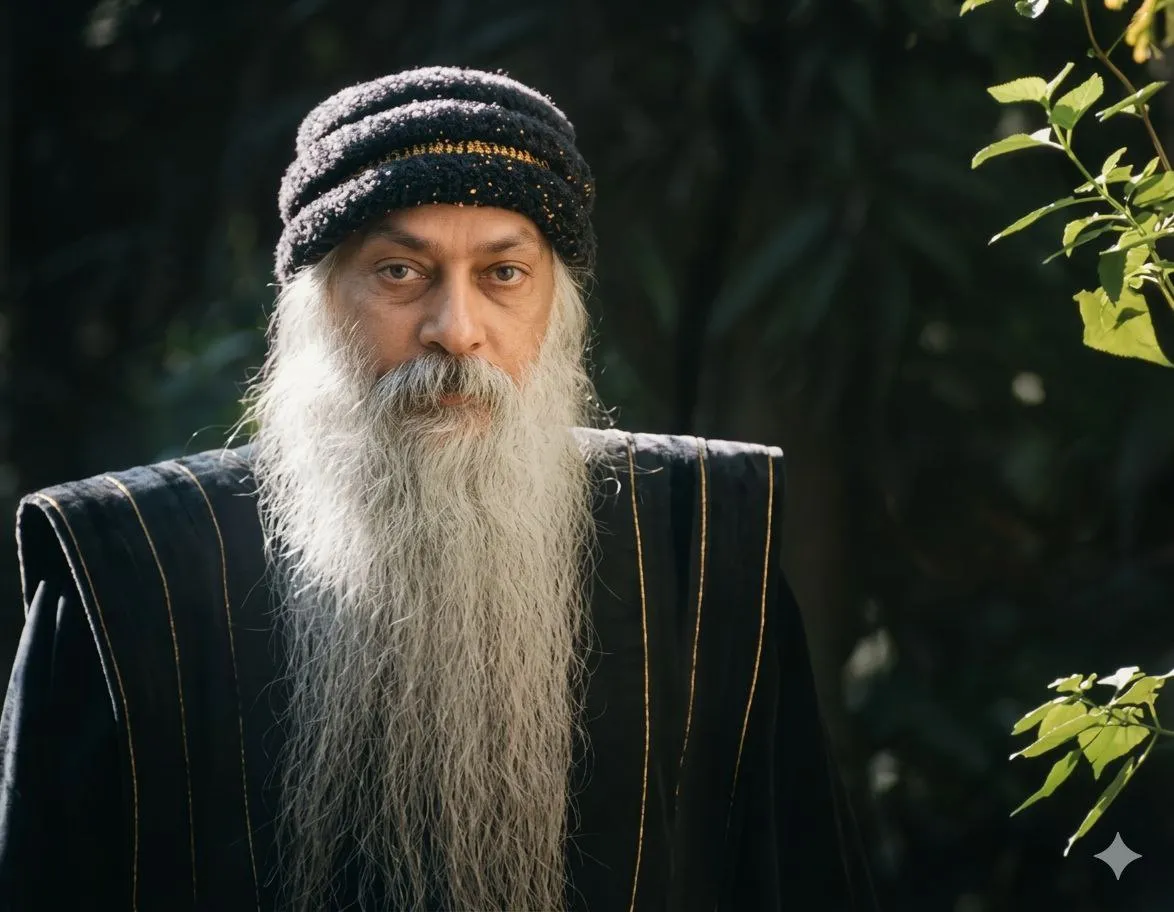
Browse an extensive collection of Osho's most profound quotes, curated semantically by topic and discourse source. Uncover transformative wisdom organized dynamically for deep contemplation.
In the essence of Osho's teachings, trance-like states dwell in the shadows of consciousness, offering fleeting sensations of relaxation or intensity, yet true spiritual awakening blossoms only through the clarity of alert awareness, far removed from mere ecstatic illusions.
In the essence of non-duality, Osho reveals that the visible world, apara, and the unseen consciousness, para, are not separate but rather a harmonious continuum, where true realization transcends their functional asymmetry, merging them into one profound tapestry of existence.
Embracing divine vision can evoke a sudden panic akin to Arjuna's, as we often brace for sorrow rather than the overwhelming joy it brings; yet through meditation and inner preparation, this profound experience unfolds gently, allowing us to welcome its vastness in manageable glimpses.
In a playful twist reminiscent of Osho's insights, the tale of Nasruddin reveals that even the most cunning trickster can be outwitted by those who embrace alertness and shrewdness, turning the tables on deception and revealing the deeper truths of human nature.
In the embrace of existence, human life emerges as a divine benediction, a sacred opportunity where every moment unfolds the potential for meditation, love, and liberation, transforming our choices into pathways of profound awareness and ultimate flowering.
Rigidity, as Osho suggests, arises when the mind clings to fixed notions, resisting the natural flow of life; while brief periods of structure can be beneficial, true danger lies in long-term fixation—embrace flexibility, letting discipline enhance awareness rather than confine it.
Youth transcends mere age, embodying an inner vitality that dares to confront the past and welcomes the new; in a world that often venerates the old, it is this spirit of awakening—full of trust and celebration—that defines true sannyas, a vibrant embrace of life.
Vairagya embodies the essence of existence, where the journey and the destination merge; it invites us to cultivate conscious desirelessness, allowing each step to blossom into effortless being, revealing the bliss that resides in the present moment.
In the spirit of Osho's wisdom, when a marriage is steeped in perpetual misery, liberation through divorce becomes not just an option but a necessary step, revealing that without joy, the bonds once thought sacred were perhaps never truly formed.
Desire for closeness becomes a form of bondage only when it disrupts your inner harmony, as true freedom arises from embracing your spirit's effortless flow; in this dance between staying and leaving, it’s the attitude that defines your experience.
The human condition reflects a paradox where relentless outer advancements overshadow the vital inner awakening; as civilizations master technology yet forsake consciousness and compassion, the true battle rages within, urging us to harmonize power with love to avert our own demise.
The Bauls, embodying an ecstatic spontaneity and a timeless celebration of life, emerge organically from existence, much like roses unfurling in spring; every child is born a Baul, only to be conditioned away, echoing the essence of humanity since time immemorial.
In the spirit of Osho, embracing the act of watching invites a gentle surrender to its natural flow, where non-doing becomes the essence; by simply witnessing without interference, we cultivate a profound trust in the unfolding of awareness.
In the essence of Vedanta, awakening unfolds through the stillness of shravana, where receptive listening to a realized master ignites the memory of ‘Tat tvam asi’; this deepens into manana, a contemplative journey that dissolves doubt, culminating in nididhyasana, where truth is lived and blossoms into samadhi, echoing Osho's celebration of experiential realization.
Originality blossoms in the purity of one’s true self, untouched by societal conditioning, embodying the essence of nature—unpredictable and vibrant—where inner silence guides direct experience, free from the constraints of borrowed beliefs and ideologies.
Osho illustrates that a command, stark and directive, starkly contrasts with the gentle invitation of upadesh, where true understanding flourishes in presence and choice, allowing one's own awareness to illuminate the path forward instead of following imposed orders.
Charisma emerges as the invisible magnetic force of a centered and relaxed being, where unified energies ascend, radiating an aura of authority and grace reminiscent of a Buddha, cultivated through the depths of meditation.
Osho reveals that asceticism often masquerades as spirituality, yet it merely cultivates a façade of piety through self-inflicted suffering, while true enlightenment blossoms from embracing life, love, and awareness, guiding us towards authentic transformation.
In the dance of existence, science emerges from the intellect, anchored in reason, while religion blossoms from the heart, guiding us to a deeper awareness; together, they harmonize through meditation, transforming knowledge into love and spirituality into profound insight.
In the dance between the observer and the observed, the illusions of maya unfold as projections of our own unconsciousness, revealing that without awareness, the mind crafts deceptive truths; yet, as consciousness awakens, these illusions dissolve, laying bare the essence of our inner state.
Bodhidharma’s essence vibrates in the laughter that echoes through our shared moments, inviting seekers to embrace the sacredness of humor and playfulness as pathways to his timeless presence, urging us to listen deeply and connect in the here and now.
In the essence of Osho's teachings, self-respect and pride intertwine as the pure expression of one's individuality, flourishing in noncomparative love and acceptance, while the ego distorts this beauty by fostering superiority; true self-respect blossoms in honoring oneself and inspiring others to embrace their own worth.
As the compulsion to act diminishes and one immerses in the stillness of inner non-doing, outer activity flourishes, transforming into a spontaneous expression of deeper awareness, where tireless engagement coexists with a serene, untouched core.
Kropotkin’s anarchism stands apart from communism, viewing the state as a hindrance rather than a necessity, while Osho beautifully emphasizes the importance of inner anarchy, advocating for personal order amidst life's chaos rather than relying on external structures.
In the spirit of Osho's teachings, true generosity transcends the ego's game, where offering more than what is sought—embracing even one's own defeat—dissolves conflict and reveals the futility of struggle, anchoring us in awareness rather than the relentless pursuit of victory.
True anguish lies in the unfulfilled potential of our being, where the seed remains unwatered and the soul's innate divinity is stifled by societal roles; liberation emerges when we embrace our true essence, allowing our authentic selves to flourish.
In the embrace of cosmic awareness, the mind's fragmentation dissolves as we shed our labels and biases, allowing the flower and the seer to merge into a singular dance of existence, where life experiences itself through our very being.
In the spirit of Osho, absurdity unveils the profound aspects of existence—love, joy, beauty, and the quest for truth—transforming what society deems irrational into a celebration of authenticity, where life’s ceaseless change defies conditioned beliefs and invites us to embrace deeper truths.
Living unfolds in choiceless awareness, where one simply observes the self, allowing a natural distinction between memory and consciousness to emerge; in this receptive state, change blossoms spontaneously, inviting the transformative power of paradox to shatter old mind-habits.
In the harmonious dance of Sahaj Yoga, the effortless flow of non-doing intertwines with the disciplined pursuit of practice, revealing that life's profound truths blossom from the creative tension of opposites, leading to a transcendent union where action arises from non-action.
True inner guidance, as Osho suggests, emerges not from the chatter of moral imperatives or social conditioning, but from a profound, wordless silence that reveals clarity and halts action, urging us to trust and cultivate this stillness through awareness.
Salvation emerges not as an external rescue or belief's promise, but as the blossoming of personal transformation; true freedom is found in embracing responsibility and cultivating awareness, liberating oneself from borrowed certainties and fervent reassurances.
In the pursuit of siddhi, one discovers that while bodily pain persists as an inevitable experience, true liberation lies in transcending suffering; the enlightened witness their sensations with clarity and sensitivity, remaining untouched by the turmoil of identification.
Transformation unfolds not through gentle wishes, but through the decisive force of concentrated energy that disrupts old patterns; it is a conscious jolt of clear resolve and unwavering intensity that shatters the familiar, inviting the new and making true change inevitable.
In the serene embrace of well-being, where life flows effortlessly, we rediscover our natural state, unencumbered by the conditioning of misery; it is through this gentle questioning that vitality awakens, inviting love, song, and celebration to flourish.
In his quest for enlightenment, Gurdjieff sought not personal attachment but the crystallization of his nearly-realized wife, channeling group energy to prolong her life just enough for her final awakening, a journey echoed in Osho's teachings on transcending the cycle of existence.
Existence unfolds in its profound simplicity, untouched by human questions and the fabricated answers we cling to; true intelligence flourishes in doubt and direct experience, urging us to shed borrowed beliefs and embrace the mystery of life with spontaneous curiosity.
Satisfaction eludes us when we are conditioned to mimic others, chasing illusions of wealth and status; true contentment blossoms from embracing our authentic selves and cultivating our unique potential, transforming our own grass into a vibrant oasis.
In the dance of existence, means and ends are intertwined, revealing that the essence of our journey shapes our destination; when we embrace awareness, compassion, and integrity in every step, the true quality of our lives unfolds beautifully.
Osho advocates for a vision of women's liberation that transcends revenge and destruction, recognizing the need for forgiveness and love while honoring the inherent differences between men and women, fostering mutual understanding to break the cycle of chauvinism.
Mulla Nasrudin transcends mere folly, embodying the collective absurdities of humanity while concealing profound wisdom; each of his tales invites us to reflect, laugh at our own absurdities, and ultimately transforms ridicule into a journey of self-awareness.
Paradise is not a destination to be sought or managed; rather, it flourishes from within, as cultivating inner joy and presence allows the world to reveal its beauty effortlessly, transforming every moment into a harmonious reflection of serenity.
Smoking can transcend mere habit when approached with awareness, transforming the act into a sacred ritual; it is not about moral judgment but about embracing consciousness, where the choice to continue or stop arises from deep understanding rather than imposition.
A pessimist, embodying an optimist turned upside down, shifts focus from counting roses to thorns after disappointments, yet true freedom lies in transcending this spectrum, witnessing life without the chains of hope or despair, as Osho insightfully suggests.
Fantasizing, often dismissed as a trivial distraction, can entrap the mind in a web of words and dreams, yet when these illusions fade, a profound emptiness emerges, revealing the boundless love, silence, and bliss that lie beyond thought, inviting true freedom.
Auspiciousness transcends rigid dietary rules, resting instead on what nurtures inner silence; if consuming meat enhances your meditative clarity and deepens awareness, it becomes a sacred choice, while anything that disturbs your peace is best left behind.
In the journey of self-realization, humanity is but a seed poised for divine emergence; the instant of transformation into godhood is hindered only by the ego's reluctance to dissolve, revealing that the divine leap occurs the moment we embrace our readiness to transcend.
In a radiant embrace of truth, Osho attracts the young and open-hearted, fostering an inclusive commune that honors women as equals, transcending gender and liberating all from the shackles of past prejudices.
Embracing the art of living means relinquishing the mind's incessant quest for reasons, allowing oneself to rest in the present moment—where the beauty of existence unfolds effortlessly, free from the burdens of explanation.
In the spirit of Osho, self-care emerges as the sacred act of nurturing one's essence, allowing for the preservation of energy and the cultivation of an inner vessel, ready to receive the profound wisdom that arises from the depths of being.
Embracing Osho's wisdom, one can see that while technical knowledge fulfills professional demands, it should never define our essence; like changing clothes, we should wear information lightly, allowing true understanding to transform us into aware beings both at work and in life.
Life unfolds as a divine Leela, a joyous play that thrives beyond belief; in embracing this cosmic dance, one finds peace and bliss, while clinging to seriousness only leads to suffering, as the essence of creation is simply an overflow of boundless energy.
Osho suggests that true harm arises not from our actions themselves, but from the unconsciousness with which we engage in them; when lived with love and awareness, even diversity becomes a canvas for growth rather than a battleground for judgment.
Maturation is an endless journey of inner growth, where true essence flourishes beyond mere appearances; through deepening awareness of body, mind, and feelings, thoughts fade, grace emerges, and the natural unfolding of maturity takes place.
Osho beautifully illustrates that the “fruit” symbolizes the inner ripeness of consciousness, love, and understanding, where effortless surrender to truth emerges naturally, akin to a ripe fruit cascading from a tree, free from struggle or striving.
Meditation transcends mere moments of rest or fleeting entertainment, infusing life with a profound bliss and peace that cannot be traded or tamed; it transforms your essence, becoming the very 'soul of your soul'—a journey that requires courage, sincerity, and dedicated practice.
Osho perceives creed as a rigid formula that shackles living intelligence, insisting that true growth flourishes through free inquiry rather than conformity, for clinging to outdated beliefs only deepens our existential malaise.
In the practice of samayik, one cultivates a disciplined equanimity that naturally unfolds into vitaragata, a state beyond attachment; this seamless journey reflects the essence of maturity described in the Gita as sthita-prajna, where wisdom remains steadfast as dualities dissolve.
Osho beautifully illustrates how the generation gap emerges as modernity liberates youth from traditional constraints, transforming education into a rapid, institutional process that fosters individuality, allowing younger generations to redefine values and identities apart from their elders.
Impatience ignites the flame of longing and alertness, urging us to nurture our desires like a lover tending a garden, yet it must dance in harmony with patience to cultivate a vibrant equilibrium, avoiding the traps of anxiety and inertia.
Emerging unexpectedly in the midst of a mundane task, the Latihan meditation, discovered by Bapak Subud, embodies the essence of surrender—where uncontrolled gestures give way to profound silence, reflecting Osho's belief in the transformative power of spontaneous, authentic experience.
In the vibrant tapestry of India, enlightened souls often remain hidden, their profound realizations manifesting through the talents of a Meera who sings and dances, while others, lacking such expressions, dwell in silent anonymity, their wisdom unseen yet deeply felt.
Osho illuminates the eighth sense—humor—as a distinctive mark of evolving consciousness, where deepening awareness transforms life's absurdities into a joyous carnival, allowing suffering to dance playfully and revealing the profound insights hidden within our existence.
In the teachings of Osho, the harsh words of saints or siddhas serve not as malice but as a compassionate tool to dismantle the ego; their seemingly painful actions, much like a surgeon’s cut, reveal grace and readiness for the Divine to flow in, igniting the spark of awakening.
In the spirit of Osho, one might reflect that society and politics lack an independent essence, serving merely as reflections of individuals intertwined in their consciousness; true transformation unfolds not through external constructs but through the awakening of the self, which in turn reshapes relationships and transcends fear.
In the spirit of Osho’s wisdom, the pursuit of arms and the escalating arms race become acts of self-destruction, hindering humanity's evolution towards consciousness; instead, we must redirect our resources towards nurturing dignity, equality, and a peaceful existence free from violence.
Pratibha embodies a thought-free consciousness, a radiant clarity where the mind shines in its purest form; it emerges from awakened wisdom, transcending cleverness and intellect to reveal an innocence and simplicity that illuminates existence itself.
Osho teaches that spiritual growth flourishes only when one wholeheartedly commits to the journey, for it is this sincere readiness that transforms methods into meaningful guides; without such inner dedication, the path remains inaccessible to the unprepared seeker.
Reformers must first undergo their own transformation, as true change emerges not from dogma but from a raw honesty and vulnerability that fosters authentic connection, allowing the essence of their humanity to inspire genuine societal evolution.
In the spirit of Osho's teachings, dogmatism emerges as a universal force, resisting change yet illuminating the path to awakening; it is through the contrast of darkness that we find the joy of enlightenment, transforming conflict into a canvas for consciousness to flourish.
Feminine energy, akin to the vast, deep darkness that nurtures and restores, embodies the earth’s calming essence, inviting introspection and balance; in this harmonious dance between light and dark, we discover the profound unity that Osho so eloquently celebrated.
Nonattachment, as Osho illuminates, reveals the profound truth that our essence exists in solitude, transcending the external ties of people, possessions, and circumstances, allowing us to engage fully with the world while nurturing an inner freedom that remains unbound and aware.
In the spirit of Osho, commune-ism embodies a harmonious tapestry of voluntary, decentralized living, where wealth and creativity flourish in self-governing communities, transcending private ownership to unite diverse talents—from plumbers to poets—who collectively elevate society through love, intelligence, and generosity.
In the dance of existence, the notion of a beginning reveals itself as an illusion, for every start is merely a continuation of what was, intertwined with an endless journey where boundaries dissolve and nothing emerges from true nothingness.
True channeling emerges in the profound silence of no-mind, akin to a hollow bamboo, allowing love to connect and existence to flow through, transforming messages into rare, luminous insights; without inner purity and meditation, such channeling becomes nothing more than the clamor of the mind.
In the spirit of Osho's teachings, true compassion flows like nectar, unburdened by expectations; when we share our light and words freely, even if just one soul awakens, it is a profound miracle that transcends the odds.
True sacrifice transcends mere suffering or self-mutilation; it emerges from surrendering the ego's compulsion to act, allowing silence to unveil truth and foster genuine connection, where authentic renunciation leads to profound awakening.
True centering unfolds as an awakening to the authentic Self, where the socially constructed ego gracefully dissolves, allowing the transcendental essence within to emerge, revealing the profound stillness that lies beyond the chaos of our illusions.
Osho insightfully suggests that pornography emerges as a byproduct of religiously enforced sexual repression, where the allure of the forbidden fuels desire; by embracing natural nudity and fostering open intimacy, we can dissolve its power and reclaim our authentic connection to love and sensuality.
Enlightenment, as Osho suggests, gives rise to true ethics, where authentic conduct flows effortlessly from inner awakening, transforming morality from a rigid imposition into a compassionate expression of freedom that resonates with the essence of consciousness.
Fainting, much like sleep and even death, reveals that while the body may fall into unconsciousness, the witnessing consciousness remains unwavering, quietly affirming, “I am,” even in the depths of stillness.
In the dance between religion and politics, where politics embodies the ego's relentless quest for power, true religion emerges as a profound surrender to existence, suggesting that genuine transformation flourishes in the space of egolessness rather than in the clutches of control.
In the therapeutic relationship, the client and therapist exist as separate entities, akin to a mind-plumber and patient, yet in the realm of the disciple and Master, the disciple dissolves into oneness, transcending the need for techniques, surrendering instead to the profound presence of the Master.
Esoteric teachings often captivate the untrained mind, enamored with the mysteries it cannot grasp; yet, existence conceals nothing, inviting us to transcend borrowed beliefs and embrace the profound inquiry of self, where true spirituality unfolds beyond words.
In the dance of existence, yawning emerges as a sacred ritual, a natural response to the encroaching embrace of sleep; it momentarily rebalances our breath, urging us to heed the body’s call for rest while reminding us of the delicate interplay between wakefulness and surrender.
In the essence of Osho's teachings, 'prakriti' transcends mere constitution, embodying the primordial fabric of existence that underlies all creation, while 'srishti' represents the manifestation and 'pralaya' the inevitable dissolution, akin to the materials that form a house, distinct yet inseparable from its design.
In Osho's perspective, what we perceive as contradictions are merely the dance of existence, where polarities like joy and pain intertwine, revealing the vibrant tapestry of life that thrives on authenticity rather than the rigid confines of man-made logic.
In the spirit of Osho's teachings, the German workaholic thrives in a joyful dance of creativity and health, where eight hours of intense, purposeful labor dissolves worries, rejuvenates the spirit, and ignites a continuous flow of transformative energy.
To truly grasp the feminine psyche, one must transcend the confines of male and female identities, embracing a state of pure awareness that perceives femininity as a dynamic flow—an ever-evolving process rather than a static entity—allowing for genuine connection free from projections and societal labels.
Embracing the essence of Osho's wisdom, true tranquility arises when we transcend the restless identity of the 'doer,' allowing meditation to unveil the watcher within; in this space, action and stillness harmonize, dissolving the ego and inviting effortless flow.
In the serene embrace of prolonged intercourse, where the woman embodies the negative pole and the man the positive, an energetic circuit ignites, enveloping them in a luminous field that transcends mere physicality, merging their essences and fostering a profound unity that quiets the mind and nourishes the spirit.
Miserable existence stems from the refusal to embrace responsibility for one's inner state, as we often blame others for our suffering; yet, true freedom and joy emerge when we reclaim our power, learn from our experiences, and cultivate inner awareness and love.
In the tapestry of spiritual practices, the Brahmin's inward journey of silence and meditation harmonizes with the Kshatriya's outward quest for courage and leadership, illustrating that true growth flourishes when one aligns their path with their innate essence, or swadharma.
Hesitation in savoring life's joys often springs from deep-seated conditioning that labels delight as frivolous, instilling guilt and fear of judgment; Osho reminds us that reclaiming our spontaneous cheerfulness can liberate the soul from this self-imposed restraint.
Doctrines and -isms, mere intellectual games, crumble in the face of true understanding, which emerges only when the mind embraces silence; in that stillness, truth reveals itself as an undeniable experience, beyond debate and conceptual confines.
In a realm where true freedom and the divine coexist, governance dissolves as individuals awaken to self-responsibility; here, love and consciousness flourish, fostering spontaneous order that transcends the need for rulers and imposed laws.
In the dance of life, when your ecstasy ignites the anger of others, embrace it fully; let the slanderers fade into the background while you remain steadfast in your joy, for true liberation lies in unwavering celebration amidst the turmoil.
In the spirit of Osho's teachings, cricket in India emerges as a vibrant catharsis, channeling latent emotions and aggression into a revered spectacle, where players are idolized for embodying collective aspirations and youthful vigor, transcending the confines of traditional games.
Embracing the fearless exploration of the unknown, as Osho suggests, invites seekers to plunge into deep waters beyond the confines of comfort and certainty, where only by risking it all can they unearth their true selves and the profound mysteries of existence.
In Osho's vision, the 'chosen few' emerge not from external decree but through their own conscious self-selection, embracing the freedom and responsibility of becoming sannyasins, thus transcending notions of superiority and divine favoritism.
One tap — creates your free account, or signs you back in.
Already have an account? Login here
New here? Create a free account
Enter your account email and we'll send you a link to choose a new password.
Remembered it? Back to login