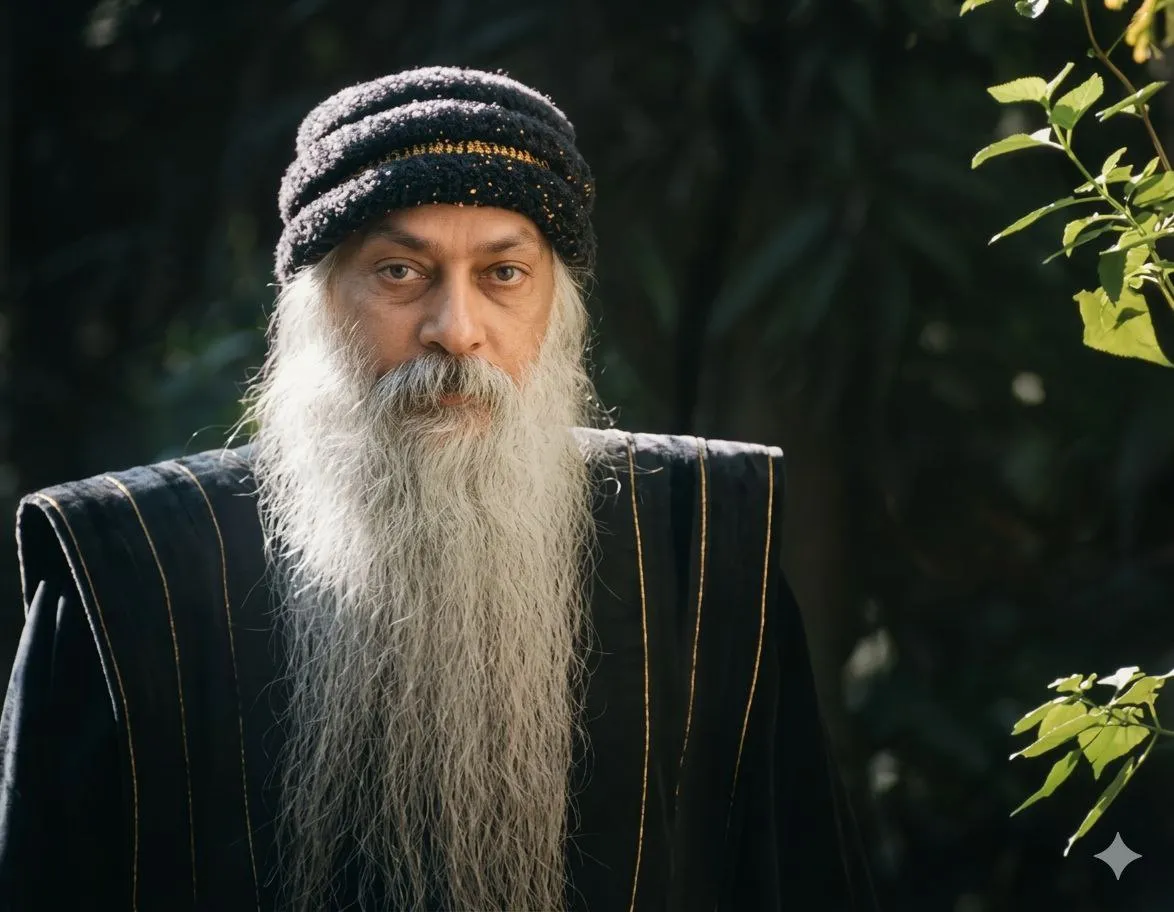
Browse an extensive collection of Osho's most profound quotes, curated semantically by topic and discourse source. Uncover transformative wisdom organized dynamically for deep contemplation.
Buddha Psychology, as envisioned by Osho, harmonizes intelligence with innocence through meditation, guiding one beyond the mind’s divisions to awaken a profound sense of wholeness, unlike contemporary psychology, which merely addresses symptoms and neglects the soul's essence.
On Guru Purnima, as the full moon graces Ashadha's night, it embodies the essence of totality and innocence, inviting us to embrace the luminous presence of the guru's wisdom; this delicate balance between metaphor and reality opens our hearts to the profound mystery of discipleship, echoing Osho's teachings on the transformative power of understanding.
In the radiant philosophy of Osho, the ‘lamp of the Name’ illuminates our inner journey, where pure awareness, when focused, dispels the shadows of ego and conditioning, unveiling the profound light of existence beyond birth and death.
In the practice of tratak, the essence lies not in the object of gaze—be it an open sky, a master’s image, or the depths of darkness—but in cultivating a profound awareness that transcends thought, inviting both expansiveness and introspection in the present moment.
Aum, embodying the essence of the seventh plane, transcends meaning with its primal sounds a‑u‑m, each devoid of concept; it serves as a pictorial symbol and an inner hum, inviting us to explore the ineffable source that lies beyond language itself.
In the tapestry of spiritual evolution, the West too boasts a lineage of mystics, where the essence of Jesus flowed for a time before yielding to new currents, illustrating how lineages ebb and flow, revealing that awakening transcends geographical boundaries.
In the realm of contemporary thought, J. Krishnamurti embodies a profound spiritual inquiry, urging seekers to cultivate choiceless awareness and personal freedom, while Osho highlights his rejection of authority as a guiding light to self-discovery and inner awakening.
In the vibrant chaos of Delhi, where the dance of power masks the essence of true governance, one finds a stage where rhetoric reigns supreme, and beneath the surface, the quest for control often eclipses the genuine pursuit of democracy, echoing Osho's insight into the illusions that bind us.
The 'goose in the bottle' koan reveals how the mind and ego create the illusion of confinement, suggesting that when we relinquish the 'I' and embrace present awareness, the truth effortlessly unfolds, as the goose has always been free.
In a transient world where nothing can be grasped, the eternal reveals itself within the fleeting moments, much like the ocean resides within its waves; by diving into each experience and surrendering to the flow, we uncover the timeless essence of existence.
Sahaja Yoga embodies the essence of being utterly natural, inviting us to flow effortlessly like air and water, embracing authenticity and acceptance over imposed ideals, as we shed resistance and judgment to return to our inherent ease.
In the tapestry of belief systems, one finds that the Christian clings to faith, the communist to ideology, while the seeker of a commune transcends mere belief through awakening, embracing the present with love, freedom, and the responsibility of direct experience.
Osho reflects on how the evolving landscape of knowledge challenges parental authority, urging a shift from outdated expectations to a reverence for the wisdom of the new generation, inviting parents to embrace learning from their children rather than clinging to a diminished self-image.
In Osho's view, true cooking transcends the kitchen, embodying an inner alchemy that reveals itself through the fragrance of experience rather than rigid recipes; it calls for eagerness, trust, and presence over mere techniques.
In the journey toward the higher bodies, a seeker finds that the conscious relish of earthly experiences anchors their essence to life; enlightened beings may choose to savor simplicity, delaying their departure to share the richness of their treasure, while beyond the fifth body, other forces effortlessly sustain their presence.
In the spirit of Osho's teachings, synchronicity emerges as the profound empathy that interlinks our essence with the universe, revealing how attunement, deep listening, and an open heart effortlessly harmonize our inner and outer worlds.
In the dance of existence, where mind and body entwine through habitual rhythms, stillness in posture can silence the mind’s relentless chatter, unveiling a serene clarity that Osho so beautifully emphasizes as the essence of true awareness.
In the spirit of Osho's teachings, the notion of 'chosen people' emerges as a political construct, for if divinity favored any, suffering would not plague them; true awakening lies in transcending this myth, embracing our universal interconnectedness across all beings.
In the dance of favor and disgrace, Osho reveals that both are mere illusions of the ego, which thrives on praise and recoils from blame; yet, when we awaken to our true essence, the chains of external validation dissolve, unveiling our inherent bliss.
In the vibrant essence of Osho's philosophy, the triumph of the new signifies a living truth and an awakened consciousness that effortlessly transcends fear and imitation, igniting hearts with a transformative fire that dismantles mediocrity and guides seekers back to their authentic source.
In the spirit of Osho's teachings, the sutra reveals that embracing the horizontal journey with full awareness dissolves the very compulsions we seek to evade, allowing for a profound vertical shift where acceptance and presence become transformative forces, freeing us from the entanglements of escape.
In the spirit of Osho's teachings, Arjuna embodies the profound human ability to embrace doubt with humility, courageously seeking higher guidance amid existential turmoil, and reflecting a receptive ignorance that values the journey of inquiry over rigid certainties.
In the spirit of Osho, a true leader within any social scheme embodies the role of a catalyst for perpetual evolution, fostering an environment where questioning prevails and even the most successful structures are dismantled to preserve the vibrant flow of life.
Nansen: The Point of Departure beautifully encapsulates the idea that true spirituality emerges when we embrace both the sacred and the secular, transforming our existence—much like Osho envisioned—by harmonizing the earthly with the divine, allowing the essence of Buddha to flourish within Zorba.
In the realm of spiritual intercourse, lovers transcend mere physicality, merging in consciousness to create a profound union; this sacred connection, exemplified by Krishna's divine conception, illuminates the transformative power of love infused with awareness, reverence, and unity.
In the essence of Osho's wisdom, the significance of life lies not in the objects we encounter but in our perception; whether we embrace the divine in all or dismiss the trivial, true freedom emerges when we engage fully with each moment, savoring love, food, and existence with unwavering presence.
Embracing the essence of misfits, sannyasins cultivate vibrant spaces—discos, ashrams, and communes—where individuality thrives and freedom reigns, inviting others to join in their joyous rebellion against a lifeless conformity.
In the dance of cause and effect, the act unfolds and concludes in an instant—like fire consuming its fuel—yet the imprint of that moment lingers, urging us to embrace awareness, healing, and transformation in the present, as Osho might reflect on the nature of existence.
The essence of true blessings unfolds not from desire or the mere presence of a master, but from the harmonious convergence of your openness and his living presence, allowing your spirit to bloom like a sunflower drawn to the sun, finding peace in silence and bliss.
A symbolic gesture transcends mere action, embodying an inner reality; Osho illustrates this through his watch glances, which, rather than reflecting a concern for time, convey compassion, much like relaxed dress codes that invite true disciples to express their authentic selves.
The journey to the inner temple unfolds not through renunciation but by embracing your authentic self, as the essence of Osho's teachings reveals that true fulfillment and bliss invite you into your innermost sanctuary, where your genuine passions become the path to spiritual connection.
In the spirit of Osho's teachings, the varna-ashrama system, often cloaked in scripture, reveals itself as a mere construct of exploiters; true spirituality transcends hierarchy, urging us to liberate ourselves from these antiquated doctrines and embrace a compassionate, egalitarian society.
In the tapestry of existence, misfortune weaves itself through unforeseen accidents that not only alter lives but also echo in the collective consciousness, revealing the delicate interplay between fate, suffering, and the laughter that lightens our burdens.
Bhang, often seen as a mere escape, pales in comparison to the divine intoxication that arises from within; true ecstasy is the nectar of the soul, beckoning us to turn inward and embrace the eternal bliss that exists in every moment.
In the state of attainment, as Osho beautifully illustrates, all seeking dissolves into a profound inner fulfillment, where desirelessness and effortless being reveal our true nature—whole, free, and complete, resting in the silence of what is.
Embracing the essence of raw eating, one might reflect on how modern humans, lacking the primal digestive fire of our ancestors, find solace in cooking as an external flame that pre-digests our food, a reminder that our dietary choices should harmonize with our inner heat and lifestyle rather than rigid ideologies.
In the light of Osho's insights, the suppression of natural desires breeds domination and guilt, often targeting women; yet, through awareness and acceptance of these desires, love flourishes without possessiveness, paving the way for true respect and equality in women's rights.
The essence of the 'Second Coming' transcends the physical return of Jesus, embodying instead the timeless arrival of Christ-consciousness—an egoless unity with the universe—awakening within each receptive soul, much like the profound realizations of Jesus and Buddha.
In the tapestry of existence, what we deem accidents are merely veiled threads of a deeper cause and effect; as Osho suggests, embracing this hidden order fosters humility and inquiry, inviting us to transcend superstition and blame.
In the intricate dance of masochism and sadism, one finds the masochist pleading for pain—Beat me, whip me—while the sadist, reveling in control, denies even that solace, revealing a profound interplay of suffering and dominion, echoing Osho's insights into the paradox of desire.
In the realm of Hollywood, where sensational gossip often masquerades as truth, Osho reminds us to transcend the noise of media projections and stray remarks, prioritizing our inner peace over fleeting fictions crafted by the press.
Embracing sexual ethics involves recognizing sex as a pure, life-affirming energy to be celebrated in love rather than constrained by law; true connection flourishes in love's presence, while mindful intimacy transforms desire into creativity and enlightenment.
Pratikraman reveals the discomfort of turning inward, as our conditioning pulls us outward towards the familiar noise of crowds and rituals; yet, in this solitary journey, akin to a death of the self, true courage emerges from embracing the unknown depths of our being.
Temptations such as greed, anger, and desire cannot be vanquished through struggle or repression; instead, true transformation arises from cultivating awareness and embracing spirituality, allowing these energies to evolve through mindful observation rather than obsession.
In the stillness of the one-hand clap, a koan unfolds, revealing that true understanding transcends the question itself, inviting us to realize that we already embody the essence of existence, where seeking dissolves into the harmony of being.
The desire to live and the Unmanifest dance as one, where the ebb of life mirrors the contraction of the Unmanifest; any illusion of cause and effect arises from the ego, for we are woven into this cosmic play, perceiving through various lenses of awareness.
In the embrace of alonement and silence, one discovers an inner joy and bliss that feels like returning home, a truth that, if genuine, endures; thus, by sharing this unconditional love, we enrich our lives and affirm that love renders all deserving.
Embracing the specter of doom serves as a profound catalyst, urging us to relinquish our attachment to tomorrow and channel our scattered energies into the vibrant now, where true awakening, transformation, and enlightenment flourish within and around us.
The public work of Indian shamans embodies a nonviolent conquest, as Eastern mysticism journeys westward to harmonize materialism and inspire inner transformation, revealing a profound spiritual science that tempers aggression and elevates wisdom over power.
In the embrace of all-pervasiveness, the ego's confines dissolve, allowing consciousness to merge with the boundless Divine; like a river surrendering to the ocean, one transcends individuality, and compassion naturally flows forth to share this profound truth with others.
Ajapa-Japa embodies a seamless flow of witnessing, where awareness transcends effort and setting; amidst life's chaos of praise and blame, one remains an unmoved observer, discovering that in presence, the journey and destination unite.
In a commune where positivity flourishes, individuals evolve into loving and responsible beings, transforming work into worship, dissolving hierarchies in gratitude, and turning arid deserts into vibrant oases—this resilience amid hostility inspires compassionate choices, creating a living testament to Osho's vision of collective harmony.
Embracing skepticism to its fullest invites us to question even our doubts, allowing them to dissolve into a pure, untainted faith; in this profound journey, the paralysis of partial skepticism transforms into a vibrant trust, paving the way for true meditation and divine experience.
In the spirit of Osho's teachings, true care flourishes as unconditional presence, free from the distortions of ideology; it nurtures authentic connection by embracing others as they are, without the chains of expectations or the shadows of control.
Gifts, when infused with consciousness rather than mere convention, become profound reminders of life's fleeting nature; as Osho suggests, a watch signifies the importance of being present, transforming each offering into a celebration that transcends the ego and elevates existence to ecstasy.
Inhibitions, as Osho insightfully reveals, are the weighty repressions of our natural energies—anger, lust, and violence—imposed by civilization, and only through the cathartic release found in meditation can we dissolve these blockages, restoring our essence and enriching our connections with others.
The essence of the 'new world' lies not in a distant utopia but in a profound shift of consciousness that anchors us in the present; when thoughts fade, a vibrant awareness reveals the eternal now, allowing living truth to flourish and compassionate action to emerge.
In the spirit of Osho's wisdom, true self-improvement flourishes not through the pursuit of results, but in the art of being fully present—whether in eating, walking, or listening—where transformation unfolds effortlessly when we release the need to measure progress.
The sacred malady of divine love manifests as a relentless ache, the Beloved’s arrow piercing the heart, inviting us to surrender our ego and immerse ourselves in the profound yearning that ultimately leads to union with the divine.
Embodying the essence of Sthita Prajna, one navigates life with unwavering wisdom, remaining acutely aware yet detached, feeling pain and pleasure without ownership, and perceiving aging and death as mere transitions of the body rather than the self.
Blessedness unfolds not through methods or the quest for answers but in the surrender of desire and the embrace of the present; in this choiceless awareness, the mind's chatter dissipates, revealing the divine that is already within us.
In the spirit of Osho, the fierce embodiments of women like Bhairavi, Chandi, Durga, and Kali emerge not from brute strength but as compassionate intelligence shaped by centuries of oppression, revealing that true healing lies in granting equality, allowing femininity to flourish without the burden of defense.
Osho reminds us that when we resist the present, we cling to illusions of enlightenment or promises of tomorrow, fostering doubt and perpetuating our own delay; true awakening blossoms only in the immediacy of now, where presence cannot be postponed.
Buddha and Christ embody the intrinsic nature within each of us, waiting to be unveiled; as Osho suggests, the journey is not about development but about peeling away societal conditioning to reveal the timeless treasure that already resides within.
True closeness transcends physical presence and rituals, blossoming instead from the heart's resonance, where love binds souls; even miles apart, we remain intimately connected, inviting our inner harmony to manifest in the world around us.
In the spirit of Osho's teachings, writing often falls short of conveying profound truths, as it transforms vibrant ideas into mere symbols on a page, lacking the immediacy and intimacy of a living exchange that truly awakens the soul.
Jazz music, when embraced with a mindful spirit, transcends mere sound to become a bridge to silence and celebration, illuminating the path to enlightenment; without awareness, its vibrant rhythms may tether us to the earthly realm.
Holistic health embodies the seamless integration of body, mind, and soul, where joy and meditation intertwine, reflecting Osho's vision of a vibrant existence that harmonizes hedonism with spirituality, celebrating the wholeness of being.
In the spirit of Osho's teachings, the fifth K, kachha, symbolizes more than mere attire within the Sikh tradition; it serves as a reminder that true wisdom arises not from external symbols but from an awakened inner consciousness that transcends superficiality.
Embracing the essence of aliveness, one must shed life-denying conditioning and guilt, joyfully affirming existence through the pure celebration of the present—singing, dancing, and loving so wholeheartedly that the self dissolves, leaving only the vibrant flow of life.
An apology often serves as a delicate dance of ego, soothing the wounds inflicted by yesterday's anger while leaving the deeper currents of resentment unaddressed; true transformation lies not in mere flattery, but in the profound understanding and transmutation of our inner turmoil.
Envy, a subtle form of jealousy, thrives on comparison and ego, diverting the seeker from their inner journey; true spiritual growth flourishes only when one relinquishes these distractions, allowing love to blossom in the silence of self-awareness.
Mourning arises from a life lived in anticipation, where death strips away the illusion of tomorrow, revealing that our tears often mourn missed opportunities for love; yet, when we embrace love fully in the present, even death can deepen our connection, transforming sadness into a profound, meditative communion with the divine essence of the other.
In the dance of existence, the seamless connection between the doer and the doing often obscures our true essence; yet, when the body moves of its own accord, a gap emerges, allowing consciousness to awaken as a witness, unveiling the profound truth of our separateness, as Osho beautifully illuminates.
When restlessness dissolves into effortless stillness, true powers emerge, revealing that authentic clarity and strength arise not from mere redirection of agitation, but from a profound inner peace that fosters genuine transformation.
Life values, ever-evolving and shaped by the passage of time, remind us that yesterday's truths may not hold today; embracing the present as sacred allows us to shed inherited burdens and adapt fluidly to change, which is the essence of a vibrant existence.
Licentiousness mirrors the mind's extreme swing between unrestrained indulgence and suppression, each feeding the other; Osho invites us to transcend this pendulum through awareness, guiding us to a balanced existence where desire is neither stifled nor mindlessly pursued.
Craving the extraordinary, like flying unaided, distracts from the essence of spirituality, tempting exploitation and turning even the most enlightened into mere tools for others; true transformation lies within, far from the allure of public spectacle.
Osho embodies the essence of disaster, serving as a radical rupture with outdated traditions, religions, and ideologies, shattering the chains that bind humanity to an insane past, thus paving the way for a freer, more enlightened consciousness to flourish.
Osho suggests that genuine disturbances in our conditioning arise only when we plunge below the mind into madness or soar above it into mysticism; all other attempts at reprogramming merely stifle the old code and maintain mediocrity, while society mislabels these profound shifts as abnormal.
In the face of an inevitable global crisis, Osho's vision reminds us that true transformation arises not from salvaging failing systems, but through nurturing awakened individuals who embrace awareness and interdependence, thereby cultivating a new consciousness for humanity.
Osho illuminates the notion that true transformation emerges not from the rigid structures of self-discipline or manipulation of the subconscious, but through an effortless, choiceless awareness that allows the natural harmony of being to unfold, revealing happiness in unity.
Osho's profound insights resonate universally, yet they encounter resistance in a world shaped by a North-South cultural divide, where the South, steeped in the magic of existence, grapples with a historical chasm that obscures the philosophical depths he invites all to explore.
Reverence, in its truest form, flourishes when it honors the living essence of truth rather than mere titles or traditions, for to proclaim oneself a saint is to overlook the profound depth of sainthood, revealing that genuine devotion lies in the fragrant qualities of humility and silence, not in hollow names.
In the spirit of Osho's teachings, cow worship transcends mere utility, honoring the cow as a spiritual predecessor that nurtured human consciousness, embodying gratitude, reverence, and a profound respect for the interconnectedness of all life.
Seers, like the timeless echoes of Osho's wisdom, are a vibrant current of consciousness, transcending logic to taste the ineffable; they breathe life into spirituality, nurturing its mystery and renewing the essence of religion beyond mere doctrine.
In the spirit of Osho's teachings, the 'twenty-four' symbolizes not a mystical threshold but a sociological barricade; when a supreme genius like Mahavira emerges, followers, fearing the chaos of innovation, confine the truth, opting for the safety of order over the liberating potential of continual evolution.
In the embrace of shared silence and mutual openness, the essence of the mystery school unfolds, allowing the crowd to merge into a singular consciousness; as Osho speaks directly to each soul, the depth of connection mirrors the openness within.
Makkhali Goshalak, a visionary seer beyond the confines of doctrine, embraced the profound mystery of life, urging us to cast aside futile questions and their anxieties; in his radical agnosticism, he invites a direct, humble perception that transcends the certainties of both theist and atheist alike.
In the spirit of Osho, Gnosticism emerges as an intimate journey of self-discovery that transcends beliefs, fostering a profound inner awareness that naturally cultivates anarchy—where true freedom flourishes, and the need for external authority fades away.
In the spirit of Osho, the Socratic Method finds its place among the blind, relying on logic and debate, yet true enlightenment transcends words, flourishing in silence and spontaneous insight, where experiential realization eclipses mere argument.
Embracing Osho's wisdom, one finds that the struggles of life stem from our desire to control and predict; by surrendering to the flow and serving existence without attachment, we discover that true fulfillment arises effortlessly, revealing that difficulty is merely a construct of the mind.
In the spirit of Osho, suchness embodies a profound, unconditional acceptance of reality as it unfolds—embracing every moment, from blindness to sight, as a catalyst for awakening, ultimately dissolving resistance and inviting healing, silence, and peace.
Inner turmoil drives individuals to seek validation through manipulation, as the longing for significance can overshadow the pain of deception; only in the embrace of wholeness and awareness can one transcend this need, liberating the spirit from the chains of counterfeit love.
In the essence of Osho's teachings, the inquiry into 'Who knows non-being?' reveals its own futility, for the act of questioning presupposes a knower, suggesting that true non-being transcends all experience and remains beyond the grasp of the observing self.
In the essence of Osho's wisdom, the realization of the Eternal transcends time, a shared knowing as constant as the sun, while its fragile expression dances like a rainbow, relying on the harmony between the awakened speaker and the receptive listener.
Dharma battles, as Osho might suggest, unfold as playful confrontations among enlightened souls, not to conquer but to ignite awakening in observers, using absurdity and paradox to transcend ordinary thought and spark profound, wordless insights.
In the spirit of Osho, Freud's insights become tools for liberation rather than rigid doctrines, as he wields them to dismantle attachments to identity and knowledge, ultimately guiding us toward awakening rather than mere accuracy.
Remorse, Osho might suggest, drains the vitality of the present; what’s past is merely a stepping stone to wisdom, urging us to embrace our missteps as essential to growth, harvest their lessons, and move forward with renewed clarity and purpose.
Ownership reveals itself as an illusion crafted by the ego, for we are merely temporary custodians of fleeting things, bodies, and relationships; true treasure lies in embracing presence and celebrating what flows through us, freeing ourselves from the chains of possessiveness.
One tap — creates your free account, or signs you back in.
Already have an account? Login here
New here? Create a free account
Enter your account email and we'll send you a link to choose a new password.
Remembered it? Back to login