
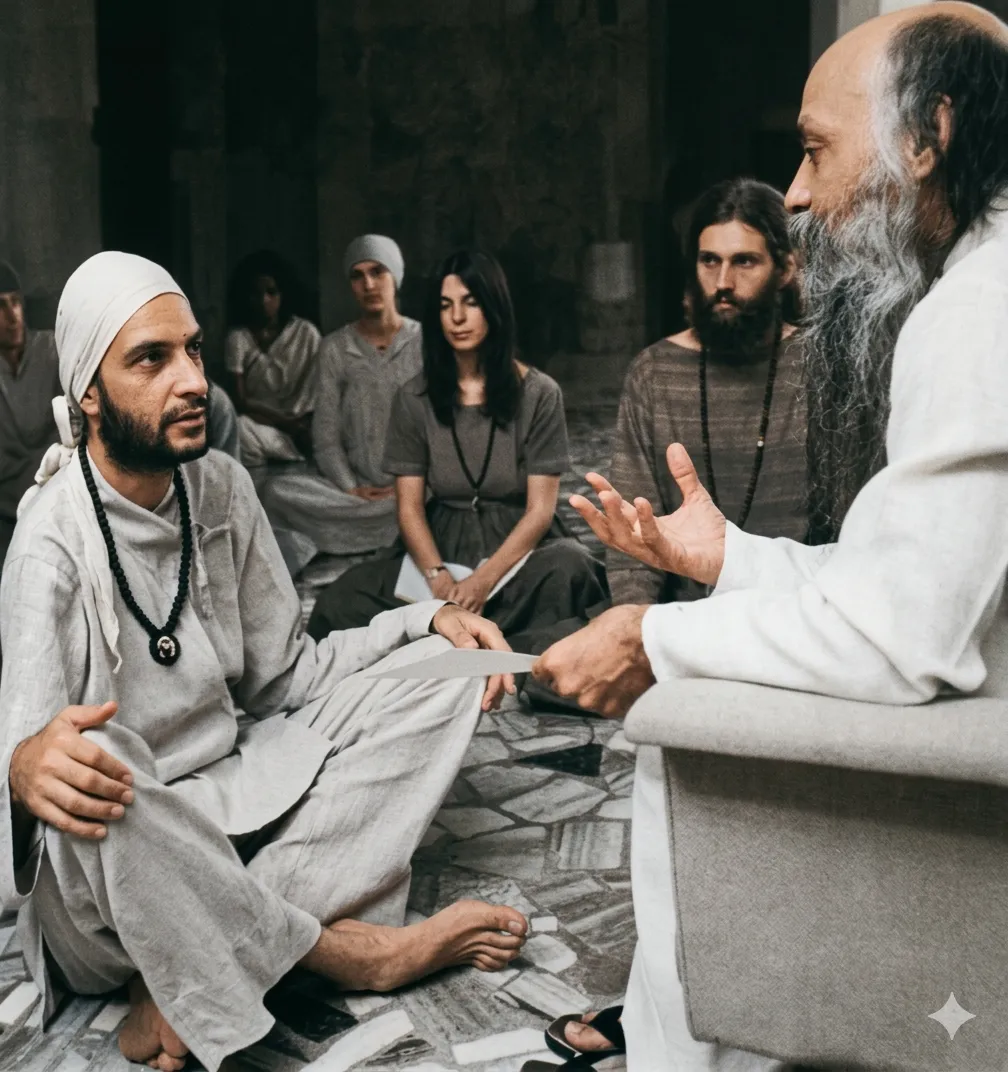
According to Osho, taking refuge in one—Krishna’s call to surrender—works in any age only for those with a true disciple’s attitude and capacity to learn; it fails for the ego-bound. Satya or Kali is your inner state, not time. Be totally receptive and trusting (lived, not verbal belief), or honestly walk alone—avoid halfhearted, two-boat dishonesty.
It still works if you’re humble and ready to learn; if you cling to ego and mere beliefs, it won’t.
From the Discourses
Passages where Osho speaks to this question — each links to the complete discourse.
A friend has asked: “Krishna once said, mam ekam sharanam vraja—‘take refuge in me alone.’ If someone were to say this today, would it still be effective or not?”
Then why take sannyas from me? What difficulty is there in making someone guru? And if there is difficulty, why take sannyas? Give sannyas to yourself. Who can stop you? But then the inner emptiness becomes visible, the ignorance becomes visible; to fill it, we want to learn from someone—and yet not admit we learned from someone. No harm—no master is attached to your acknowledgment that you learned from him. But the one who isn’t ready for acknowledgment cannot learn at all. That is the obstacle. This is why Krishnamurti’s attraction becomes so precious—he suits our dishonesty. The total reason for Krishnamurti’s attraction is that he fits our dishonesty. Krishnamurti says: “I am not your guru; I don’t teach you.” He also says what I’m saying isn’t teaching, it’s dialogue. “You’re not the listener and I the speaker; there is a dialogue between us.” So people have been listening to…
Mahavira’s sutra is: I accept refuge in the Arihant. From this there can be no return. It is the point of no return. There is no way to go back from here. It is a total, a whole leap. “I go to refuge”—there, time will still intervene, it will still take time to reach refuge. Time will be spent in between. And one who says today, “I go to refuge,” who knows after how many births he will actually arrive. It will depend on each one’s speed, and on each one’s mind. But the beauty of the “pavvajjami” formula is that it is a sudden jump. Thereafter, time no longer intervenes—“I accept.” And one who has accepted refuge has instantly disowned himself. These two cannot coexist. If you accept yourself, you cannot accept refuge. If you accept refuge, you will disown yourself—you will have to.
Philosophically there is no difficulty in denying God—but then how will you create the feeling of surrender in the seeker? Whether God is or is not is not what is valuable. There is no need to prove He is. Buddha said there is no God. But then a snag arose: how to bring about surrender? For that, new formulas had to be found. And those formulas ended up the same; nothing really changed. So the Buddhist monk says, Buddham sharanam gacchhami, sangham sharanam gacchhami, dhammam sharanam gacchhami—“I go for refuge to the Buddha, to the Sangha, to the Dharma.” There is no escaping “I go for refuge”! Buddha says there is no God. But the seeker of Buddha has to call Buddha “God” in effect. And Buddha does not refuse saying, “Do not call me God,” because Buddha clearly sees the difficulty.
But man’s cunning knows no end. A very strange thing I have observed: if you tell someone, Surrender to this person, he says, To this person? There are so many faults in him! Or you say, Surrender to that one — the ego is pricked: I — surrender to him? He too is a man of flesh and bone. He feels hunger, so he must feel anger too. He sleeps, so lust must also trouble him. Somewhere he must be hiding it. And I — to him! I too am such a man. Even if Buddha stands before you — the same difficulty arises. If Krishna stands — the same difficulty. And if no one stands there, the cunning mind says: To whom should I surrender? None is visible! To save man from this dishonesty, the very wise created images of God. The murti was a middle device.
Osho, how can we believe that the soul exists after death and transmigrates to another form of life, or dissolves into the universe?
Both together can come out of the fire; there is no problem at all. But remember, the intellect has to accept the heart above its shoulders. It has to. The heart has no legs, only eyes, and intellect has to listen to the heart and follow its directions. In the hands of the heart the intellect becomes intelligent. It is a transformation, a total transformation of energy. Then the person does not become an intellectual, he simply becomes wise. Wisdom comes through the meeting of the heart and the intellect. And once you have learned the art of how to create a synchronicity between your heartbeats and the workings of your intellect, you have the whole secret in your hands, the master key to open all the mysteries. I could have taught you doubt, but that would have changed you into intellectuals. I would have defeated my purpose and I…