
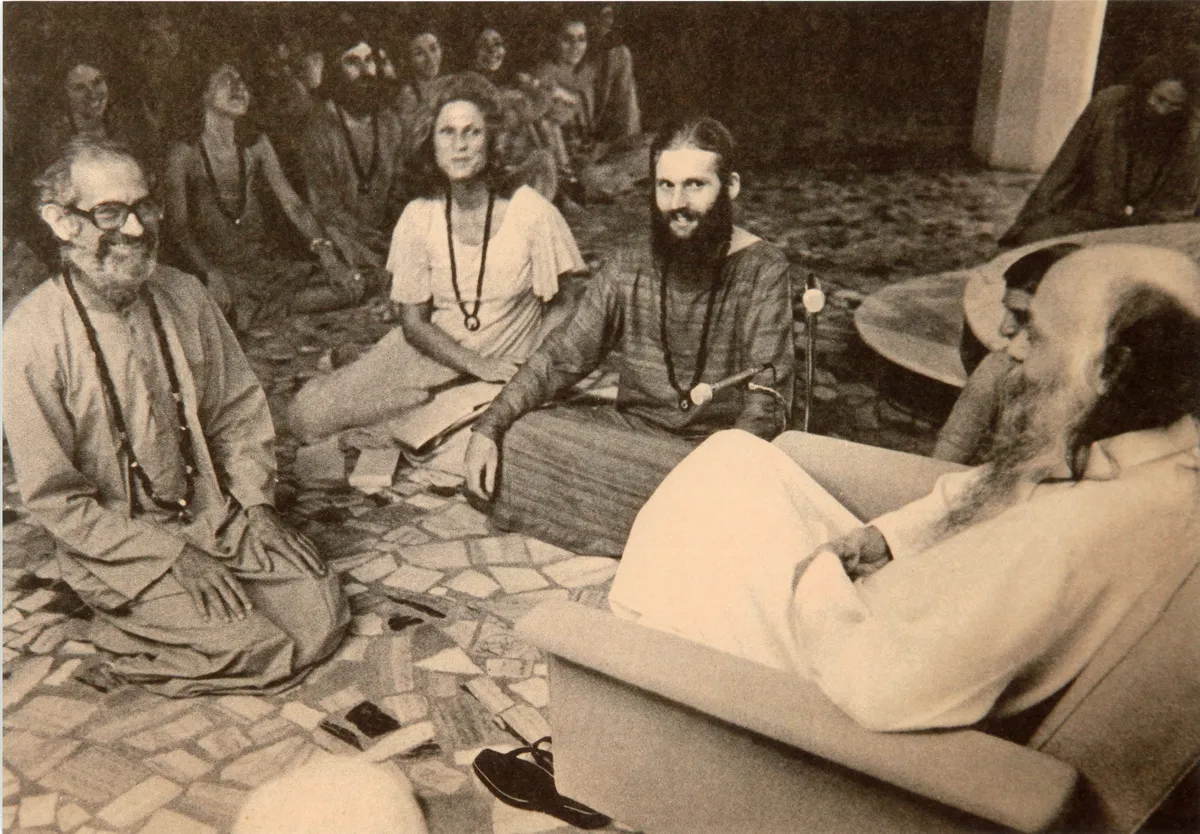
You feel safe because his calm helps you forget your noisy “me,” and then life’s natural peace holds you.
From the Discourses
Passages where Osho speaks to this question — each links to the complete discourse.
Beloved Osho, some people came to know that rama is the only refuge by arriving there, but we start feeling this just by looking at you. Why is this so?
Yes, you can feel this provided you look -- but who looks? In order to look, a different kind of eyes is needed. There are times when, without your knowing, such eyes appear on their own; there are times when, without your knowing, you forget yourself. In those moments when you are absent, when you are not, the curtain in front of your eyes disappears. In those moments you catch a glimpse. Seeing happens when there is no seer inside, because the seer is continuously distorting the vision. He has his biases, his theories, his concepts and so on. He is constantly disturbing the seeing, saying: "Look in this way," "See this," or "What you are seeing cannot be." The seer inside does not allow you to see. But sometimes the seer moves aside. This happens unaware, without your knowing. If you knew, you would not let it move aside;…
Osho, someone, on arriving, came to know: “There is no shelter without Ram.” But just by looking at you we start feeling the same. Why?
It can be felt—if you truly see. But who is it that sees? To see, a different kind of eyes is needed. At times, in unguarded moments, those eyes come to you unawares. Unknowingly, sometimes you forget yourself. Sometimes you get lost. And when you are not, the curtain over the eyes lifts. In that instant, a glimpse is possible. To see means that the one who sees is not standing inside. Then vision happens, because the inner seer keeps obstructing the eyes all the time—his biases, his beliefs, his theories. He goes on interfering: “Look this way. Look at this. What you are seeing cannot be.” That inner onlooker does not let seeing happen. Sometimes he slips aside. Without your knowing, you don’t even notice when he moved. If you became aware, he wouldn’t be able to move—you would hold on to him. Sometimes, while you are listening to…
Beloved Osho, for a fortnight now and from different dimensions you have been expanding for us that rama is the only refuge, there is nowhere to go but in, and we are deeply grateful to you. Finally, we beg you once again to explain to us some more in order that we can remain wakeful to the distinction between the essential and the nonessential, and our experience of "rama is the only refuge" remains deep and undeterred in us.
The understanding of the essential from the nonessential is the greatest treasure, but the mind will never be able to make this distinction. The mind itself is nonessential and that is the difficulty. So whatever your mind tells you is essential, you can be sure that it is nonessential. Don't listen to the mind! To not listen to the mind is the greatest asceticism for the seeker. And whether you ask for it or not, whether you listen to it or not, the mind goes on giving you advice. The mind goes on and on repeating whatever it chooses, whatever it wants, and the trouble is that because of its sheer repetitiveness you listen to it. You are not so wakeful that you can avoid listening to that which is constantly repeated. If someone goes on and on offering you advice and counsel, that counsel eventually becomes your own. And…
Osho, for a fortnight, and from many angles, you have helped us see that “there is no refuge without Ram.” We are deeply grateful. In the end, we request once more: please help our discrimination between the essential and the non-essential awaken, and help our living certainty of “there is no refuge without Ram” become deep and unshakable.
So too with all the senses. The eyes gradually lose their relish for form and delight in the formless. Beauty for the eyes will no longer be in form; the body will be felt as a hindrance to beauty. If you could truly see a person, you would find: no matter how beautiful the body, it reduces beauty—for a body, however beautiful, cannot be truly beautiful. The body obstructs beauty. Beauty is perfect only when there is no body—then nothing remains to intrude. In China the sages say: when music is complete, the musician breaks his veena—because then even the veena becomes a hindrance. When the sculptor becomes truly consummate, he throws away the chisel—because whatever is made with a chisel cannot be beautiful in the ultimate sense. The formless cannot be made with a chisel; only form can. However beautiful the form, it will remain incomplete—open to improvement. The…
Osho! You were just here, you were just here. The fragrance of your breath is in these breezes. The whisper of your lovely footsteps is in the air. The earth and sky that beheld you… you were just here, you were just here. When I saw you, my breath simply stopped, my Master! These eyes would not lower. The moment I came to my senses, where did you hide? You were just here, you were just here.
Meera! If you want to know the divine, to attain it, you must sustain a very paradoxical kind of awareness. Paradoxical because from one side it is awareness, and from the other it is a kind of unawareness too—an ecstasy, a divine drunkenness that is not stupor but awakening; in which within, a lamp of meditation is lit, a flame of alertness burns. Love knows this art of paradox. Love is the key that opens the lock on that door. Love knows how to sway and yet remain centered within. Love knows how to close the eyes and still come to vision. Love knows how to move not even an inch, and yet complete a journey of a thousand miles. Reason will not grasp it. For thought it is inaccessible. But for love it is natural and easy. What is needed is an awareness colored by ecstasy; and an ecstasy…