
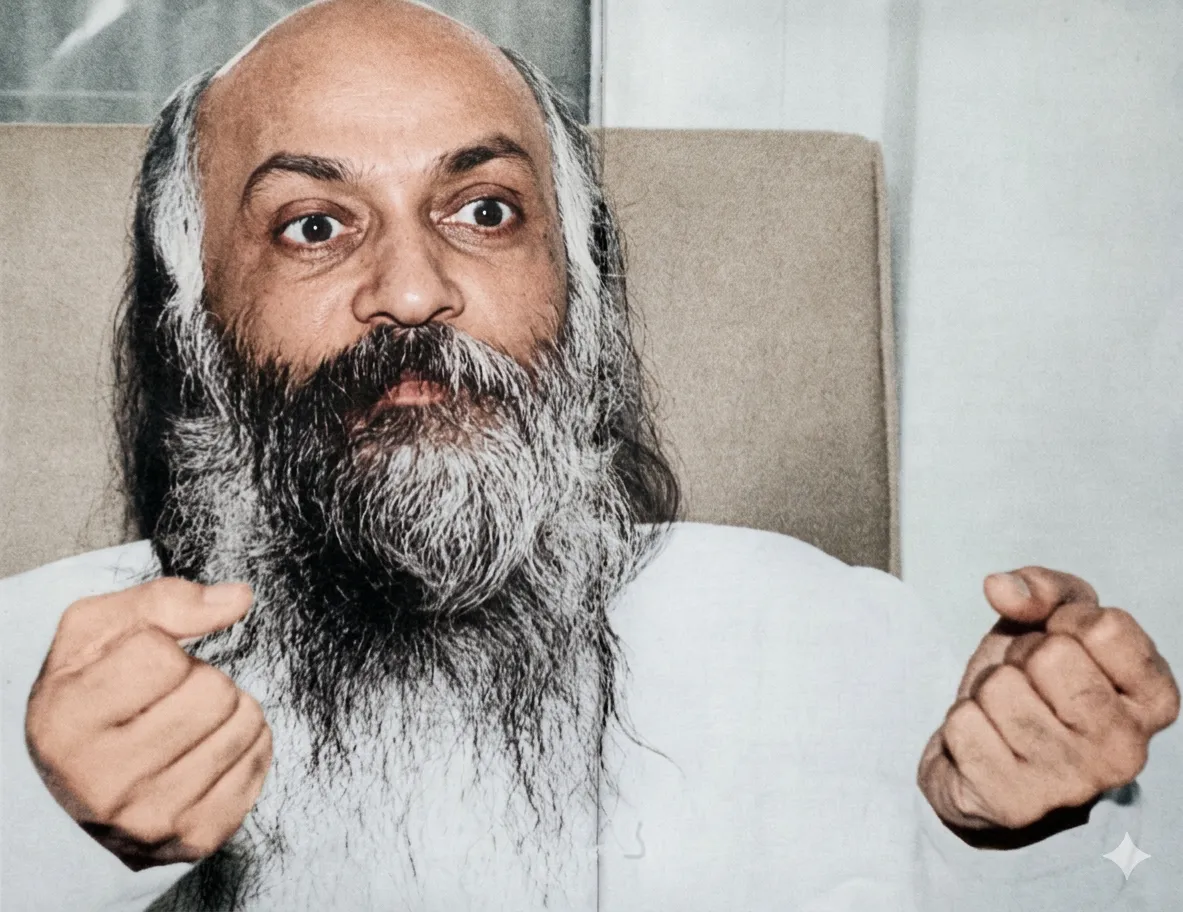
According to Osho, meditation needs no 'why'—it is an end in itself, like love or health. It is being established in your own being, a joyous, causeless fragrance. Meditation is love for the Whole, where the ego dissolves like a salt doll in the ocean. Don’t debate its utility; dive in and let the meditator disappear.
Meditate not to get something, but to be whole inside and melt into life itself.
From the Discourses
Passages where Osho speaks to this question — each links to the complete discourse.
Question: First question: Osho, why should I meditate? Divakar Bharti! In life there are some things that are not means but ends. And there are many things that are means, not ends. One may ask, “Why should I earn money?” One cannot ask, “Why should I meditate?” Because money is a means—the “why” can be answered. Ramakrishna tells this story again and again: two dolls of salt, seeing the crowd, had come to the fair. They heard the debate. They said: Wait! We’ll go and find out. How else will it be settled? Sitting on the bank, how will you measure the ocean’s depth? We’ll go, we’ll take a plunge, and we’ll be right back! The two salt dolls plunged in. The people waited—and waited. The fair ran for months—then it dispersed—people went home. The dolls did not return. They could not return.
Why meditate? Why seek?
I DON'T SAY that you should meditate, I don't insist that you should meditate. It is you who are seeking it. And you have to seek it. It is just like a man who is ill and asks, "Why take medicine?" Because you are ill, that's why. If you are not ill, then there is no need. Why seek health? There is no need if you are healthy. But if you are not healthy; then you have to seek health. Meditation is not meaningful for a Buddha, for one who has attained the wholeness of his being. Meditation is a medicine; it has to be thrown. Unless you become capable of throwing your meditation, you are not healthy. So remember, meditation is not something to be carried forever and ever. The day will come when the meditation has worked and it is no longer needed. Then, you can forget it.…
Osho, what is the first experience of samadhi like?
You will know only when it happens. It cannot be said; at most a few hints can be given. It is as if, in the dark, a lamp is suddenly lit. Or as if a dying patient, right at the edge of death, suddenly finds a medicine that works; life’s wave, life’s thrill spreads again—so it is. As if a corpse becomes alive—such is the first experience of samadhi. It is the taste of nectar. The experience of the ultimate music. But it will be only when it happens; and only then will you understand. You will not understand by my saying it. It is as with love. How can anyone explain it? To someone who has never loved, never known love, no matter how many explanations you offer—he will hear it all and still ask, “I haven’t understood; please explain a little more.” It is like explaining light to…
Osho, what is the goal of meditation?
Even Ananda, Buddha's closest disciple, asked one day when they were walking through a forest. It was autumn and leaves were falling from the trees and the whole forest was full of dry leaves and the wind was blowing those dry leaves about and there was a great sound of dry leaves moving here and there. They were passing through the forest and Ananda asked Buddha, "Bhagwan, one question persists. I have been repressing it, but I cannot repress it anymore. And today we are alone; the other followers have been left behind so nobody will know that I have asked you. I don't want to ask it before others. My question is: Are you telling us all that you have discovered or are you still hiding something? -- because what you are telling us does not clarify your bliss, your peace. It seems you are hiding something. " And…
Meditation gives you unbounded space. It makes you as vast as the ocean. Without it one is only a dewdrop, confined into a very small space, imprisoned. And that's our misery, that wherever we try to move there is a limitation. The body limits us, the mind limits us, even the heart limits us. One has to go beyond the body, beyond the mind, beyond the heart. Only then, these three concentric circles transcended, you become as vast as existence itself. You are no more in that vastness. You cannot be the way you have always been; there is no ego. The ego can exist only in the dewdrop. The ocean means egolessness. The moment you are infinite, you taste the truth for the first time; otherwise whatsoever we go on thinking about truth is not truth. Thinking about truth can never be truth.