
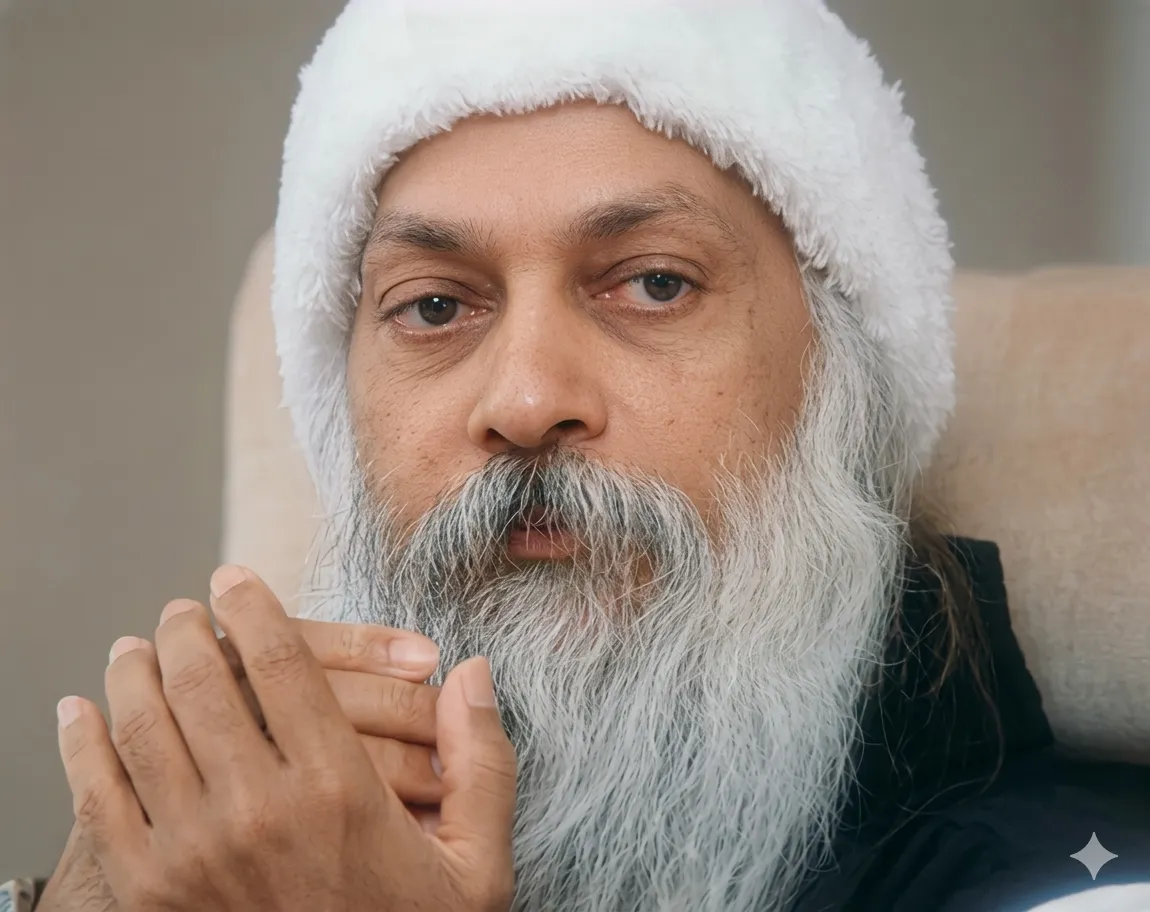
Paying a little shows you truly care, like trading some of your time for something special, and it keeps only the really interested people in the room.
From the Discourses
Passages where Osho speaks to this question — each links to the complete discourse.
Why must everybody who wants to do meditation or hear the lecture pay for this?
I am also not interested in the mob, in the crowd. I am not interested in casual visitors, I am interested only in the few sincere seekers. They have to show their mettle. And, the money that you have to pay is just the beginning. It is just the alpha; by and by I will persuade you to pay with your life. Unless you have that much courage, nothing is going to happen. Religion is not cheap, certainly not free. But the Indian mind is very money-minded: they talk about being religious but they are very money-minded people. Their whole outlook about things is money. No westerner has ever asked this; they understand: the ashram has to be maintained, the place has to be ready for you, some musician has to prepare for the music, somebody has to conduct the meditation, the gardens have to be looked after, the buildings…
A Jain friend from Ludhiana has asked: “No enlightened person ever charged a fee for his discourses, did they?”
So Gurdjieff’s book—one thousand pages long—had a hundred pages of preface cut open, and the remaining nine hundred pages were uncut. He would say, “Take it. Read the first hundred pages. If they don’t suit you, return the book and take back your thousand rupees. If they do, only then cut the remaining pages; otherwise don’t cut them. If you cut them, I won’t take the book back.” But those hundred pages were so extraordinary that it was hard for a man to stop without cutting further. Still, he had made it clear: “Read a hundred pages for free. Then don’t cut further—return the book and take your money back.” You have listened for a day. If it doesn’t click, if five or ten rupees are so dear to you—save your money and run back to Ludhiana. What are you doing here? Why are you wasting time? But these small,…
Beloved Osho, in his book "the fourth way", ouspensky says, "in the work, the first condition is understanding what one wants to gain and how much one is prepared to pay for it, because one has to pay for everything." in the marketplace we accept that nothing is free; yet as far as the non-material things are concerned, like love, happiness, meditativeness, we tend to think this law does not apply. We seem to take them for granted, as if they are our due -- things that life owes us, because we have been good enough to grace existence with our presence. Would you please comment?
She said, "That is absolutely true. You can see, all my things are with me. I am also amazed about what has happened. Perhaps he forgot or something, that's why he has not returned them." Those things were never returned, and when the woman asked, "I had given them because of my friend's assurance that they will be returned tomorrow morning, but three days have passed. The teaching has started, but I cannot concentrate on the teaching; my whole mind is thinking about my money and my diamonds and my ornaments, because that was all that I had." Gurdjieff said, "The first woman's things were returned because she offered them with love and trust. Yours will not be returned because you offered them with the idea that they will be returned -- and first you made sure of it by asking your friend. You have not given out of trust…
Is there anything I can give you back?
Then you don't understand my concept of Bhagwan. My concept of Bhagwan is not that a Bhagwan is a special being, that a Bhagwan is a perfect being, that a Bhagwan is not of this world. My concept of Bhagwan is that God is a normal quality of existence. Just by being, you are God. You are not a painter by just being. For painting, you will have to learn some skill, you will have to go to an art school. And then too your being a painter will depend on so many recognitions -- people will recognize, may not recognize; the critics will appreciate, may not appreciate; a thousand and one things. If you want to be a musician, just by being, you are not a musician. You will have to learn; this is something which has to be learned. When I say God, I mean you ARE God,…
When the morning sun is rising, when a beautiful dawn is spreading, the east blushing, the sky singing in colors—you will not look. What value has it? I said to that friend who went with me to the exhibition: Do you ever watch the sunrise? There is no label there; you will be in great difficulty. Without a price, what is there to see? Do you ever look at the night sky jeweled with stars and its mysteries? There is no price-tag there; how will you look? He said to me—an honest man he is—On the way home you reminded me rightly. I have never seen the morning, and I have never seen the night. Perhaps that is why I look only at those things that have a price. There, no price can be set… Practice, then, to see the priceless. Even here—there is no price.