
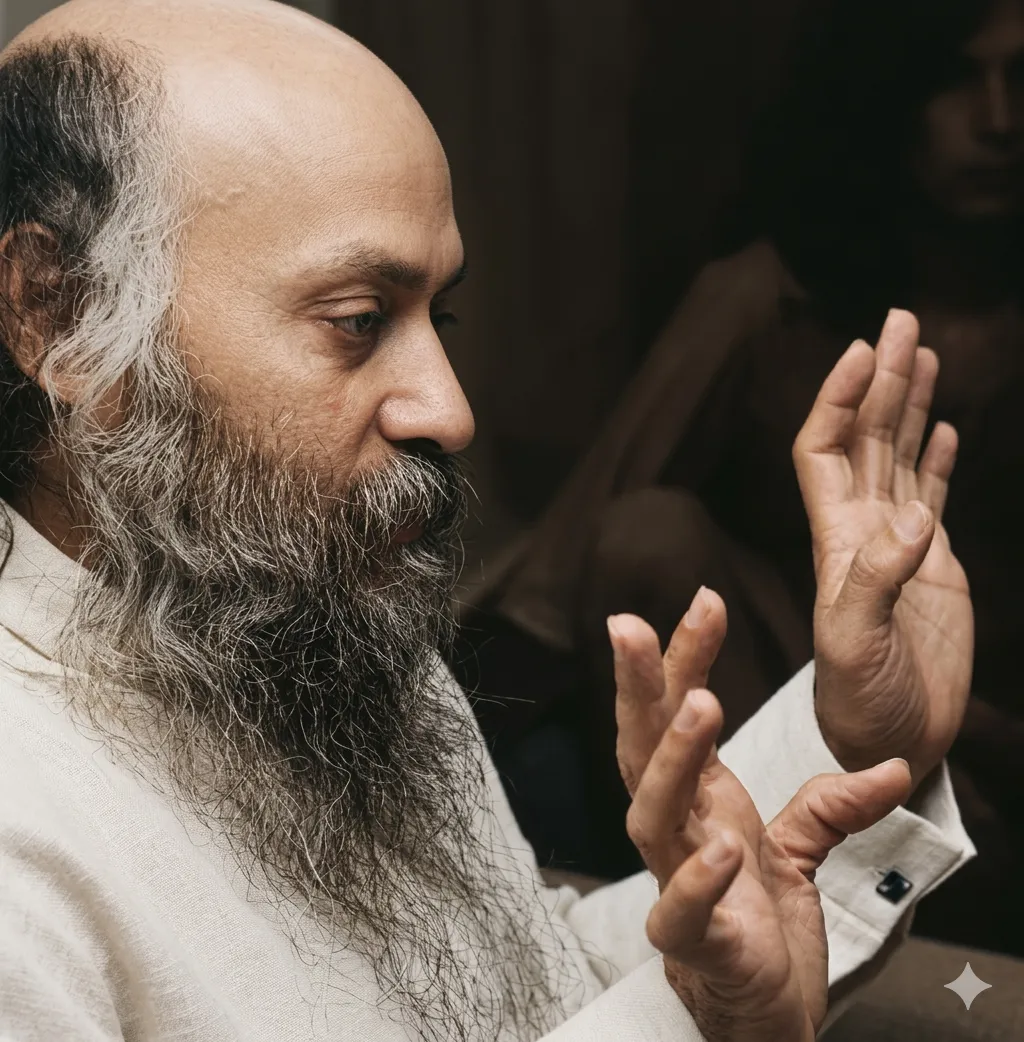
The empty, quiet awareness behind everything lasts forever, while shapes, thoughts, and words come and go—so trust the silent space more than the passing noise.
From the Discourses
Passages where Osho speaks to this question — each links to the complete discourse.
Beloved master, why, despite appearances, is the void more tangible than the form, consciousness more than thought, silence more than the word?
Deva Bruce, the void is the source of all forms. The void is eternal, forms are temporary. Forms are like ripples in the lake, the void is the lake itself. Forms come and go, the void remains. Forms are only appearances, the void is the reality. Hence Buddha calls reality SHUNYA. Shunya means the ultimate void. Yes, it is far more tangible than your so-called real things, because these real things come from the void and will go back down to the void. The void is the source and the goal. Everything comes out of nothingness and disappears back into nothingness. Hence, remember, nothingness does not mean that it is nothing; nothingness simply means that it is all. Nothingness means "no-thingness." Things are forms; nothingness is a formless energy. It can manifest in millions of forms, and it can only manifest in millions of forms because it has no form…
Here, o sariputra, form is emptiness and the very emptiness is form; emptiness does not differ from form, form does not differ from emptiness; whatever is form, that is emptiness, whatever is emptiness, that is form; the same is true of feelings, perceptions, impulses, and consciousness. Here, o sariputra, all dharmas are marked with emptiness;
Buddha says nothing is ever defiled and nothing is ever immaculate. Purity, impurity, are mind attitudes. Can you tell about a tree whether it is moral or immoral? Can you say about an animal that he's a sinner or a saint? Try to see this ultimate vision: there is no sinner, no saint, nothing moral, nothing immoral. In this acceptance, where is the possibility of worrying? There is nothing to improve either! And there is no goal, because there is no value. This journey is a journey without any goal. It is a pure journey; it is a play, a leela. And there is nobody behind it, doing it. All is happening, and there is nobody doing it. If the doer is there then the problem arises -- then pray to the doer, then persuade the doer, then become friends with the doer. Then you will be benefitted, and those…
A friend has asked: Osho, it is said that not even a leaf moves without God’s will. If that is true, then our whole life runs according to His will. Then the good and bad thoughts that arise in us, the good and bad actions that happen—are they also according to His will?! Then what is the purpose of sadhana? What meaning is there in changing oneself?
If this point truly lands, then sadhana has no further purpose. Sadhana has begun. If only this much occurs to you—that whatever is being done, God is doing it—then my sense of doership is finished. All of sadhana is only this: that my ego dissolve. Then He is doing the good, He is doing the bad. Then there is no question of good and bad at all. He is doing it—both are His doing. He gives suffering; He gives joy. Birth is His, death is His. Bondage His, liberation His. Then there is no question of me. There is no need for me to come in between. Then there is no need for sadhana—because sadhana has happened; it has begun. This very understanding becomes the supreme sadhana. This very insight cuts the root of life’s disease. For the whole disease is the ego, the notion that “I am doing.” This…
एक मित्र ने पूछा है कि ओशो, ऐसा कहा जाता है कि भगवान की इच्छा के बिना पत्ता भी नहीं हिलता। यदि यह बात सच है, तो हमारा सारा जीवन उनकी इच्छा के अनुसार ही चलता है। तो फिर हमें जो भले-बुरे विचार आते हैं, अच्छे-बुरे काम बनते हैं, वह भी उनकी ही इच्छा के अनुसार होता है! फिर तो साधना का भी क्या प्रयोजन है? फिर तो स्वयं को बदलने का भी क्या अर्थ है?
… अगर इतनी ही बात खयाल में आ जाए कि जो भी कर रहा है, वह भगवान कर रहा है, तो मेरा कर्तापन समाप्त हो गया। सारी साधना इतनी ही है कि मेरा अहंकार समाप्त हो जाए। फिर अच्छा भी वही कर रहा है, बुरा भी वही कर रहा है। फिर अच्छे-बुरे का कोई सवाल ही नहीं रहा। वही कर रहा है, दोनों वही कर रहा है। दुख वही दे रहा है, सुख वही दे रहा है। जन्म उसका, मृत्यु उसकी। बंधन उसका, मुक्ति उसकी। फिर मेरा कोई सवाल न रहा। मुझे बीच में आने की कोई जरूरत न रही। फिर साधना की कोई भी जरूरत नहीं है। क्योंकि साधना हो गई। शुरू हो गई। यह विचार ही परम साधना बन जाएगा। …
We are not the body and we are not the mind either. Mind is also part of the body. The visible part is called body, the invisible part is called mind. It is a psychosomatic mechanism and we are the witness of it. We are in it but we are not it. This is the greatest experience. Once it has happened your life goes through a radical change. Then you are never the same again. It is a breakthrough. The whole effort here is to bring this breakthrough closer and closer. Every support, every technique and device is provided for this breakthrough so that you can see yourself as a witness of it all, as pure consciousness. To know oneself as pure consciousness is to be free of all bondage. It is to be free of birth and death, it is to be free of time.