
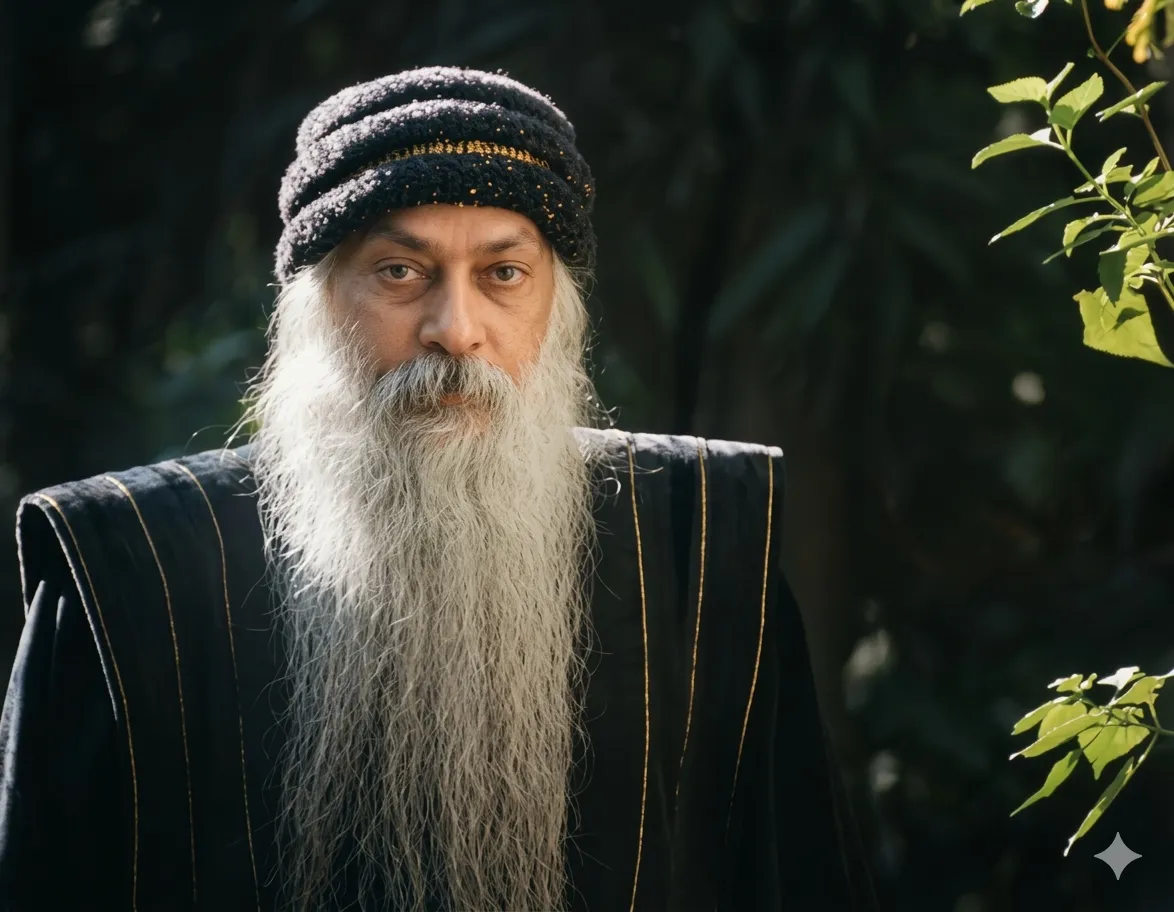
It’s like trying to explain the taste of sugar—you only know by tasting, not by talking.
From the Discourses
Passages where Osho speaks to this question — each links to the complete discourse.
Question: First question: Osho, why is the divine called ineffable? Everything in life is ineffable. The divine is the totality of life. When every single thing in life is ineffable, then the sum of all will be supremely ineffable. Can you define love? Someone may ask, “What is love?” And it is not that you have not known love. Perhaps the monsoon hasn’t poured, but a drizzle has surely touched you. In some way, by some door, a little taste of love has been felt. You must have known a friend’s love, a husband’s, a wife’s, a son’s, a mother’s, a father’s. From somewhere or other a ray of love must have descended, for without a ray of love no one can live. There has been a recognition, a small window has opened. But if someone asks, “What is love?” you will be struck dumb. What will you say?
तुम प्रेम का निर्वचन कर सकते हो, कोई पूछे प्रेम क्या है? और ऐसा भी नहीं है कि तुमने प्रेम न जाना हो। न बरसी हो वर्षा, बूंदाबांदी जरूर हुई होगी। किसी-न-किसी ढंग, किसी-न-किसी द्वार से प्रेम की थोड़ी अनुभूति हुई होगी। मित्र का प्रेम जाना होगा, पति का, पत्नी का, बेटे का, मां का, पिता का। कहीं-न-कहीं से प्रेम की कोई किरण उतरी ही होगी, क्योंकि बिना प्रेम की किरण के तो कोई जी ही नहीं सकता। पहचान हुई होगी, झरोखा खुला होगा। पर अगर कोई पूछे प्रेम क्या है, तो एकदम अवाक रह जाओगे न, क्या कहोगे?
Why is god said to be indescribable?
Those who know talk about methods how god can be known. Those who don't know try to prove god, they offer proofs saying, "Here, this is the proof. God exists this way. He has one thousand hands or four hands or three heads." All these are foolish statements. His hands cannot be measured in a thousand hands. Three heads will not be enough because all heads are his, and all hands are his. And not only hands that exist today. Hands that do not yet exist are also his. Those that exist today are his, and those that exist in the infinite future are also his. How can it be expressed in a thousand hands? And not only man's hands are his, the hands of birds and animals are his too. Branches of trees, these hands of trees are also his. Everything is his. How can this vastness fit in…
Osho, why can the Supreme Beloved not be defined? If something can be experienced, why can it not be expressed?
We could conduct this experiment with a child: the child is born and we remove all the fibers that sense sweetness—plastic surgery, excise them, peel the tongue. Then tell him, “The sugar drop is sweet.” He will say, “Say something more; this doesn’t help. What do you mean by sweet? What does ‘sweet’ mean?” You too would be baffled: what is there to explain about “sweet”? “Sweet is sweet!” He will say, “That solves nothing—that’s mere repetition. ‘Sweet is sweet’—what did that clarify? Please explain.” How will you explain? No; there are experiences, and yet they cannot be defined. And those experiences that can be defined only mean this much: they are common experiences—everyone shares them. But the experience of the divine is supremely uncommon. It happens, once in a great while, to a rare individual. Understand the plight of that rare one. He has known—now how to tell you?…
पांचवां प्रश्न: ओशो, उस परमप्रिय का निर्वचन क्यों नहीं हो सकता है? जिसका अनुभव हो सकता है, उसका निर्वचन क्यों नहीं?
नहीं; अनुभव होते हैं और फिर भी निर्वचन नहीं हो पाता। और जिन अनुभवों का निर्वचन हो जाता है, उसका केवल इतना ही अर्थ है कि वे सामान्य अनुभव हैं, सभी को उनका अनुभव हो रहा है। लेकिन परमात्मा का अनुभव तो बड़ा असामान्य अनुभव है। कभी-कभार इक्के-दुक्के विरले व्यक्ति को होता है। उस विरले व्यक्ति की मुसीबत समझो। उसने जान लिया। लेकिन अब तुमसे कैसे कहे? गूंगे केरी सरकरा! बिलकुल गूंगा हो जाता है वैसा आदमी। और ऐसा भी नहीं है कि नहीं बोलता।
Osho, what is the definition of God?
Words are very small. If you say God is light, then what of darkness? The scriptures have said that God is light. Suppose we accept this as a definition—then what about darkness? Where will darkness go? Darkness is too; in fact it is far more than light. Light sometimes is and sometimes is not; darkness is always, eternal. Where will you place darkness? If you say God is light, darkness is left out. If you say God is darkness, then light is left out. If you say God is both darkness and light, a contradiction arises: they cannot be together. Try to have both darkness and light in the same room. If you bring in light, darkness disappears; if you preserve darkness, you cannot have light. Then how can both be together? That becomes an impossibility. So you cannot say “both” either. Then the fourth device is to say: it…
पहला प्रश्न: ओशो, परमात्मा की परिभाषा क्या है?
शब्द तो बड़े छोटे-छोटे हैं। अगर कहो परमात्मा प्रकाश है, तो फिर अंधेरे का क्या होगा? ऐसा कहा है शास्त्रों में कि परमात्मा प्रकाश है। चलो मान लें इसे परिभाषा, फिर अंधेरे का क्या होगा? फिर अंधेरा कहां जायेगा? अंधेरा भी है, प्रकाश से कहीं ज्यादा है। प्रकाश तो कभी होता है कभी नहीं भी होता; अंधेरा सदा है, शाश्वत है। अंधेरे को कहां रखोगे? अगर कहा परमात्मा प्रकाश है, तो अंधेरा बाहर पड़ गया। अगर कहा परमात्मा अंधेरा है, तो प्रकाश बाहर पड़ गया। अगर कहो परमात्मा अंधेरा प्रकाश दोनों है, तो विरोधाभास होता है। दोनों एक साथ हो नहीं सकता। एक ही कमरे में अंधेरा और प्रकाश करके दिखाओ। प्रकाश करोगे, अंधेरा खो जायेगा; अंधेरा बचाओगे, प्रकाश न कर सकोगे। तो दोनों साथ कैसे होंगे? तब एक असंभव बात हो गई। तो यह भी नहीं कह सकते कि दोनों है।
It is written that for him who is on the threshold of divinity no law can be framed, no guide can exist. Yet to enlighten the disciple, the final struggle may be thus expressed: hold fast to that which has neither substance nor existence.
IT IS WRITTEN THAT FOR HIM WHO IS ON THE THRESHOLD OF DIVINITY NO LAW CAN BE FRAMED, NO GUIDE CAN EXIST. The ultimate is uncharted. Nothing can be said about it because nothing that can be said will be true. It remains indefinable, uncharted, unknown, for so many reasons. Not only unknown, but, in a sense, unknowable. The first reason is that those who enter it are dissolved into it. They cannot remain themselves. They are totally destroyed by it. They are reborn, they are totally new. And only the old can define. Try to understand this. Only the old can define. If I see you and I have seen you before, I recognize you immediately. Who recognizes you? The past. Because I had known you before, I remember your face; I recognize you. Recognition comes from the past. But if my mind is totally washed and I have…