
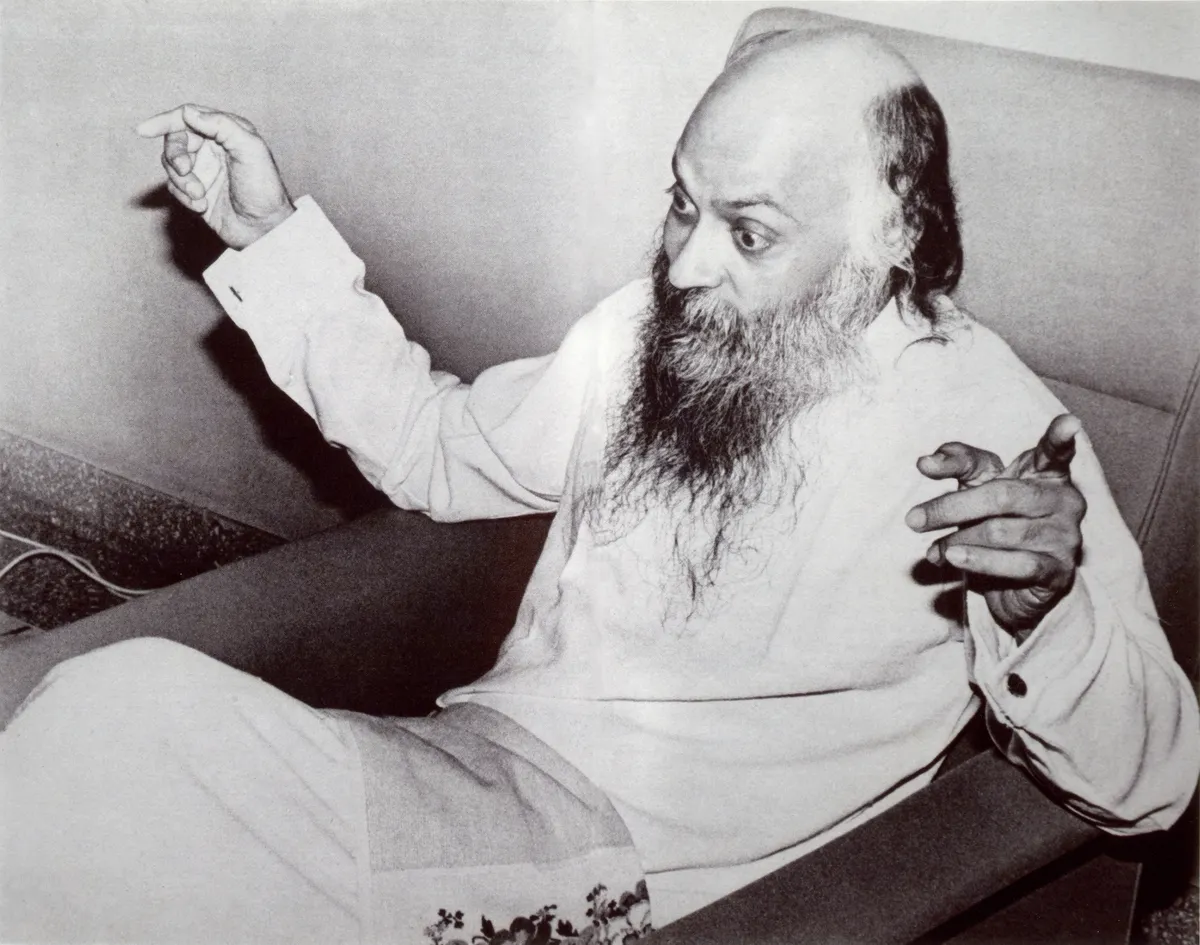
According to Osho, teachings seem hard not because they’re obscure, but because the mind is crowded with borrowed knowledge and the pundit’s authority. The ego clings to scholarship—an illusion of knowing that blocks real seeing. Understanding dawns only when one risks dropping secondhand ideas, enters meditation, and moves beyond mind into silent no-mind, where truth reveals itself.
It’s hard to understand when our heads and egos are stuffed with secondhand ideas; if we drop them and sit quietly in meditation, truth becomes clear.
From the Discourses
Passages where Osho speaks to this question — each links to the complete discourse.
Osho, Why does unlearning seem even more difficult than learning?
A scholar is an egotist—supremely so. He may think, “I am very humble.” He may even display humility: “I am the dust of your feet.” But look into his eyes—he is saying, “See how humble I am! Is there anyone more humble than I?” And if a scholar says to you, “I am the dust of your feet,” and you reply, “Brother, that much we know—you are worse than the dust of our feet,” watch how angry he gets! He’ll buzz with rage: “What did you say?” And if you say, “We’re only affirming what you yourself said,” know that he never said it to be affirmed. He said it so you would protest, “No, no—dust of our feet? You are the peacock-plumed crown! You are the diadem! You are the Kohinoor diamond! Dust of our feet? Never! It is your humility that proves you are our crown!” Three Christian…
Question: OSHO, WHY IS IT THAT I CANNOT UNDERSTAND YOUR PHILOSOPHY? Beware of your mind! You have never thought about it as a drug -- it is a very subtle drug. And the society goes on drugging you from your very childhood. It becomes part and parcel of your life and it colors everything. Whatsoever you see, you see through it; whatsoever you listen to, you listen to through it -- and it is quick at interpreting for or against. Listening to me, if you are thinking about for or against, you will go on missing me. A drunkard accidentally found his way into a luxurious swimming club and was standing by the pool when he was approached by the manager. "Excuse me, sir, but we are forced to ask you to leave," the manager told him. "Why should I leave?" asked the drunkard.
Beloved Osho, why is it always so difficult to understand you and your work?
Narendra, you must be really dumb, very thick. Whatever I am saying is so simple, so obvious. There is no question of understanding it; just listening to it is enough. And if it is difficult, that simply means you have not listened. Forget understanding. Put your whole energy into listening, and understanding will come on its own accord, just like a shadow that follows you. I am not saying anything difficult; I am not a philosopher. I am saying very simple things, so obvious that people have forgotten them. But I can feel your difficulty. Narendra is a psychologist, more in the mind. His whole training is of the mind, and here the whole approach is to put the mind aside. The psychologist is really in a difficulty, because his whole training is of getting deeper into the mind, its mechanics. And here it is a question of getting out…
Osho, you explain with so much love, yet nothing sticks with an ignorant fellow like me. Whereas the Vedas, Puranas, the Gita, etc., I understand perfectly well. Then why is it that I cannot understand you?
People aren’t ready to listen even to a living man; what to say of books! Put flowers on a book—it can’t do anything. Burn a book—it can’t do anything. But if you come and sit in my satsang… And Swaroopananda is a sannyasin! He has shown courage. For one who “understands” the Vedas, Puranas, Gita—to become a sannyasin is an act of bravery. If he had become a sannyasin in some old-style monastery—that was easy. He became my sannyasin—he is courageous. There is strength there, inner strength. Don’t be afraid! Perhaps my words are not getting through because the Vedas, Gita, Upanishads are stuffed in your head—rammed in. First they have to be taken out. I will take them out—don’t worry; that is my job. That is my skill. I speak on the Upanishads—and then I remove the Upanishads from your skull. I speak on the Gita—and you think, “We’re…
Osho, why don’t you speak in a language I can understand? I listen to you, I weep, but nothing makes sense to me!
Understanding and understanding—there are two kinds of understanding. One is of the intellect: of words, of thought, of logic. And one is of the heart. You feel joyous, you weep, tears of joy flow; that is the deeper understanding. What will you do with the intellect’s understanding? And you say, “Why don’t you speak in a language I can understand?” Could language be any simpler? I am speaking in everyday, colloquial speech. The difficulty is not of language. The difficulty lies in that great synthesis of mine which doesn’t fall into your grasp. The difficulty is not language. The language is perfectly plain and straightforward. What could be plainer! I don’t know Sanskrit; I don’t know Pali or Prakrit; even my Hindi is broken—just enough to get by. The difficulty isn’t language. The difficulty is with the vision of life I am offering, because you carry fixed notions. You have…