
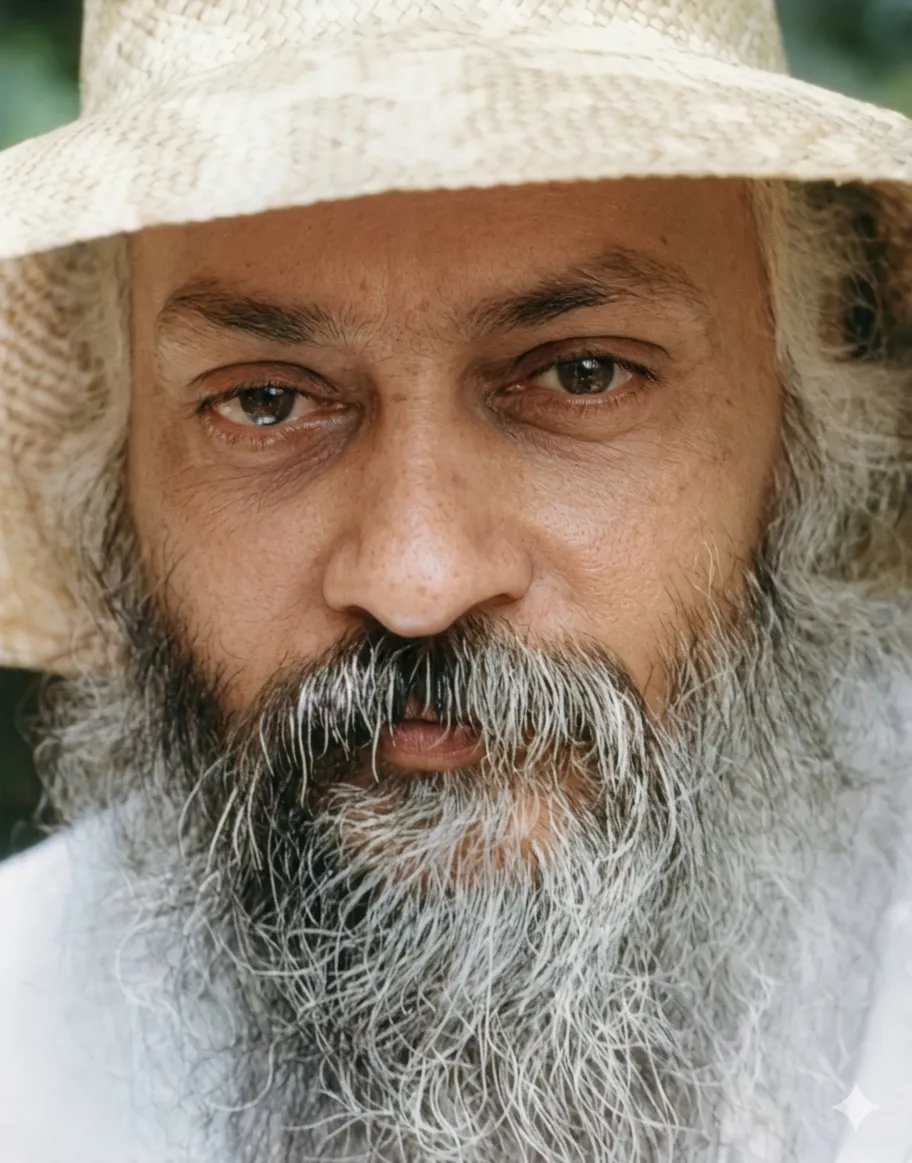
People call it a fall because your thinking brain loses control and you sink back into your childlike heart, but that 'down' is really going deeper where real love and life are.
From the Discourses
Passages where Osho speaks to this question — each links to the complete discourse.
You said that when two beings are in love they are in communion with each other. Then why does the world call it 'falling' in love when it is such an ecstatic happening and not a fall to a lower plane?
The world calls it falling in love because the world is ruled by the head, and heart is lower than the head. When somebody falls in love he falls from the head towards the hear And heart is there in childhood, head grows later on. Head is a later growth. You are born with a heart, you are not born with a head. You are born only with the possibility of a head, not with the head. Reason has to be taught, love cannot be taught. Reason has to be forced on you, your mind has to be conditioned. Schools, colleges, universities exist for reason, there exists no school, no college, no university for love -- there is no need! One is born with a heart already functioning perfectly. The head is just a possibility. If it is taught, conditioned, it will function; if not, it won't function at all.…
Osho, I have fallen in love with chuang tzu, with joshu, with mumon, with bodhidharma. How can I not follow them? I feel already they have transformed me. How can I not be thankful?
Let me tell you one anecdote first. When Rabbi Nor, Rabbi Moudekai's son, assumed the succession after his father's death, his disciples noted that there were a number of ways in which he conducted himself differently to his father, and asked him about this. 'I do just as my father did,' he replied.'He did not imitate and I do not imitate.' Meditate over this anecdote. He said,'I do just as my father did. He did not imitate and I do not imitate.' If you really understand Joshu, Bodhidharma or me, you will not imitate -- because I have not imitated, because Bodhidharma never imitated anybody. Joshu used to say to his disciples,'If you utter Buddha's name, go and rinse your mouth immediately.' Joshu also used to say,'If you meet the Buddha on the way, kill him immediately.' And he used to worship Buddha every day. Ordinarily Zen looks puzzling, but…
Beloved Osho, to fall in love is so easy. Why is it so difficult to fall out of love? So many discussions, tears, fights, fears.... I don't want to hurt the person I've been with, because it's not that there is no feeling. I'm so confused. And the love for you is a different feeling altogether. Can you say something?
Love should come out of your silence, awareness, meditativeness. It is soft, it is unbinding -- because how can love create fetters for the one who is loved? It is giving freedom to each other, more and more. As the love grows deeper, freedom becomes bigger. As the love grows deeper, you start accepting the person as he is. You stop trying to change the person. It is one of the miseries of the world that lovers are continuously trying to change the other person. They don't know that if the person really changes, their love will disappear, because they had not fallen in love with this changed person in the first place. They had fallen in love with a person who was not touched by their ideas -- "Change this and that." Rising in love, you become aware that the other has his own territorial imperative, and you are…
What is love? I feel that what I call love and what you call love are totally different.
Out of the first love the second has to be found. And out of the second the third has to be found when you have started standing on your own, rooted deep in the earth, in the soil. This earth is beautiful. This earth is an opportunity, a great opportunity to experiment. Your being here is experimental -- you should experiment as much as possible, you should not waste any opportunity to experiment. And each experiment will bring a little bit of wisdom to you. It comes the hard way. A man who tries to remain always secure, safe, will not learn anything, will not learn ever. I have heard: A general had come to visit the army in Poona. He asked some soldiers, 'How do you manage with the Poona water?' They said, 'First we boil it. Then we purify it. And then just to be safe we drink…
OSHO: Love is the most intoxicating phenomenon. It is the wine that wells up within. It is not something chemical that comes from the outside, it is not even part of the body, not part of the mind either. It is the dance of the heart in tune with the whole. Love is your heart in deep harmony with the heart of the universe. Then there is great intoxication. And yet the intoxication does not make you unconscious; on the contrary it makes you more conscious than ever. That's the paradox of love: on one hand one is intoxicated, on the other hand one has never been so aware before. It is an intoxication that makes you wake up. HER SIX-YEAR-OLD DAUGHTER: PREM GARIMA, GLORY OF LOVE. NENE BECOMES MA PREM KUNDAN OSHO: It is by passing through the fire of love that one becomes one's real self.