
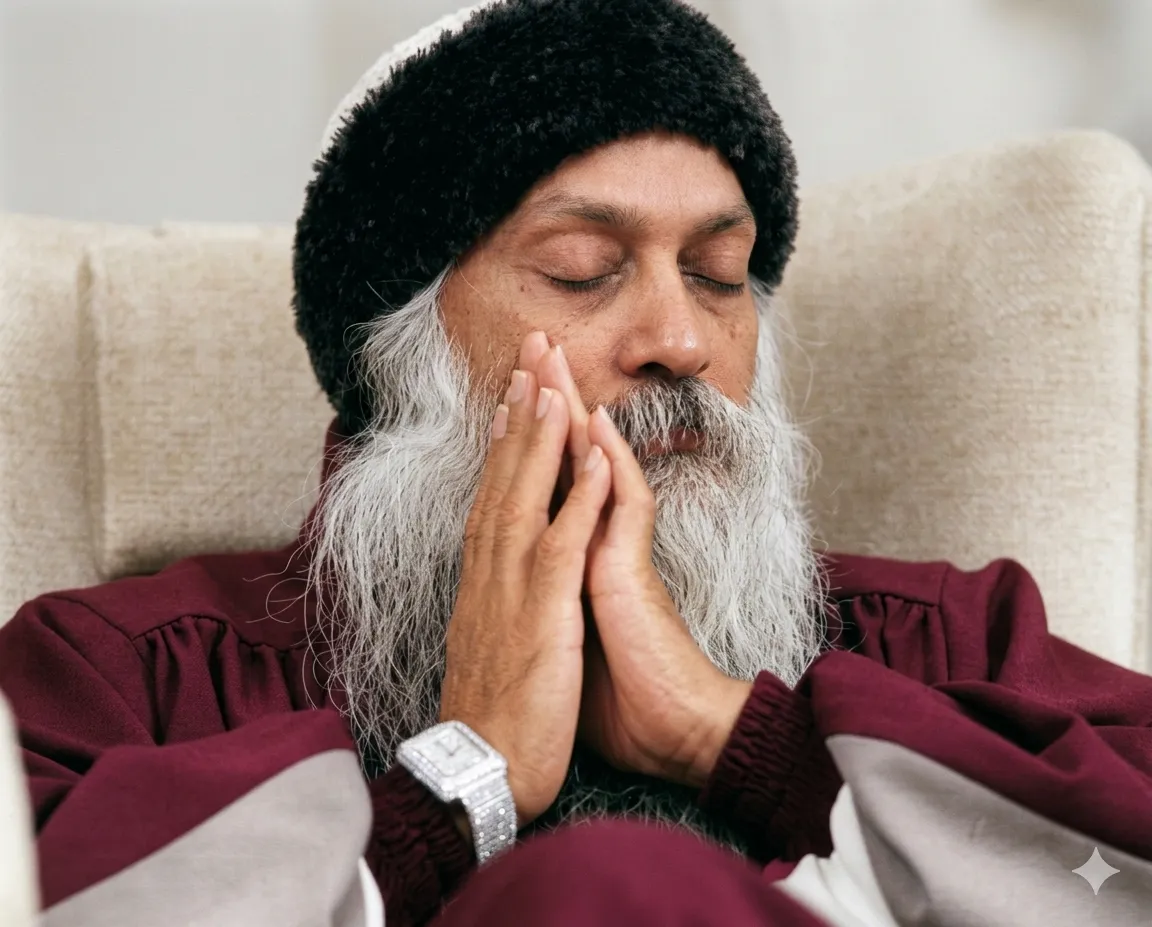
He speaks bluntly from lived truth to keep you from taking a wrong turn, not to belittle other sages.
From the Discourses
Passages where Osho speaks to this question — each links to the complete discourse.
Osho, why does there seem to be so much conflict between the world and God?
It is as if someone were sleeping deeply in this garden. The cuckoo comes and sings, birds are chattering, the sun rises, breezes dance through the trees; but someone is fast asleep. The breezes touch him, the birds’ songs echo at his ears, the sun’s rays play on his face, but he knows nothing. Then someone comes and shakes him awake. His eyes open—the glory of the sun is revealed, the song of the passing breeze is heard, suddenly the cuckoo’s call, the fragrance of flowers. Do you think something new has happened? Everything was already there, just as it is. Only this man has become new—nothing else has changed. The same garden, the same sun, the same flowers, the same birds—everything the same; only a small difference: he was asleep; he is awake. The meaning of “world” is: you are asleep in God. The meaning of “God” is: you…
Beloved Osho, I don't understand why enlightened masters are critical of each other. Are they not all working towards the higher good? Are they not different flavors of the same truth?
"My wife, Bridget," Sean confided to Paddy, "is an angel." "You are lucky," said Paddy, "my wife Maureen is still alive." Hymie Goldberg was having his first session with the psychoanalyst. "Do you cheat on your wife?" asked the shrink. "My God," said Hymie, "who else could I cheat on?" A Californian psychiatrist was driving along in his car, when he saw a man lying on the sidewalk. He stopped his car and got out. It turned out the man had been mugged and left for dead. "Quick," said the shrink, "tell me who did this to you; he needs help immediately!" An Indian businessman who had made millions after a childhood of poverty was on his deathbed giving advice to his son. "Listen, son," he said, "I owe my success to two principles -- honesty and wisdom. Honesty is if you promise to deliver some goods, no matter what…
Beloved Osho, I have heard you say that seeking the truth is as ecstatic as finding it. Does that not eliminate the search?
"And anyway we cannot deceive you. All that we know, we have given to you. We don't know whether it leads to truth or not, because how can we know? -- we are also in the middle of the way. Whether it leads to somewhere or not can be known only when we have reached to the end. And I know almost all the masters around. It is better you start moving alone -- on your own." Perhaps Buddha is the first person who reached to the goal without a master. But one cannot say that those masters did not help him. They did not help him to the end -- they may have helped him only in small ways -- but they certainly helped him to eliminate many things. They certainly made it clear to him that it is better to go alone, to take the risk. Perhaps that…
Osho, the way you speak of Shri J. Krishnamurti with love and praise, he does not speak of you in the same way. Sometimes it feels as if he is about to say something different, but then he avoids it. As a result, your disciples go with great love to listen to Krishnamurti, but his followers do not come to you with an open heart. Please explain.
What Krishnamurti says is entirely right—one hundred percent right. But Krishnamurti’s way is very narrow. It is completely right, yet it is like a footpath. My way is a great royal road. On my path, Buddha, Krishna, Christ, Moses, Zarathustra, Bodhidharma, Lao Tzu—all are included. So I include Krishnamurti as well; no difficulty arises for me—my house is spacious. Krishnamurti lives in a small room. The room is perfectly fine; nothing is wrong with it. In my large house Krishnamurti’s room fits easily, but my large house cannot be contained in Krishnamurti’s room. Krishnamurti is Hinayanist; I am Mahayanist. Krishnamurti’s boat is a small dinghy—you know, in small villages at most one person sits and rows out to catch a fish. My vessel is big, a great ship—Mahayana. Come aboard from every direction, all kinds of people: those who follow every scripture, every doctrine—there is room for all. That’s why.…
Osho, true masters are different, and a follower of one master cannot accept another. But we find ourselves bowing to Buddha, Mahavira, Lao Tzu, Jesus, Krishna—everyone. Perhaps it is because you yourself have oriented us toward them. Even on seeing the living master Krishnamurti, our hearts overflowed with joy, our feet began to dance. Why? And we cannot understand why Krishnamurti’s lovers cannot accept you?
True masters are certainly different. Broadly, three kinds can be seen. First is the kind of master like Krishnamurti; Mahavira and Buddha belong to the same line. Such a master has one central message: become utterly free, do not depend on anyone. Your liberation lies in your freedom. Liberation is not a final event waiting at the end; you must learn freedom from the very first step—only then will it flower at the last. Krishnamurti’s famous book is The First and the Last Freedom: the first freedom is the last freedom; the very first step of freedom is already the last step. So: do not go into anyone’s refuge, do not surrender anywhere, do not bind yourself to any ideology; avoid belief. Mahavira called this the state of ashraya-shunyata—no refuge. Take no shelter. Buddha’s last message at the time of his death—Ananda asked for a final word to treasure forever—was:…