
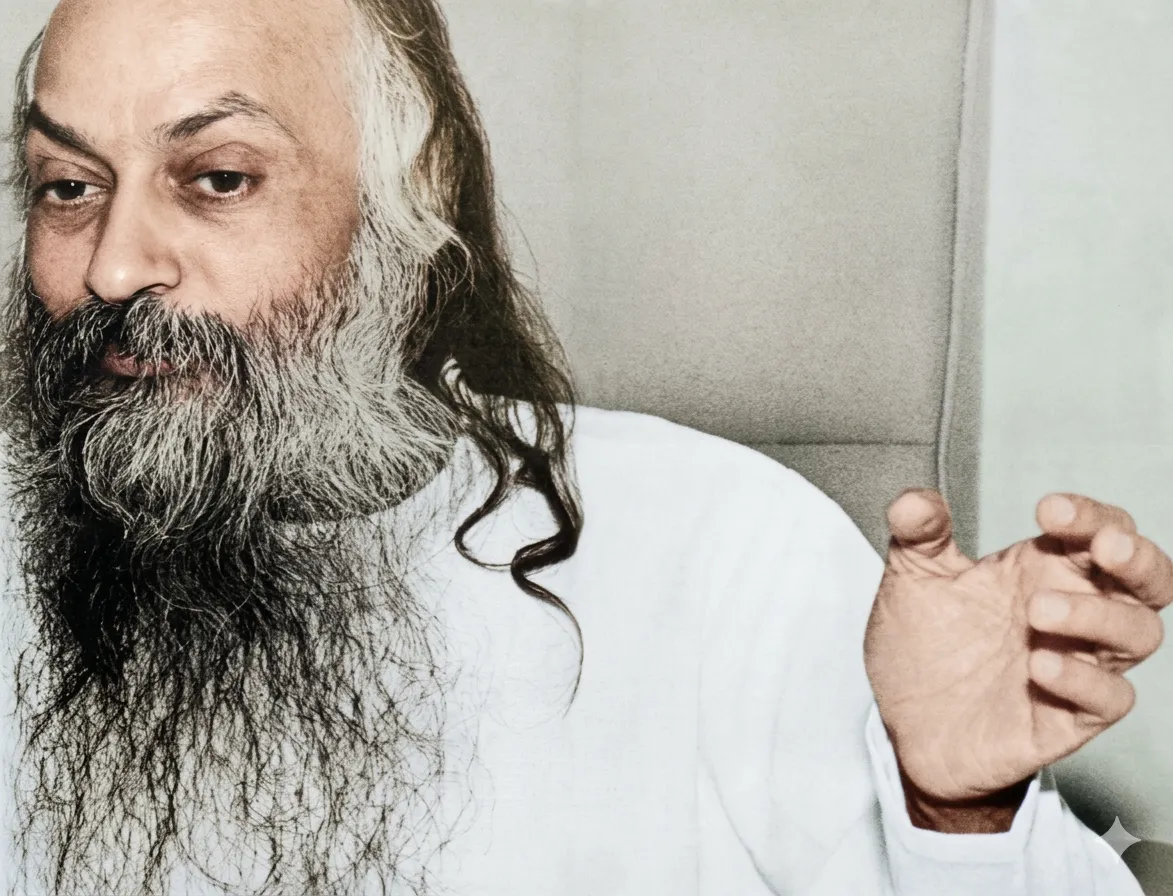
People misquote because we forget, and what matters is the living meaning now, not perfectly repeating old words.
From the Discourses
Passages where Osho speaks to this question — each links to the complete discourse.
Why do you make so many mistakes when you quote other people or refer to biblical events or to scientific discoveries? I have answered this question many times myself in various ways. Now I would like to hear your answer.
So allow me to commit a few more mistakes. First: my memory is marvellous. Mulla Nasruddin was talking to a man and he said 'My wife has a very bad memory.' And the man asked 'Do you mean she forgets everything?' Mulla Nasruddin said 'No, she remembers everything!' If Mulla Nasruddin's wife has a bad memory, I have a marvellous memory. I forget everything. And I enjoy this forgetfulness; I am not worried about it. Secondly: I am an ignorant person. I am not a scholar. I enjoy reading books, but I read the Bible. the Gita, the Koran just as one reads novels; they are ancient, beautiful stories. Krishnamurti says he never reads any scripture; he reads only detective stories. I read the scripture, but I read in the scripture just the detective story and nothing else. And I would suggest to Krishnamurti that it would be good if…
Osho, why is your memory so miraculous? By the time afternoon comes I even forget what I had for breakfast. Would you kindly share the secret of a good memory?
“So then,” I said, “my concern is with the inner stream. What have I to do with scriptures? If it appears in scripture, fine; if not, fine. I am no scriptural scholar, nor am I interested in being one.” Therefore, when I give quotations, do not assume you will surely find the exact citation. You may find it—or you may not. But the listener will certainly feel that I speak with such force that it must be so. The force is not because it is in scripture; the force is because I know from my own experience that this is the truth. Whether it is in the scriptures or not, it is so. Even if all the scriptures were destroyed, what I am saying would still be true. Even if all the scriptures were opposed, what I am saying would still be true. And even if all the scriptures were…
Osho, Dariya Sahib was not a scholar, not even educated. Then how did the dust of the scriptures settle on him, such that the Master had to blow it away?
I have heard: two small children were passing by a nudist camp—a settlement of people without clothes. They peeped through a small drainage hole in the wall. Everyone inside was naked—women and men. The boys were perhaps six or seven, schoolbags slung over their shoulders, returning from school. They were in great difficulty: which were women, which were men? They had never seen a naked woman or naked man; they knew only one distinction—if a sari is worn, it is a woman; without a sari, a man. Now they were in trouble. When they got home they said to their parents, “We passed the colony of the naked; we peeked.” The mother asked, “Who were there—men or women?” They said, “How can we tell? They were wearing no clothes!” Do you understand the children’s point? Their recognition is a recognition of clothes. But how much beyond clothes does your recognition…
पहला प्रश्न: ओशो, दरिया साहिब पंडित नहीं थे, पढ़े-लिखे भी नहीं थे, फिर उन पर शास्त्रों की धूल कैसे जमी कि गुरु को उसे उड़ाना पड़ा?
… स्त्रियां भी नग्न थीं, पुरुष भी नग्न थे। दोनों छोटे-छोटे बच्चे होंगे छह-सात-सात साल के, अपना बस्ता लटकाए स्कूल से लौटते थे। दोनों बड़े विचार में पड़ गए कि कौन स्त्री है, कौन पुरुष? क्योंकि उन्होंने कभी नंगी स्त्री, और नंगे पुरुष देखे नहीं थे वे तो एक ही फर्क जानते थे कि साड़ी पहने हो तो स्त्री, और साड़ी न पहने हो तो पुरुष। आज बड़ी मुश्किल में पड़ गए। घर लौट कर आए तो उन्होंने अपने मां-बाप को कहा कि हम नंगों की बस्ती से गुजरते थे, हमने देखा झांक कर। तो मां ने पूछा कि कौन थे वहां, आदमी थे कि औरतें? उन्होंने कहा, अब हम कैसे बताएं? वस्त्र तो पहने ही नहीं थे।
Osho, if a conscious person does not make mistakes, then please tell me what is the secret behind the difference in my name in Hindi and English? In Hindi: Swami Shyamdev Saraswati, and in English: Swami Shyamdev Bharati.
The body does many things mechanically. At night you are asleep; a mosquito comes, the hand waves it off. You don’t even need to wake up for that. You’re sitting; someone tosses a pebble toward your eye—you do not have to decide to close the eye; it closes by itself. It is automatic, and it is good that it is automatic. Otherwise the pebble would hit and you would still be thinking whether to close the eye or not. Nature has not left that to you. Something as delicate as the eye cannot be left in your hands. Nature has arranged that as soon as anything approaches, the eye closes on its own. You do not blink the eye; the eye blinks. Have you ever noticed how many things the body silently goes on doing? You eat food; the body digests it—you do not digest it. You don’t even have…
चौथा प्रश्न: ओशो, होशपूर्ण व्यक्ति भूल नहीं करता तो कृपया मेरे नाम में अंग्रेजी और हिंदी में इस अंतर का क्या रहस्य है? हिंदी: स्वामी श्यामदेव सरस्वती, और अंग्रेजी: स्वामी श्यामदेव भारती।
शरीर बहुत से काम यंत्रवत करता है। रात तुम सोए भी रहते हो, मच्छर आ जाता है, हाथ उड़ा देता है। उसके लिए जागने की भी जरूरत नहीं होती। तुम बैठे हो, कोई एक कंकड़ फेंक दे तुम्हारी आंख की तरफ, तो तुम्हें आंख बंद थोड़े ही करनी पड़ती है। आंख अपने से बंद हो जाती है। वह स्वचालित है, आटोमैटिक है। और अच्छा है कि स्वचालित है। नहीं तो कंकड़ पड़ जाता और तुम आंख बंद करने की सोचते ही रहते, करें बंद कि न करें। इसलिए प्रकृति ने तुम पर नहीं छोड़ा है। तुम्हारे लिए नहीं छोड़ा है कि तुम सोचो, फिर बंद करो। उसमें तो खतरा हो जाएगा। …
Osho, a question arises in my mind. Last night you said some things about the scriptures. It seemed to me that whatever you say could also be found in the scriptures. And what you are saying is itself gradually becoming a scripture. And what you say about the scriptures will apply verbatim to what you yourself have said as well. One who can see will see it here too; one who cannot see will not see it here either. And one who can see will also see it in the ancient scriptures, while the one who cannot see will not see it there either. Then there remains no purpose in criticizing them.
If this much becomes clear to us, then you will see I am not condemning scripture; I am stating the factual situation of scripture. And what you say is right: much of what I say will be found in the scriptures—not because it is there, but because you will have understood me. If my words have been understood by you, you will find them in the scriptures, because in scripture you will find only what your understanding is. Whatever your understanding is, that is what you will find—because we project our own understanding into scripture. Ordinarily we think that understanding comes out of scripture. It does not. We put our understanding into the scripture. That is why a thousand commentaries on the Gita are possible. If understanding came out of the Gita, how could there be a thousand commentaries? And if Krishna had a thousand meanings, then Krishna’s mind must…
प्रश्न: ओशो, एक प्रश्न मेरे मन में उठता है। आपने रात को शास्त्रों के बारे में कुछ बात कही। मुझे ऐसा लगा कि आप जो भी कुछ कहते हैं, वह शास्त्रों में भी उपलब्ध हो ही सकता है। और आप जो कुछ कह रहे हैं, वह भी स्वयं में एक शास्त्र ही बनते चले जा रहे हैं। और जो बातें आप शास्त्रों के संबंध में कह रहे हैं, वह आपकी कही हुई बातों पर भी ज्यों की त्यों लागू हो जाएंगी। जो देखने वाला है, उसे इसमें भी दिखेगा। जो नहीं देखने वाला है, उसे इसमें भी नहीं दिखेगा। और जो देखने वाला है, उसे प्राचीन शास्त्रों में भी दिख ही जाता है। और न देखने वाले को उनमें भी नहीं दिखता। फिर उनकी निंदा का कोई प्रयोजन शेष नहीं रह जाता।
यह जो हमें खयाल में आ जाए, तो मैं शास्त्र की निंदा नहीं कर रहा हूं, शास्त्र की वस्तुस्थिति क्या है, वह कह रहा हूं। और वह जो तुम कहते हो, वह ठीक है। मेरी बहुत सी बातें शास्त्र में मिल जाएंगी--इसलिए नहीं कि वे शास्त्र में हैं, इसलिए कि तुम मेरी बातों को समझ लोगे। अगर मेरी बातें तुम्हें समझ में पड़ गईं, तो तुम्हें शास्त्र में मिल जाएंगी। क्योंकि शास्त्र में तुम्हें वही मिल जाएगा, जो तुम्हारी समझ है। जो तुम्हारी समझ है, वही मिल जाएगा। क्योंकि हम शास्त्र में अपनी समझ डालते हैं। आमतौर से हम सोचते हैं कि शास्त्र से समझ निकलती है। निकलती नहीं, हम शास्त्र में अपनी समझ डालते हैं। इसीलिए तो गीता की हजार टीकाएं हो सकती हैं। अगर गीता से समझ निकलती हो तो हजार टीकाएं कैसे हो सकती हैं? और कृष्ण के अगर हजार मतलब रहे हों तो कृष्ण का दिमाग खराब रहा होगा। कृष्ण का मतलब तो एक ही रहा होगा। हजार टीकाएं हो सकती हैं, लाख टीकाएं हो सकती हैं, क्योंकि हर एक व्यक्ति अपनी समझ उसमें खोज लेगा। …