
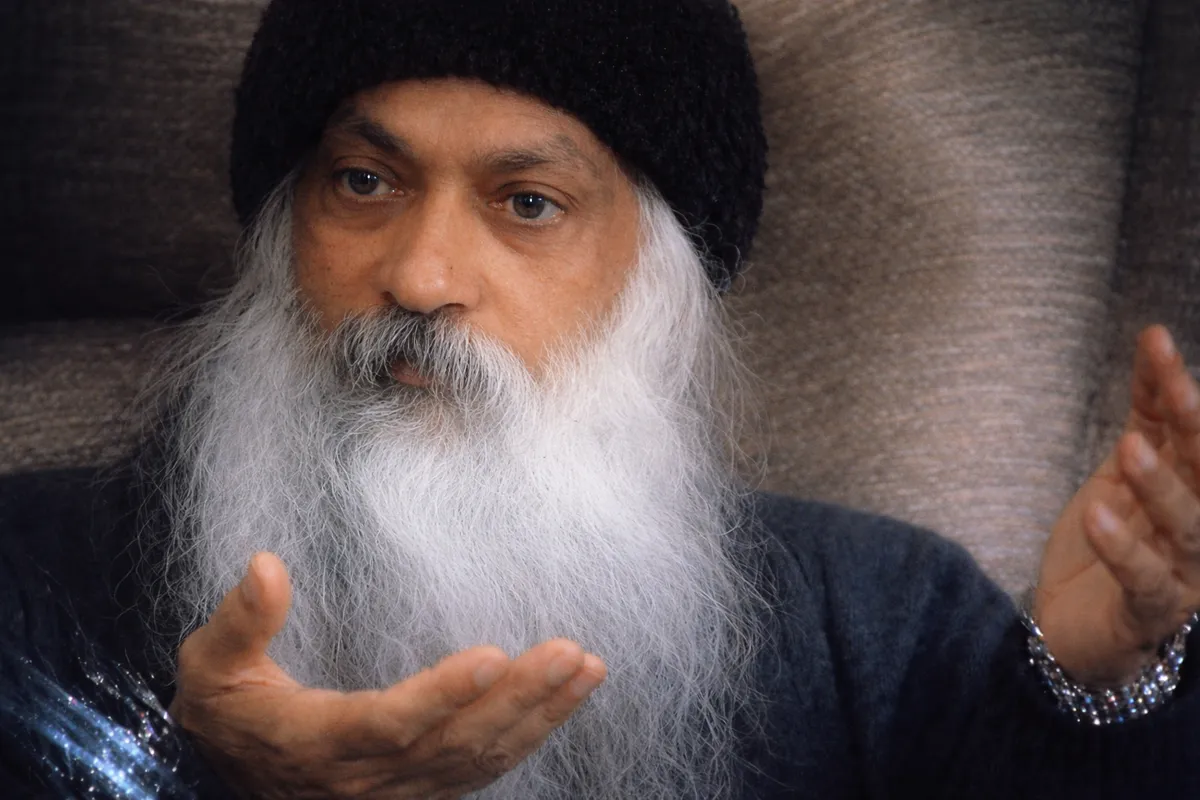
According to Osho, only a rare few become wealthy from the divine treasure because perception follows desire: you only see what you seek. Inner riches are everywhere, but only the truly thirsty, inwardly oriented eyes recognize and seize them. Most remain fixated on outer gains, dismissing seekers as mad, and thus overlook the silent, invisible bounty within.
Like only a thirsty person noticing a river, only those who truly long for truth notice and take the inner treasure—others are busy looking elsewhere.
From the Discourses
Passages where Osho speaks to this question — each links to the complete discourse.
Osho, Sant Palatu Das says the looting of the divine treasure is going on and “whoever wants may take.” If that is so, why is it that among millions only one or two become wealthy with it?
When Buddha left his palace, his old charioteer—who had driven him since childhood and loved him like a son—fell at his feet in the forest and pleaded, “What are you doing? Where are you going—leaving this marble palace, your beautiful wife Yashodhara, your newborn son Rahul, your aged father? You are his staff in his old age. What will you find in the jungle? I’ve roamed the forests; there is nothing there. The whole world wants to come to palaces, and you are leaving one! Anyone would want to be a king, and kingship is in your grasp—yet you turn away?” The old man wept. From his side too, he was right: the forest showed him nothing; all value was in the palace. To the poor man, wealth seems to live in palaces; it takes an actual rich man to discover that palaces are empty. Having seen, he finds no…
In those days, Emperor Prasenjit came to Mahavira and said: I have listened to your words, and it has become clear to me that I am utterly impoverished. I have everything—and I have nothing! You have shaken me; you have broken my sleep! I used to dream—one dream—of being an emperor. But I have nothing. You have filled me with anguish too. Great pain has arisen in my heart. I am destitute. The wealth you speak of—where shall I find it? How shall I find it? Mahavira said: I call only meditation true wealth. There is no other treasure. There is nowhere else to go to obtain it. But Prasenjit was Prasenjit—his whole life had been a race outward. He had made great journeys, built a vast kingdom, conquered far and wide, planted his standard.
Osho, you said... then you will find that the devotee is God. The question arises: if one devotee prefers to be God and another wants to remain only a devotee, then which of the two is superior?
The one who wants to be God will not be able to be. And the one who wants to remain a devotee will become God. The question of superior or inferior does not arise, because only one of the two will happen. The one who does not want to be will be. The one who wants to be will be deprived. That very wanting is of the ego. But the matter is a little delicate. Sometimes humility too belongs to the ego. Beware that your humility may not be of the ego. Perhaps you are saying, “No, I don’t want to be,” because you know that those who refuse are the ones who attain. Then you are clever. Then your humility is adulterous. Your humility is not pure, not sacred, not virginal—it is like a prostitute. The one who wants to be God, whose ego says, “I must become God,”…
Osho, the path of sannyas is unfamiliar and I am afraid. What should I do?
But this is everyone’s belief—that love arises from fear. So the husband frightens the wife as much as he can, thinking otherwise there will be no love. And the wife frightens the husband as much as she can, thinking the same. Parents frighten the children; and the children, for their part, do not hold back—they frighten the parents too; they have their own ways, their recipes. All devotees of Baba Tulsidas! Everyone is frightening everyone. Teachers are frightening students; students are frightening teachers. Fear pervades everywhere. Our notion of God is as if he were a policeman. We imagine he watches you twenty-four hours a day; he won’t even leave you alone in the bathroom—sitting there, peeping through the keyhole. I have heard: a Christian nun used to bathe with her clothes on. At last her companions became concerned. They said, “What sort of madness is this? Why don’t you…
Those Majnus who do get their Lailas—do they care about others’ Lailas? They forget even their own!” It is the law of mind: what is obtained is forgotten. And the Divine is already obtained. Even the convenience to remember Him does not arise. So the law of the mind must be changed. At present the mind runs toward pits; we must train it to run toward peaks. There is no other difficulty. In life, feel delight in what has been given. Rejoice in what is present. Be content with what is at hand. Thank the Divine for what is. See what is; drop what is not. Very soon you will find that your search for the Divine has begun. Therefore those who have made contentment indispensable in the search for the Divine—understand the reason; it is hidden in this sutra. Contentment has no value in itself.