
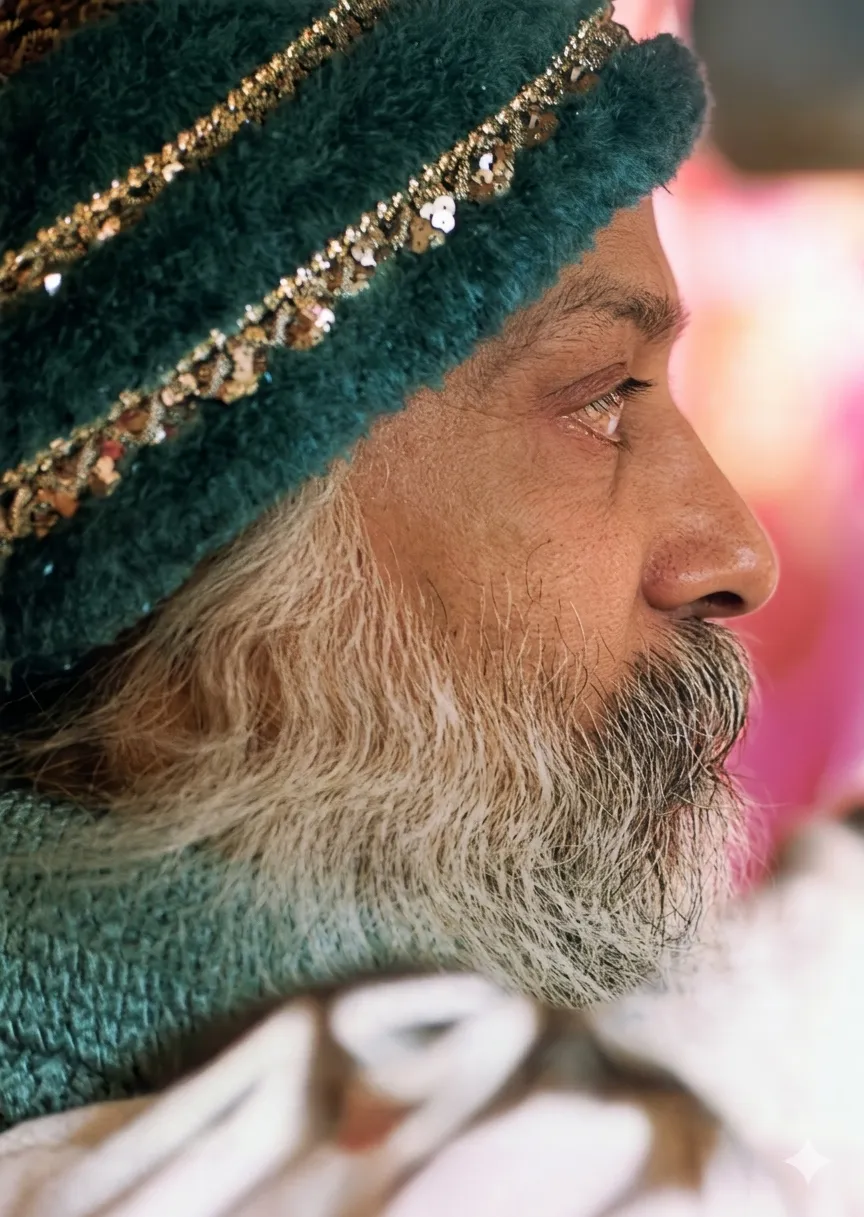
You cry because love fills you so much that it overflows as happy tears—nothing is wrong, let them flow.
From the Discourses
Passages where Osho speaks to this question — each links to the complete discourse.
Question: BELOVED OSHO, WHY DO I ALWAYS HAVE TO CRY WHEN I AM TOUCHED BY LOVE? What do you want? What more do you want? Certainly you are thinking that those tears are something wrong. Crying when touched by love is something wrong? -- you are carrying a wrong conditioning. It is absolutely right. When touched by love, what can you do? Words won't help; only tears can convey what is happening deep down in your heart. Tears are the most valuable treasure that you have. But man has been distorted everywhere, man's nature has been pruned according to the ideas of the vested interests. Nations need armies and they do not want man to be at all touched by love.
Osho, the moment I arrived here, intellect turned into heart and words into silence. While listening to you, my heart sometimes begins to flow as tears. I am doubtful whether this state will remain when I return home. Kindly explain how this state can be stabilized.
First thing: a human being has nothing more sacred than tears. There is no prayer greater than tears. People have known only one form of tears—tears of sorrow. But there is another form—tears of joy. Very few have known it; very few ever come to know it. When you see someone crying, you think he must be unhappy, in pain, wounded, burning. Not necessarily. Tears flow whenever any feeling becomes so intense that you cannot contain it—any feeling. If sorrow grows too much, it overflows as tears. If happiness grows too much, it too overflows as tears. Great pain flows out and lightens the heart through tears; great bliss also flows out as tears. So first, do not tie tears inextricably to sorrow. Deep down our minds have been conditioned to think tears come because of suffering. So we hide them, we hold them back. We try hard that tears…
Osho! While listening to you I start to weep. Now, even in the celebration of active meditation, tears burst forth. What is this? In the midst of meditation a feeling arises that this body is a hindrance now; how can it be shed—the feeling keeps growing more intense. Why? Please explain out of compassion.
Akshay Vivek! Human beings have been given such wrong conditioning that they have neither ever cried to their heart’s content nor laughed to their heart’s content. They have never really lived to their heart’s content. In no aspect, in no dimension, have they ever done anything totally; everything remains half-done! So many things hang inside, suspended like Trishanku. I say meditation is a celebration, but what is happening to you happens to others as well. While celebrating, suddenly tears arise from some unknown corner! They must have been suppressed somewhere—perhaps for lifetimes. Especially in men. Because from childhood we tell boys: Don’t cry! Girls cry. You are a man; crying is not for you. This is false. It is utterly false. Nature has made the tear glands in the eyes of men and women just the same. Men’s tear glands are not smaller than women’s. So one thing is certain—nature…
Osho, why does love for the Lord make one mad?
People ask me: Where is the heart? One day a young man asked, “Where exactly in the body is the heart located?” I said to him, “Your head is inside you; you are inside the heart.” The heart is not inside you. Do not mistake these lungs, pumping air, for the heart—they are only an apparatus for purifying air. You are within the heart. The heart is bigger than you. The head is smaller than you. The web of thoughts that spreads inside the head—that is yours, your private world. It is not the world of truth; it is the world of falsity, the world of dreams. The moment your energy slips out of the noose of the head— the moment you step outside the head—the courtyard of the Vast opens: the courtyard of your heart. It is as vast as the sky. Within you lies a sky as immense…
Beloved Osho, during your first discourse on the mahagita many people were weeping streams of tears. What does this mean? Are those who were crying weak hearted or is it the power of your voice? Please throw some light on this.
Everywhere in the world it has always been like this. Politicians only have lust for power, they are not concerned with order or revolt. Yes, when they are not keeping order, when the power is not in their hands, then they say everything is wrong; then a revolution is needed. And as soon as they come to power, revolution isn't needed any more because the work of the revolution is complete. Its work was this -- to bring him to power -- the job is done. Then whoever mentions revolution is an enemy. And those that speak of revolution also have nothing to do with it. It is an amazing thing to watch -- it is happening every day, and still man does not become alert. All revolutionaries become counter-revolutionary when they come to power. And all ousted politicians become revolutionaries as soon as they step down from office. Political…