
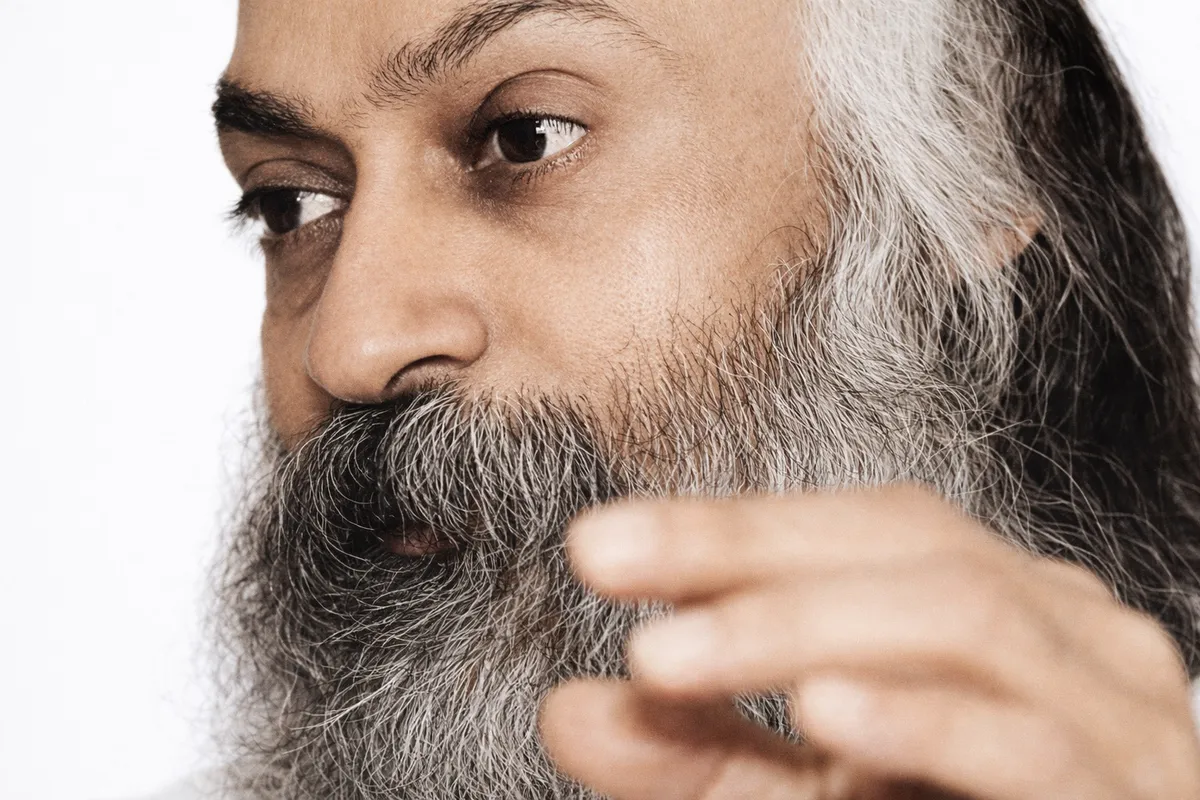
According to Osho, God cannot be known because all knowledge requires a split between knower and known; but God is the very knower - your own subjectivity. Treating God as an object creates separation and frustration. Drop the urge to know; be innocent, let divisions fall, and recognize you already are That. Don't seek God as elsewhere - turn within, merge, and live in harmony as existence itself.
You can't know God like a thing because God is the awareness in you - stop searching outside and relax into what you already are.
From the Discourses
Passages where Osho speaks to this question — each links to the complete discourse.
Why can't I know god?
FOR YOU ARE IT! Knowledge is not possible. Knowledge pre-supposes division, split. The knower has to be separate from the known. That's why God cannot be known. You can be God -- you are -- but you cannot know Him. The very effort to know Him is based on separation. Knowledge separates, divides; it never bridges you. That's why I insist again and again: Be innocent, not knowledgeable -- then you will be in harmony with existence. Then you will be existence! Be ignorant. Blessed are the ignorant. Why? Because when there is no knowledge, no effort to know, divisions disappear. You merge... you meet... you become one. You cannot know God because God is hiding in you. God cannot be reduced to an object. God cannot become the known. God is the KNOWER; God is your subjectivity. It is not the goal, it is the seeker. It is not…
Osho, what is the definition of God?
Words are very small. If you say God is light, then what of darkness? The scriptures have said that God is light. Suppose we accept this as a definition—then what about darkness? Where will darkness go? Darkness is too; in fact it is far more than light. Light sometimes is and sometimes is not; darkness is always, eternal. Where will you place darkness? If you say God is light, darkness is left out. If you say God is darkness, then light is left out. If you say God is both darkness and light, a contradiction arises: they cannot be together. Try to have both darkness and light in the same room. If you bring in light, darkness disappears; if you preserve darkness, you cannot have light. Then how can both be together? That becomes an impossibility. So you cannot say “both” either. Then the fourth device is to say: it…
I am the incomprehensible shakti (energy), I am without hands and feet.
I CAN SEE WITHOUT EYES, HEAR WITHOUT EARS, KNOW WITHOUT INTELLECT. DEVOID OF ALL FORMS, I KNOW ALL; BUT THERE IS NONE WHO KNOWS ME,THE EVER PURE CONSCIOUSNESS. So how to call it knowledge? Or if we insist on calling it knowledge, we have to qualify it, we have to give a different meaning to the very word. Knowledge means: the division between the known and the knower. If I call this self-knowledge, that means: without any division between the knower and the known. How can knowledge exist without the division? So, this is not knowledge; rather, this is an existential feeling. This is less like knowing and more like being. This being is not known by anything else -- it is known by itself -- so this being can never be made an object. It can never be put before; it is always behind. It always transcends; it always…
God is not a thing about which questions can be asked... or answered. The question, the answer, are both irrelevant. Whatsoever you say about god will be wrong. Even to say 'God is' is wrong, because the word 'is' is very ordinary. We say 'the table is', 'the chair is'; how can we use the same word for god? The word is too ordinary, mundane. And when we say 'the table is' it is implied that one day the table was not and one day the table will again disappear and will not be. God is always. So the 'is' has a totally different meaning with god. You cannot use the past or future tense with god. You cannot say 'God was'; you cannot say 'God will be'. God always is, but the chair is not always, the man is not always, the tree is not always.
"It is meaningless to say you want to find God. How can you find something you have never lost? How can you find that which you yourself are? The one thing you cannot see if your self. And the idea of visualizing God as an external being simply separates him from the self. God is your self; he is your soul -- and so you will never be able to see him. And my friend, if you do see God then know well, he is just a figment of your imagination. The human mind is capable of giving form to all its fantasies, but when you lose yourself in these creations of your mind you move further and further away from God, away from truth itself." I am reminded of this incident because you also want to see God.