
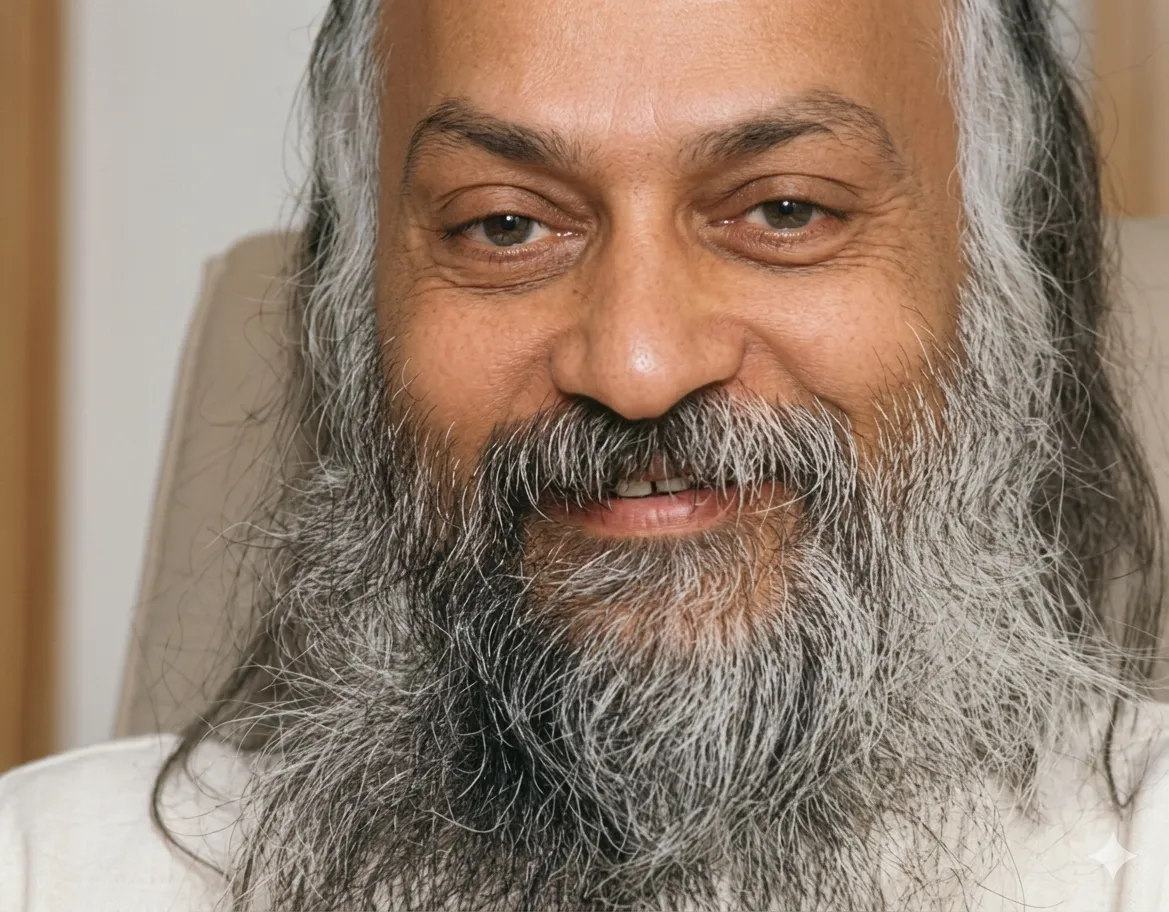
It’s like trying to pour the whole sky into a teacup—God is too vast for words, and when you truly find Him, the talker disappears, leaving only silent knowing.
From the Discourses
Passages where Osho speaks to this question — each links to the complete discourse.
The second and last question: Osho, after realizing God, why can one not express that experience?
But Krishnanand, why worry now? For now, worry about attaining. We are very strange people! We raise strange questions. You have not attained yet, and you are anxious about why, after attaining God, that experience cannot be expressed? This is a hypothetical question. It has no value. First attain, then you will know why it cannot be made known! You yourself will smile, you yourself will laugh. The question will not arise at all. It arises only because as yet you have no taste of the vastness within yourself. But even in life, if you explore a little, you will find experiences that cannot be told. You wake at dawn and watch the sun rise—the beauty of it. Can you convey it to someone? Yes, if you wish you can take a photograph, you can paint a picture of sunrise. But is a picture of the sunrise the sunrise? If…
Osho, what does realization feel like? How can a seeker know that something has truly happened? How can one distinguish reality from self-created imagination? How can others recognize the attainment of one who is realized?
You ask: “How can a seeker know that something has truly happened?” When you have a headache, how do you know you have a headache? When I was in school, I had a Muslim teacher—perhaps he is still alive—Rahamuddin, a lovely man, but very strict in one thing: it was almost impossible to get leave from him. He himself never took leave and would not grant it to students. I often needed leave. I would say my stomach hurts, or my head hurts. He said, “Listen, I accept fever; I do not accept stomachache or headache. If you have fever, I can at least take your hand and feel it. But how am I to know whether you truly have a stomachache or headache?” I said, “Since you ask, let me ask you—have you ever had a headache? A stomachache?” He said, “I have.” I said, “What proof can you…
Why is truth inexpressible? Why can't it be told?
All words are small. All human efforts are limited. And then, it cannot be told straight. It can be communicated straight, but it cannot be told straight -- and that is the difference between a thinker and a meditator. The thinker goes roundabout because he has to go through thought. He searches for the sky through the clouds and gets lost in the clouds, may never reach the sky. The thinker gets lost in thoughts. The meditator starts by dropping thoughts. He starts by dropping thinking itself, and a moment comes when there is no thought: then there is immediacy. Then there is nothing between you and that which is. Then there is nothing at all -- you are bridged with reality. But that is an experience. Whenever you would like to tell that experience to somebody else you will have to use words, out of necessity, and words cannot…
Question: BELOVED OSHO, HOW DO YOU EXPERIENCE YOUR ENLIGHTENMENT? Milarepa, enlightenment is not an experience. Experience always divides the experiencer from itself. But enlightenment knows no duality; hence it is not an experience but simply experiencing. It may not be right language; in fact, it cannot be right language because the linguist will not understand what you mean by `experiencing'. One has to know it. But some effort can be made; some indications and hints can be given. When you are in love, is it an experience? Is it objective? Is it separate from you? Is it something that you can exhibit? Is it something for which you can give some evidence, proof, argument? No, love simply knows itself. It is self-evident. It needs no proof and no witnesses. It needs no evidence, no arguments, no philosophy. Enlightenment goes even deeper than the reaches of love.
O how may I ever express that secret word? O how can I say he is not like this, and he is like that? If I say that he is within me, the universe is ashamed. If I say that he is without me, it is falsehood. He makes the inner and the outer worlds to be indivisibly one; the conscious and the unconscious, both are his footstools. He is neither manifest nor hidden, he is neither revealed nor unrevealed: there are no words to tell that which he is.
II. 56. dariya ki lahar dariyao hai ji THE RIVER AND ITS WAVES ARE ONE SURF: WHERE IS THE DIFFERENCE BETWEEN THE RIVER AND ITS WAVES? WHEN THE WAVE RISES, IT IS THE WATER; AND WHEN IT FALLS, IT IS THE SAME WATER AGAIN. TELL ME, SIR, WHERE IS THE DISTINCTION? BECAUSE IT HAS BEEN NAMED AS WAVE, SHALL IT NO LONGER BE CONSIDERED AS WATER? WITHIN THE ABSOLUTE, THE WORLDS ARE BEING TOLD LIKE BEADS. LOOK UPON THAT ROSARY WITH THE EYES OF WISDOM. THE TRUTH IS KNOWN AND YET NOT KNOWN -- known in a sense and not known in another -- known because we are part of it, but not known because we are not separate from it. To know something, the knower has to be separate; and yet again, to know something really, how can you know it if you are separate? This is the basic…