
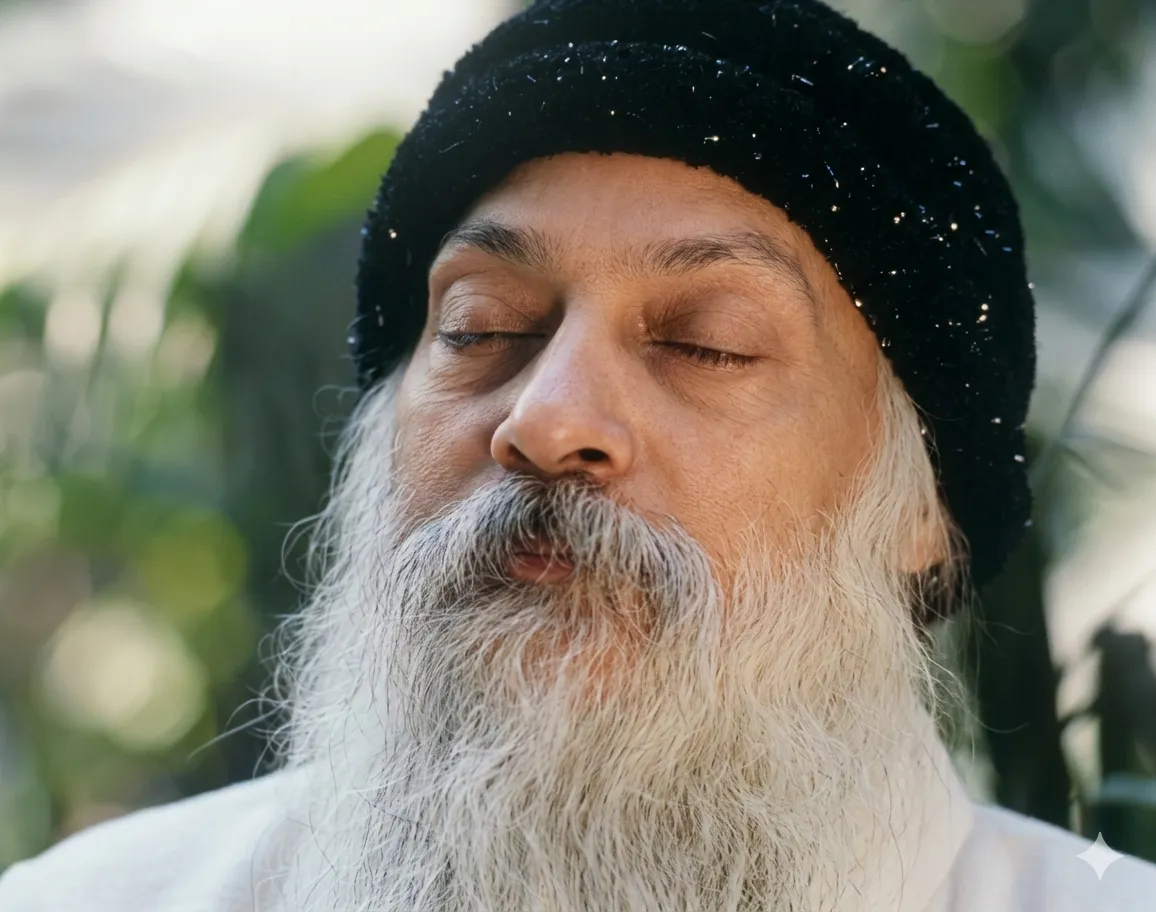
According to Osho, meditation cannot be achieved through effort; effort belongs to the mind, and meditation is its transcendence. Relax, let go of striving, and rest in effortless, alert awareness—like deep sleep with consciousness. When struggle drops, samadhi flowers by itself. Sit or lie down, breathe naturally, remain watchful but unforced; allow silence to happen rather than manufacture it.
Stop trying hard; relax your body, breathe easy, and gently watch—then meditation comes on its own.
From the Discourses
Passages where Osho speaks to this question — each links to the complete discourse.
In 1969 followers of the Maharishi Mahesh Yogi invited Osho to talk to them. This was the first occasion on which Osho addressed a western audience, and the first time he talked publicly at length in English. The discourse has been published in OTI January 1 & 16, 1991; and February 1, 1991. Osho: Really, there can be no method as far as meditation is concerned. Meditation is not a method. Through technique, through method, you cannot go beyond mind. When you leave all methods, all techniques, you transcend mind. So meditation itself is not a method. Truth cannot be achieved through method. Method is our own invention. We, who are ignorant, have achieved knowledge through methods constructed, created, projected, in our ignorance. Through method you can achieve a sort of self-hypnosis, a sort of auto-hypnosis. Any method, whatsoever it's name, can only give you an illusory kind of peace.
Osho, what is the first experience of samadhi like?
You will know only when it happens. It cannot be said; at most a few hints can be given. It is as if, in the dark, a lamp is suddenly lit. Or as if a dying patient, right at the edge of death, suddenly finds a medicine that works; life’s wave, life’s thrill spreads again—so it is. As if a corpse becomes alive—such is the first experience of samadhi. It is the taste of nectar. The experience of the ultimate music. But it will be only when it happens; and only then will you understand. You will not understand by my saying it. It is as with love. How can anyone explain it? To someone who has never loved, never known love, no matter how many explanations you offer—he will hear it all and still ask, “I haven’t understood; please explain a little more.” It is like explaining light to…
Meditation is always passive; the very essence of it is passive. It cannot be active because the very nature of it is non-doing. If you are doing something, your very doing disturbs the whole thing; your very doing, your very "activeness," creates the disturbance. Non-doing is meditation, but when I say non-doing is meditation I do not mean that you need not do anything. Even to achieve this non-doing, one has to do much. But this doing is not meditation. It is only a stepping stone, only a jumping board. All "doing" is just a jumping board, not meditation. You are just on the door, on the steps.... The door is non-doing, but to reach the non-doing state of mind one has to do much. But one should not confuse this doing with meditation. Life energy works in contradictions. Life exists as a dialectic: it is not a simple movement.
Osho, please explain how I can meditate over something without using my mind.
Meditation has nothing to do with mind; meditation simply means a state of no-mind. The functioning of the mind is the only disturbance in meditation. If you are trying to achieve meditation THROUGH mind you are bound to fail, doomed to fail. You are trying to achieve the impossible. A Zen initiate was meditating for years and whenever he would come to his Master, whatsoever experience he would bring to the Master, the Master would simply reject: "It is all nonsense. You go back and meditate again." One day the Master came to the but of the disciple -- he was sitting in a Buddha posture. The Master shook him and told him, "What are you doing here? If we needed stone Buddhas we have many in the temple! Just by sitting like a stone Buddha you will not attain to meditation. Do what I have been telling you to…
When wolves were discovered in the village near master shoju's temple, shoju entered the graveyard nightly for one week and sat in zazen. This put a stop to the wolves' prowling.
OVERJOYED, THE VILLAGERS ASKED HIM TO DESCRIBE THE SECRET RITES HE HAD PERFORMED. 'I DIDN'T HAVE TO RESORT TO SUCH THINGS,' HE SAID, 'NOR COULD I HAVE DONE SO. WHILE I WAS IN ZAZEN A NUMBER OF WOLVES GATHERED ROUND ME, LICKING THE TIP OF MY NOSE, AND SNIFFING MY WINDPIPE, BUT BECAUSE I REMAINED IN THE RIGHT STATE OF MIND, I WASN'T BITTEN. AS I KEEP PREACHING TO YOU, THE PROPER STATE OF MIND WILL MAKE IT POSSIBLE FOR YOU TO BE FREE IN LIFE AND DEATH, INVULNERABLE TO FIRE AND WATER. EVEN WOLVES ARE POWERLESS AGAINST IT. I SIMPLY PRACTICE WHAT I PREACH.' You cannot see both together. They are contradictory. They cannot be seen together. When you see the figure, the background disappears; when you see the background, the figure disappears. Mind has a limited capacity to know -- it cannot know the contradictory. That s why…