
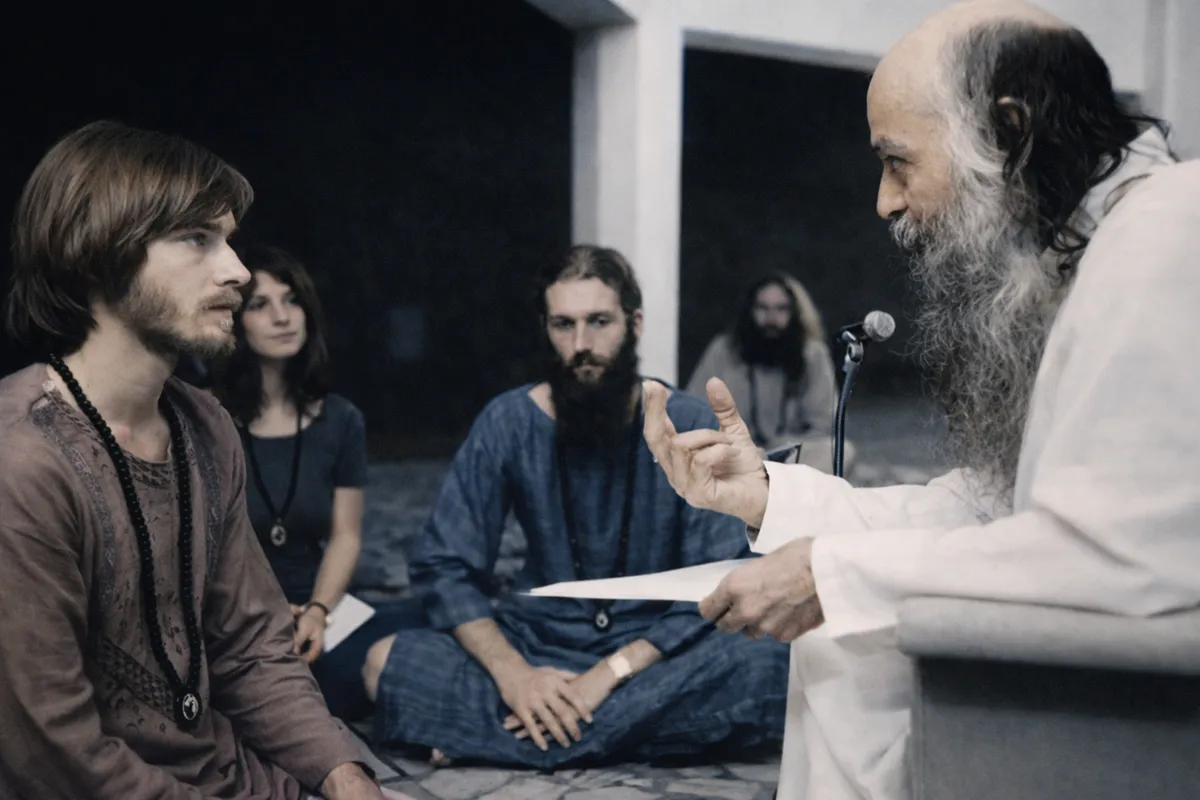
According to Osho, structured meditation is only a provisional support—use it if helpful, especially as a beginner. The mature sannyasin lets meditation permeate all activities, dissolving any separate timetable. When the same joy and silence arise while working as in sitting, technique can be dropped; life itself becomes uninterrupted meditation and grateful witnessing.
Start with set meditation if you need it, but aim to be mindful all day so you don’t need a special time.
From the Discourses
Passages where Osho speaks to this question — each links to the complete discourse.
No, take the challenge to stay with the every-day activity. Vipassana should not become a style of life. These are just techniques to be learned and immediately forgotten, so only the quality is carried with you. The flavour, the fragrance, not the flower, has to be carried into day-to-day activity. so by and by you don't know what is meditation and what is ordinary activity -- they become one. Learn the technique -- and for learning, of course, one needs to be in a particular place. Once you have known the technique, then unlearn it. Then just move into ordinary life -- eat, drink, sleep. Just be ordinary, and carry the sense of silence that has come to you. Again and again remember it, again and again remind yourself. Again and again move into that feeling and catch hold of it in ordinary life.
Now try to go deep into meditation. Sannyas needs nothing, nothing external; its need is just internal, and that is that you should be deeply involved in meditation and all your energy should flow into it. It is only a matter of effort for a few days in the beginning. Once the rock is broken and the stream starts flowing, there is no difficulty. Once the stream starts flowing, then the stream itself will carry you to the ocean. Effort is needed only in the beginning. If you do it for the first four to six months with determination, without wavering and without relaxing your efforts, then meditation will happen by itself; you will not be required to do it. Try all the meditation techniques here, and then regularly continue one of them that suits you. [The new sannyasin says: I do Vipassana.] Vipassana is good. Concentrate on Vipassana....
So my sannyas can be reduced to a simple definition: non-identification with any role you are playing, whatsoever it is. One can be a doctor or a businessman, one can be an engineer or a painter -- whatsoever role you are playing, remember it is a play. Don't get serious about it. Success and failure are the same when it is a play. Whether you succeed or fail does not matter; what matters is that you remained alert all the time. Success comes, you watch it; failure comes, you watch it. Life is there, you watch it; death comes, you watch it. Your whole work is to remain a witness to all that happens around you, within and without. This is the foundation for my sannyas. And the second thing to remember is: this witnessing is possible only if you slowly move into meditation.
A friend has asked, Osho, why should we be religious when neither the beginning nor the end is known, and there is no trace of God or soul? The enlightened ones speak of truth—if that truth is real, why can’t they make everyone experience it?
No one is telling you to be religious—at least Lao Tzu would not. The so-called religious people have created so much disturbance that it is better you do not become one of them. Lao Tzu does not say, “Be religious.” He simply says: be what you are. You may ask, why should I be what I am? Because that is the only thing you can be. There is no way to be anything else. Yes, you can try to be something else—and in that trying your life can be wasted. You may then say, why not waste life? No one can stop you. And precisely for this reason even the enlightened ones are defeated and cannot give you the knowledge of truth—because you say, why should we know the truth? What can the enlightened do? They can speak. They can try to awaken in you the thirst for the joy…
All that we do here is to help you to put the mind aside. All the meditations are nothing but devices to put the mind aside. And once you have got even just a glimpse of your inner light, then things become very easy. Then you know that the light is inside. And then to put the mind aside is not difficult because now you know there is no risk -- it is worth putting it aside. Only in the beginning is it difficult because you only know the mind. You have been identified with it, you think you are the mind so to put it aside feels very dangerous. It feels like committing suicide, because it is you! But you are not it. It is just a deep-rooted misconception, a wrong calculation. You are simply making a mathematical mistake. Two plus two are four, and you are putting five.