
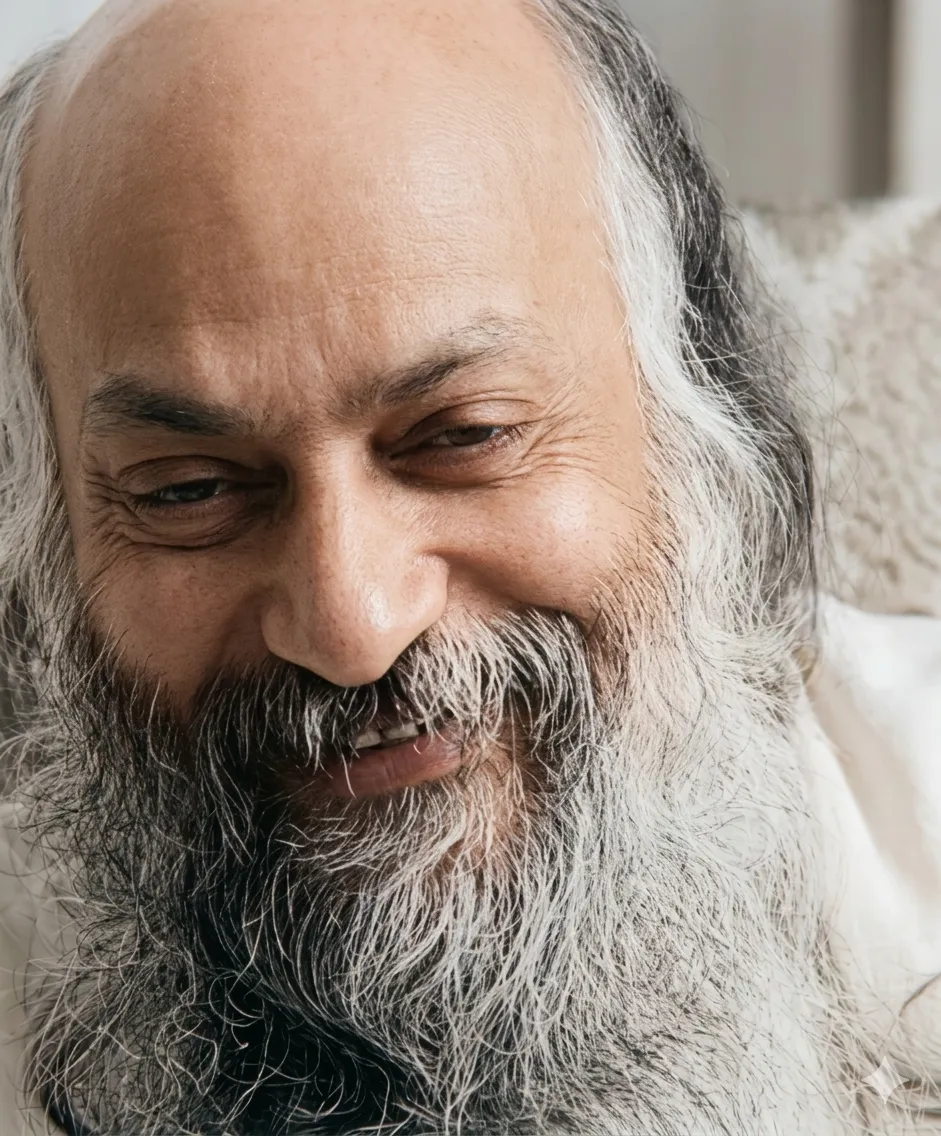
Watch your mind and keep reminding yourself you’re not your thoughts or conditioning—ask, “Am I just what I know?”—until a calm inner distance appears.
From the Discourses
Passages where Osho speaks to this question — each links to the complete discourse.
But Osho, as I understand it, our mind is conditioned, and sometimes it plays all sorts of monkey tricks and does not allow us to enter the state of meditation. What measures do you suggest for that?
It will happen. The mind will make every effort to save itself. It will try with all its strength to preserve itself. And the truth is, it succeeds only because we also believe that we are the mind. Therefore its efforts succeed. But these efforts can be broken, because they do not stand on truth—this is not the truth. What we have been taught is not what we are. If that were what we are, then who would there be to teach? A child is born. He brings consciousness; he does not bring a mind. The mind will now be manufactured. He has brought consciousness, the capacity to learn, an inner awareness, a soul. Around this soul a wall of mind will be raised, on which it will be written, “You are a Hindu.” Into it everything will be written: higher and lower; Brahmin and Shudra; what is and what…
There are social needs and there are existential needs that are to be fulfilled. I will not say, "Do not condition children." If you leave them totally unconditioned, they will be barbaric. They will not be able to exist. Survival needs conditioning but survival is not the end, so you must be able to put your conditioning on and take it off--just like clothes. You can put them on, go out and do your business, and then come home and take them off. Then you are. If you are not identified with your clothes, with your conditioning, if you do not say, for example, "I am my mind," it is not difficult; then you can change easily. But you become identified with your conditioning. You say, "My conditioning is me," and all that is not your conditioning is denied.
Beloved Osho, for years I have been a "groupie" searching for ways to understand myself. I have been in such misery that almost nothing asked of me was too much if it held a chance of alleviating my distress. Now you offer meditation as a means for leaving my misery behind, and all I do is resist. The thought of being still and quiet doesn't excite me. In fact it scares me, and I end up even more anxious. I don't understand this. Could you please explain this resistance to meditation?
In India if you take a bath once a year you alone will be enough to stink up the whole neighborhood -- so much perspiration, so much dust. And those lamas are still using many clothes, layer upon layer, I think seven layers at least. And they suffer from the heat, but the mind... they feel something is wrong, but the mind has gone so deep. For centuries they have lived that way. I told them, "If you want to talk to me you have to be at least ten feet away. Don't come near me because I am allergic to any kind of smell -- it may be Buddhist, it does not matter." In India it is very usual to take two baths, one in the morning, one in the evening. And those who have time, people like me... I used to take three -- one in the morning,…
[And to remind the next sannyasin of that promise Osho gave him the name Akash -- sky!] Mind is a very small thing, it is like a prison cell. And everybody is imprisoned in his own mind: in his prejudices, creeds, dogmas, religions, philosophies -- political and spiritual. Everybody is living in a very small dark cell. The cell is made of conditionings. Meditation means unconditioning the mind and never allowing it to be reconditioned. Otherwise it is very easy to move from one dark cell to another dark cell. A Hindu can become a Christian; that is very easy, there is no conversion. Instead of worshipping Krishna he starts worshipping Christ. In fact linguists say that the word 'Christ' comes from the word 'Krishna'; they are not different words, their root is the same. So you have changed from one cell to another. A Christian can become a Hindu.
All that we do here is to help you to put the mind aside. All the meditations are nothing but devices to put the mind aside. And once you have got even just a glimpse of your inner light, then things become very easy. Then you know that the light is inside. And then to put the mind aside is not difficult because now you know there is no risk -- it is worth putting it aside. Only in the beginning is it difficult because you only know the mind. You have been identified with it, you think you are the mind so to put it aside feels very dangerous. It feels like committing suicide, because it is you! But you are not it. It is just a deep-rooted misconception, a wrong calculation. You are simply making a mathematical mistake. Two plus two are four, and you are putting five.