
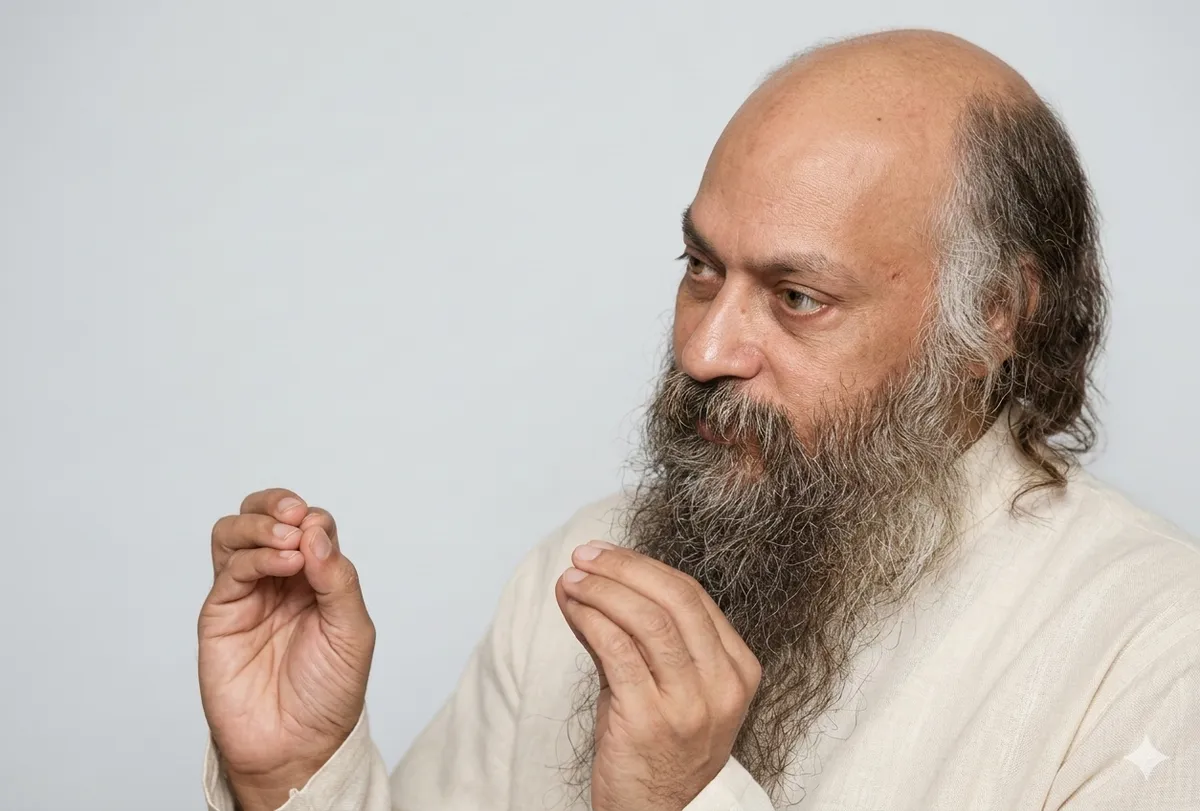
Fighting can’t create real peace; it only stops a bigger hurt for a while.
From the Discourses
Passages where Osho speaks to this question — each links to the complete discourse.
Osho, you said... then you will find that the devotee is God. The question arises: if one devotee prefers to be God and another wants to remain only a devotee, then which of the two is superior?
The one who wants to be God will not be able to be. And the one who wants to remain a devotee will become God. The question of superior or inferior does not arise, because only one of the two will happen. The one who does not want to be will be. The one who wants to be will be deprived. That very wanting is of the ego. But the matter is a little delicate. Sometimes humility too belongs to the ego. Beware that your humility may not be of the ego. Perhaps you are saying, “No, I don’t want to be,” because you know that those who refuse are the ones who attain. Then you are clever. Then your humility is adulterous. Your humility is not pure, not sacred, not virginal—it is like a prostitute. The one who wants to be God, whose ego says, “I must become God,”…
Peace of mind can be gained by withdrawal from the world, by stilling the vortices of the mind. But how much inner peace is appropriate in a world that contains attica, vietnam, johannesburg, biafra, pakistan and sub-sahara africa?
Withdrawal is escapist. Withdrawal can give you a kind of death, but not peace. Peace is very alive. Peace is more alive than war -- because war is in the service of death, peace is in the service of life. Peace is very alive, vibrant, young, dancing.... Withdrawal? -- that is the oldest way escapists have chosen. It is cheap. It gives a kind of peace -- remember, I say 'a kind of peace' -- the same kind as you see in a graveyard. You can go to a Catholic monastery -- there is a kind of peace, the same that exists in the graveyard. You can go to the Jaina monks and you will see a kind of peace -- the same that exists in a graveyard. These people are dead! They have renounced life. The day you renounce life you renounce responsibility, you renounce all kinds of commitments.…
Should I take it, Osho, that an escapist cannot love and cannot be nonviolent?
Yes, an escapist can neither love nor be nonviolent. But an escapist may appear to love, and he can even put on the costume of nonviolence—and often he will do exactly that. The escapist cannot love because he has not yet been born; he is not yet there. Who will love? As I have said, it does not depend on the one who is loved; it depends on the one who loves. Only one whose individuality has dawned within, whose person has been born, can love. And the person is born out of struggle and challenge, by fighting every day—just as a sculptor chisels a stone. If the stone refuses to be cut and struck, no statue appears; it remains a rough rock. The struggles of life polish the statue within. If we refuse them, we remain stone. If individuality, soul, being, have not yet arisen within, who is there…
The first kind of peace is very easy. One can become a monk and go to the monastery and can attain to the first kind of peace very easily. Its method is renunciation: escape from all the possibilities which can disturb your peace. But it is cowardly, it is not for the brave. For the brave is the second kind of peace. Amidst all noise you should know how to be silent. In the marketplace you should know how to be a sannyasin. But then it has to be positive. So begin by being blissful and end in peace. Prem Renzo. Prem means love, renzo means victory -- victory through love. It is a paradox, because love does not want to be victorious, it does not want to conquer. On the contrary, it wants to surrender, it wants to be conquered; but in that very surrendering is the victory.
Osho, you know that right now the world is abuzz with talk of war. What can each of us do to avert this danger?
In one sense this is good, because we will have to decide. Only in moments of such danger do people decide; otherwise they don’t. When life itself is at stake, then decisions are made. Now life is at stake. Before this century ends, the world will have to decide: if you want war, let nations continue; if you do not, bid nations farewell. Once nations are gone, India need not keep an army—against whom would it keep one? Pakistan need not keep an army—against whom? And right now armies are devouring everything. Seventy percent of the world’s wealth is eaten up by armies. This world could become a paradise. Just imagine if that seventy percent were invested in productive work, and these idle people who do nothing all day but drill—foolishness! Left turn! Right turn! What is the point of left turn and right turn? Why on earth are you…