
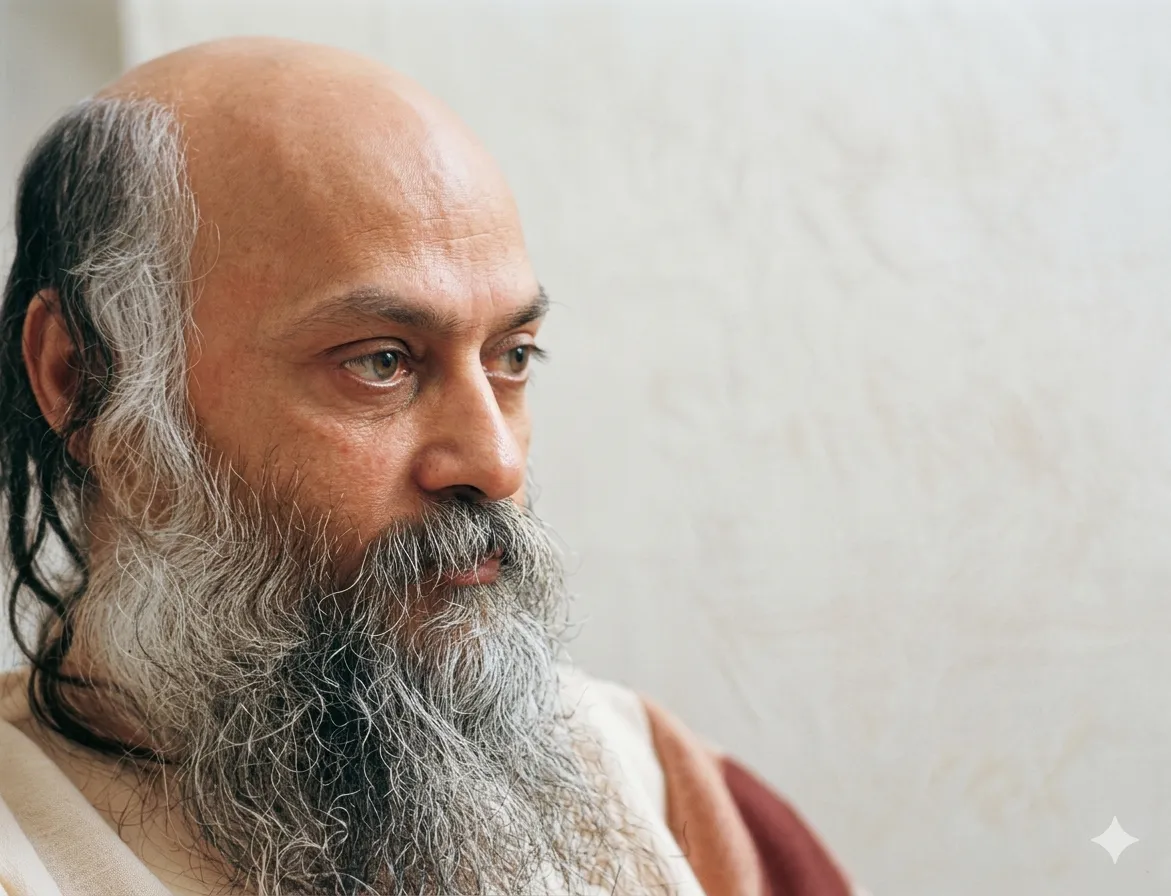
The real Gayatri and Namokar aren’t what you say; they show up by themselves when you become totally quiet inside and simply listen.
From the Discourses
Passages where Osho speaks to this question — each links to the complete discourse.
Osho, you told the story about the parrot-like rote chanting of the Gayatri Mantra and the Namokar Mantra. You want to stop this parrot-chanting. Is that what the Gayatri Mantra is? Is that what the Namokar Mantra is?
Achyut! Exactly so. Where all mantras fall silent, there the real mantra is born. The mantra you repeat has no value. If it is repeated by your tongue, it cannot be worth more than the tongue that repeats it. The Om you hum will be smaller than you. There is another Om that does not arise from your humming—the humming from which you arose. There is another Om whose resonance envelops the whole universe, from which the world is fashioned. To hear that Om, you don’t need to hum. To hear that Om, all humming must cease; speech must fall utterly silent; thoughts dissolve; no ripple remains in the mind—then suddenly, in amazement, you will hear: a music is playing within! It has been playing forever. But you were filled with your own noise and could not hear it. And sometimes, when you slip out of worldly noise, you fill…
दूसरा प्रश्न: ओशो, आपने गायत्री मंत्र और नमोकार मंत्र के तोता-रटन की कहानी सुनाई। इस तोता-रटन को आप बंद करवाना चाहते हो। क्या यही गायत्री मंत्र है? क्या यही नमोकार मंत्र है?
अच्युत! ऐसा ही है। जहां सारे मंत्र शांत हो जाते हैं, वहीं असली मंत्र पैदा होता है। जो मंत्र तुम दोहराते हो, उस मंत्र का कोई मूल्य नहीं है। तुम्हारी जबान से दोहराया गया, तुम्हारी जबान से ज्यादा मूल्यवान हो भी नहीं सकता है। जिस ओंकार को तुम गुनगुनाते हो, तुम्हारा ओंकार तुमसे छोटा होगा। एक और ओंकार है, जो तुम्हारे गुनगुनाने से पैदा नहीं होता--जिसकी गुनगुनाहट से तुम पैदा हुए हो। एक और ओंकार है, जिसका नाद सारे जगत को घेरे हुए है; जिससे जगत निर्मित हुआ है। उस ओंकार को सुनने के लिए गुनगुनाने की जरूरत नहीं है। उस ओंकार को सुनने के लिए सब गुनगुनाना बंद हो जाए, वाणी मात्र शांत हो जाए, विचार लीन हो जाएं, मन में कोई तरंग न रहे, तब अचानक तुम चकित होकर सुनोगे--एक संगीत बज रहा है भीतर! सदा से बजता रहा है। …
Osho, different religions have discovered different great mantras—like Om Namah Shivaya, Namo Arihantanam, Allahu Akbar, Om Mani Padme Hum. In what state did such great mantras descend, and how are they related to the inner centers? And how should a seeker choose the mantra suitable for himself?
It happened that when Vivekananda came to Ramakrishna, his household was in dire straits. His father had died—and, being a worldly, whimsical man, had left many debts. There was not even food enough. If somehow there was food, it was not enough for both mother and son. Vivekananda would tell his mother, “A friend has invited me today,” so that she would eat; otherwise she would feed him and remain hungry. Saying so, he would wander the lanes, then return home cheerful, belching, as if well-fed—no friend had invited him—but to make his mother feel at peace that he had eaten well so she could eat without worry. Ramakrishna came to know and said, “You are a great fool. You come daily to Mother Kali’s court—why don’t you ask? Such a small matter—why suffer needlessly?” At Ramakrishna’s insistence, Vivekananda said, “If you say so, I will ask.” Ramakrishna sat outside…
प्रश्न: ओशो, अलग-अलग धर्मों ने अलग-अलग महामंत्र पाए हैं, जैसे ॐ नमो शिवाय, नमो अरिहंताणं, अल्लाहो अकबर, ॐ मणि पद्मे हुम्। तो ऐसे महामंत्र कौन सी अवस्था में उतरे हैं और इनका भीतर के कौन-कौन से केंद्रों से कैसा संबंध है? और साधक इनमें से अपने लिए योग्य महामंत्र कैसे चुने?
… पिता चल बसे थे। और पिता संसारी मनमौजी आदमी थे, तो बड़ा कर्ज छोड़ गए थे। घर में रोटी का भी इंतजाम न था। किसी तरह रोटी जुटती थी, तो मां और बेटे दोनों के लिए काफी नहीं होती थी। तो विवेकानंद मां को कहते कि मुझे किसी मित्र ने निमंत्रण दिया है आज, ताकि मां रोटी खा ले, अन्यथा विवेकानंद को खिला देती और खुद भूखी रह जाती। तो ऐसा कहकर आस-पास की गलियों में चक्कर लगाकर वहां से बड़े प्रसन्न और डकार लेते लौटते थे। न किसी मित्र ने निमंत्रण दिया है, लेकिन मां को दिखाने को कि भोजन कर आया हूं, बड़ा प्रसन्न हूं, बड़ा अच्छा भोजन था, ताकि मां भी निश्चिंतता से भोजन कर ले। रामकृष्ण को पता लगा तो रामकृष्ण ने कहा, तू भी बड़ा मूर्ख है। यहां रोज काली के दरबार में उपस्थित होता है तो मांग क्यों नहीं लेता? …
Even more surprising is the third point: Russian scientists think this energy that spreads all around can be stored—can be stored in instruments. Certainly, if it is energy, it can be stored. Any energy can be stored. And this prana-energy, which Yoga calls prana—if this energy is stored in devices, then the essential mood of the person at that time remains in the stored power as a quality. For example, if Mikhailova is drawing an object towards herself, at that time the energy flowing from her body—by which she will lose three or ten pounds—can be stored. Receptive instruments have been prepared such that the energy enters and is stored in them. Then, if that device is placed in this room and you enter the room, it will draw you towards itself. You will feel like going near the device—the person is not there.
इससे भी हैरानी की बात जो तीसरी है वह यह कि रूसी वैज्ञानिकों का खयाल है कि यह जो एनर्जी है, यह चारों तरफ जो ऊर्जा फैलती है, इसे संगृहीत किया जा सकता है, इसे यंत्रों में संगृहीत किया जा सकता है। निश्चित ही जब एनर्जी है तो संगृहीत की जा सकती है। कोई भी ऊर्जा संगृहीत की जा सकती है। और इस प्राण-ऊर्जा का, जिसको योग ‘प्राण’ कहता है, यह ऊर्जा अगर यंत्रों में संगृहीत हो जाए, तो उस समय जो मूलभाव था व्यक्ति का, वह गुण उस संगृहीत शक्ति में भी बना रहता है। जैसे, माइखालोवा अगर किसी वस्तु को अपने पास खींच रही है, उस समय उसके शरीर से जो ऊर्जा गिर रही है--जिसमें कि उसका तीन पौंड या दस पौंड वजन कम हो जाएगा--वह ऊर्जा संगृहीत की जा सकती है। ऐसे रिसेप्टिव यंत्र तैयार किए हैं कि वह ऊर्जा उन यंत्रों में प्रविष्ट हो जाती है और संगृहीत हो जाती है। फिर यदि उस यंत्र को इस कमरे में रख दिया जाए और आप कमरे के भीतर आएं तो वह यंत्र आपको अपनी तरफ खींचेगा। आपका मन होगा, उसके पास जाएं--यंत्र के, आदमी वहां नहीं है। और अगर माइखालोवा किसी वस्तु को दूर हटा रही थी और शक्ति संगृहीत की है, तो आप इस कमरे में आएंगे और तत्काल बाहर भागने का मन होगा।
Many friends have asked: Osho, is there no place at all for japa? We chant Om, the Gayatri; some chant Ram-Ram, some the Namokar—this or that. Is there no use in these? You never speak in favor of chanting!
Even human names are fictitious. You were born, and then a name was given to you. You came without a name—nameless. For convenience, parents stick on a label: this one is Ram, this one Vishnu, this one Krishna. These names are makeshift, false, pasted on from outside. No person truly has a name. That tree standing there—does it have a name? A tree has no name. All names are human givings. If humans were to vanish from the earth, would anything have a name? Nothing would. The trees would still be there, the mango would still be there; the moon and stars would still be there—but there would be no names. Even now, they have no names of their own. Names do not exist in existence; they are a human invention. And we are so clever we have not only named things—we have named God as well. Names are a…
अनेक मित्रों ने पूछा है कि ओशो, क्या जप का कोई भी स्थान नहीं है? कि हम ओम को जपते हैं, हम गायत्री को जपते हैं, कोई राम-राम, कोई नमोकार, कोई कुछ, कोई कुछ। इनका क्या कोई उपयोग नहीं है? आप तो इनके जप की कोई बात नहीं कहते!
नाम तो आदमियों के भी झूठे हैं। आप पैदा हुए, तब आपको नाम दिया गया। आए आप बिना नाम के हैं--अनाम। फिर मां-बाप काम चलाने के लिए नाम दे देते हैं कि इनका नाम राम है, इनका नाम विष्णु है, इनका नाम कृष्ण है। ये नाम सब कामचलाऊ हैं, झूठे हैं, ऊपर से चिपकाए गए हैं। कोई आदमी का कोई नाम नहीं है। यह सामने वृक्ष खड़ा है, इसका कोई नाम है? वृक्ष का कोई नाम नहीं है। सब नाम आदमियों के दिए हुए हैं। अगर पृथ्वी पर आदमी समाप्त हो जाए, तो किसी चीज का कोई नाम रह जाएगा? किसी चीज का कोई नाम नहीं रह जाएगा। फिर भी दरख्त होंगे, आम होगा; फिर भी होगा। चांद-तारे होंगे, लेकिन नाम नहीं होगा। नाम अभी भी नहीं है उनका। नाम कहीं है ही नहीं जगत में, सिर्फ आदमी की ईजाद है। और हम इतने होशियार हैं कि हमने चीजों के भी नाम रख लिए हैं और परमात्मा का भी नाम रख लिया है।