
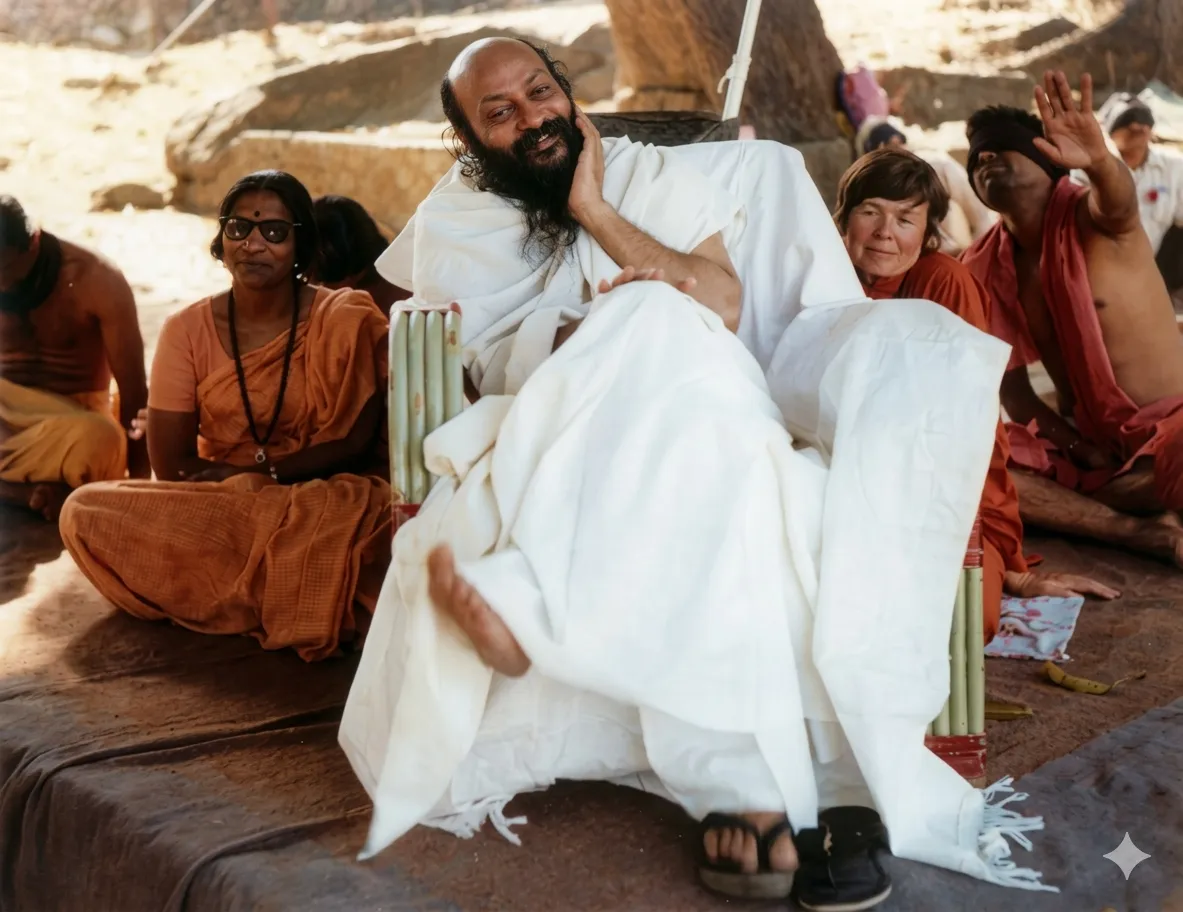
According to Osho, truth isn’t an external thing to be found; it is your own subjectivity—pure, silent awareness free of objects and objections. In deep silence, all preventions fall away and only presence remains; then your very existence is truth. Do not seek a labeled 'Truth' out there; realize the here-now, unhindered consciousness that you are.
Truth isn’t a thing to find; it’s you being quietly aware right now.
From the Discourses
Passages where Osho speaks to this question — each links to the complete discourse.
Beloved Osho, for the past seven years I have heard you speaking about truth. But this is still an empty word for me. Often you say that one knows truth when one is silent inside. I know this delicious feeling that takes me over when I close my eyes and become quiet inside, but what is truth to do with that?
That is the truth. Truth is not an object that you will find somewhere when you are silent. Truth is your subjectivity. Just try to understand. You are there, and the whole world is there. Whatever you see is an object, but who is seeing it is the subject. In silence all objects disappear -- and the word `object, has to be remembered; it is the same word as `objection.' `Object' means that which prevents you. So all preventions, all objects, all objections, disappear; you have the whole infinity, and just silence. It is full of consciousness, it is full of presence, of your being. But you will not find anything as the truth -- that will become an object. And truth is never an object. Truth is subjectivity. To discover your subjectivity -- unhindered, unobjected to by anything, in its total infinity and eternalness -- is the truth. "The…
truth cannot be achieved by human efforts because all human efforts are bound to originate in the mind and mind is the barrier between truth and consciousness the mind has to be put aside that's what man is capable of doing not using the mind, putting the mind aside by-passing the mind, transcending the mind and the moment the mind is not functioning consciousness immediately becomes connected with the truth the barrier is no more there hence the bridge happens and that is the greatest blessing in existence when truth showers on you only with the experience of truth life becomes meaningful, significant a celebration a man without truth is a beggar a man without truth is not yet really alive he is simply living in a kind of dream he is not awakened not awakened to the tremendous beauty of existence to the immense ecstasy of life not aware…
Osho, what is the definition of God?
Words are very small. If you say God is light, then what of darkness? The scriptures have said that God is light. Suppose we accept this as a definition—then what about darkness? Where will darkness go? Darkness is too; in fact it is far more than light. Light sometimes is and sometimes is not; darkness is always, eternal. Where will you place darkness? If you say God is light, darkness is left out. If you say God is darkness, then light is left out. If you say God is both darkness and light, a contradiction arises: they cannot be together. Try to have both darkness and light in the same room. If you bring in light, darkness disappears; if you preserve darkness, you cannot have light. Then how can both be together? That becomes an impossibility. So you cannot say “both” either. Then the fourth device is to say: it…
Question: Fourth question: Osho, where is truth? Dhirendra, truth is here! Why ask “where”? “Where” means somewhere else—at the Kaaba, in Kashi? “Where” means somewhere else—at Girnar, at Shikharji? “Where” means somewhere else—on the Himalayas, in Tibet? Feet not anchored on earth, yet flying in the sky; flowers of emptiness, bubbles of the mind, ripening without any breeze. Accursed hope keeps hoeing the green fields of belief. But how simple is man! He has endured for countless ages, has kept hearing a great hullabaloo age after age, yet he has always been a worshipper of life. The ocean’s waters crashed over him, and still he did not collapse. The religion of the earth is a fair of beliefs. How many beliefs we have piled up here! There are three hundred religions on the earth, and from those at least three thousand sects.
First you have to become a little happier, you have to learn to be a little more love-full, joyful; your life has to have the color of a little happiness. Then go into the search for truth and you will be moving in the right direction, because then no lie can ever deceive you. You are no more interested in lies, because you are no more interested in consolation and comfort. Now you are ready to know the naked truth as it is. And to be a seeker of truth is the greatest thing in life. Satbodh One cannot find truth by mere thinking. Thinking is not the process that leads you to the truth. It leads only to inference. And inferences are just inferences, they are hypothetical. They may be true, they may not be true. They are just conjectures, not real conclusions.