
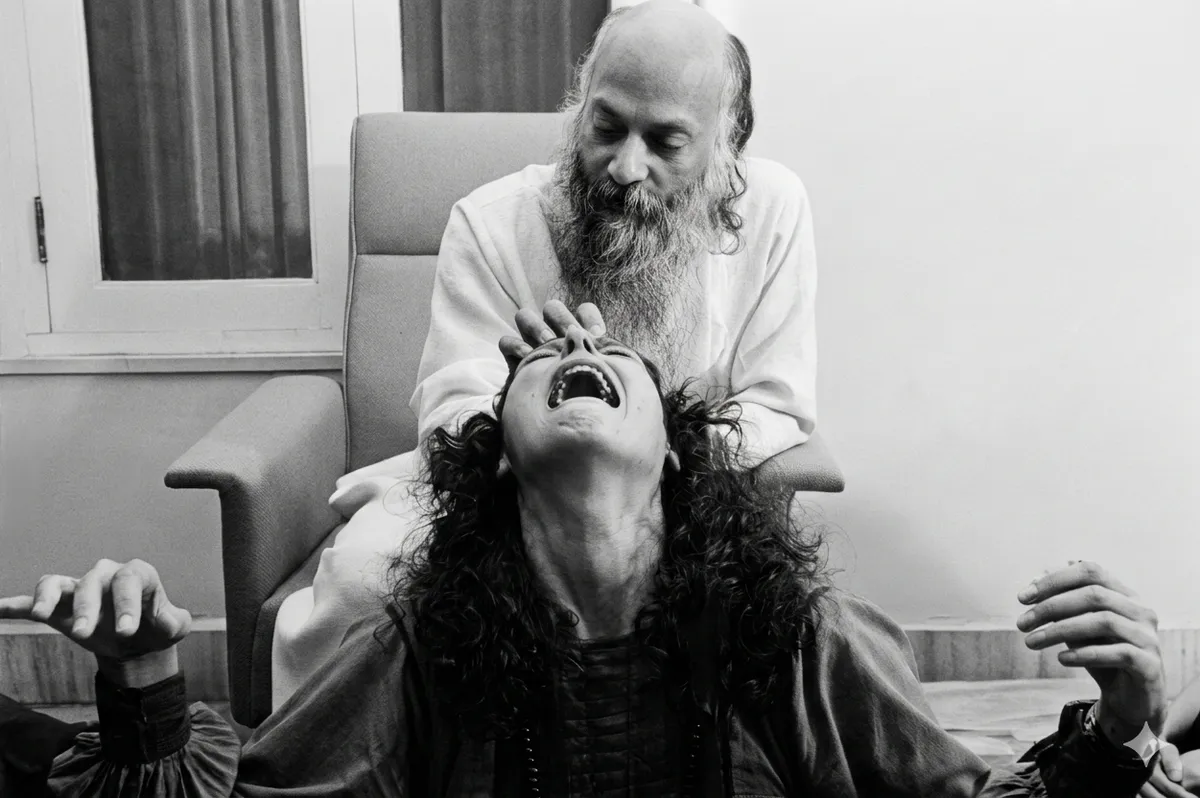
Stop trying to win and control everything; relax and trust life, and your head and heart become clear.
From the Discourses
Passages where Osho speaks to this question — each links to the complete discourse.
Question: BELOVED OSHO, WHAT IS THE TRANSCENDENTAL? ... And existence is a mystery. It is not something that you have to solve. It is not a problem, nor is it a puzzle; there is no solution to it. No philosophy can demystify it. You can experience it, you can enjoy it, you can dance it, you can live it, but you cannot know it. The young mother is skeptically examining the new educational toy. "Isn't it rather complicated for a young boy? she asks the assistant. "It is the very latest idea," replies the girl. "It is designed to adjust the child to live in today's world. Any way he tries to put it together is wrong. But this small anecdote is true about existence. Any way you want to explain it, your explanation is wrong. Those who know it do not try to explain it.
Beloved Osho, recently I heard you say that transcendence of life's misery and confusion can occur by either a let-go of life or by fight -- as long as either is done with totality. Mahavira's way was fight, and yours is let-go. Could you say more about let-go and its relationship to intelligence and responsibility? I don't have this understanding, and my life seems to be an odd mixture of let-go and fight. Let-go seems more natural, and fight seems more responsible.
He was standing there just to see her for the last time. It was enough for him that she was happy and healthy -- and he would wait. If his love has any power, she will come back. There was tremendous trust in him. He had seen the love, the same flame that was burning in his heart, in the eyes of Laila too. Laila was also searching and looking all around from the camel she was riding. She knew Majnu must be waiting somewhere on the way, and then she saw him hiding under a tree in its thick foliage. For a moment, without a single word or gesture, they were one; and then the caravan passed. But for Majnu time stopped then and there. He remained standing by the side of the tree waiting and waiting. It is said years passed. Laila came, but came a little late.…
You said yesterday that life exists with death. Then please explain what is the need of transcendence.
This is the need. There is the need. Life exists with death... if you can understand this, you have transcended. You accept life, you don't accept death. Or do you? You accept life but you reject death, and because of that you are always in trouble. You are in trouble because death is part of life. When you accept life, death is going to be there, but you reject death. When you reject death you have rejected life also because they are not two. So you will be in trouble. Either accept the whole, or reject the whole. That is transcendence. And there are two ways of transcending. Either accept both, life and death together, or reject both, life and death together -- then you have transcended. These are the two ways, the negative and the positive. The negative says, "Reject both." The positive says, "Accept both" but the emphasis…
Beloved master, it seems to me that being here with you means to let go of everything -- not only the misery, fear, sadness and the so-called negative spaces, but also the happy, loving, flowing feelings, the so-called positive spaces that have always been my goal. Beloved master, is this the way it is?
Anand Hareesh, the positive and the negative, the night and the day, the summer and the winter, birth and death -- they are not separate. If you want to let go of one, you will have to allow the other also to go. That is one of the greatest dilemmas: people want the positive to remain with them -- but if the positive remains, the negative remains as its shadow. The positive will not have any meaning without the negative. If you don't know what darkness is you will not be able to see light at all. If you want to see light you will have to be ready to experience darkness too. You cannot avoid death if you cling to life. It is life that brings death in. And everybody wants to cling to the positive spaces and everybody wants to avoid the negative spaces. This is impossible --…
And you say that you don't know the meaning of it. That's one of the essential qualities of a sannyasin: to function from the state of not-knowing. If you don't know something, simply say "I don't know." If you know, if you really know, only the say "I know." Much of the misery of the world can disappear if people become a little more alert. People go on saying things which they don't know, they go on pretending, as if they know. Not only do they deceive others, they deceive themselves too. People talk about God and heaven and hell and the theory of karma and rebirth; they go on talking about these things as if they know. They go on believing in their own false knowledge and because of this false knowledge they will never be able to attain to true knowledge.