
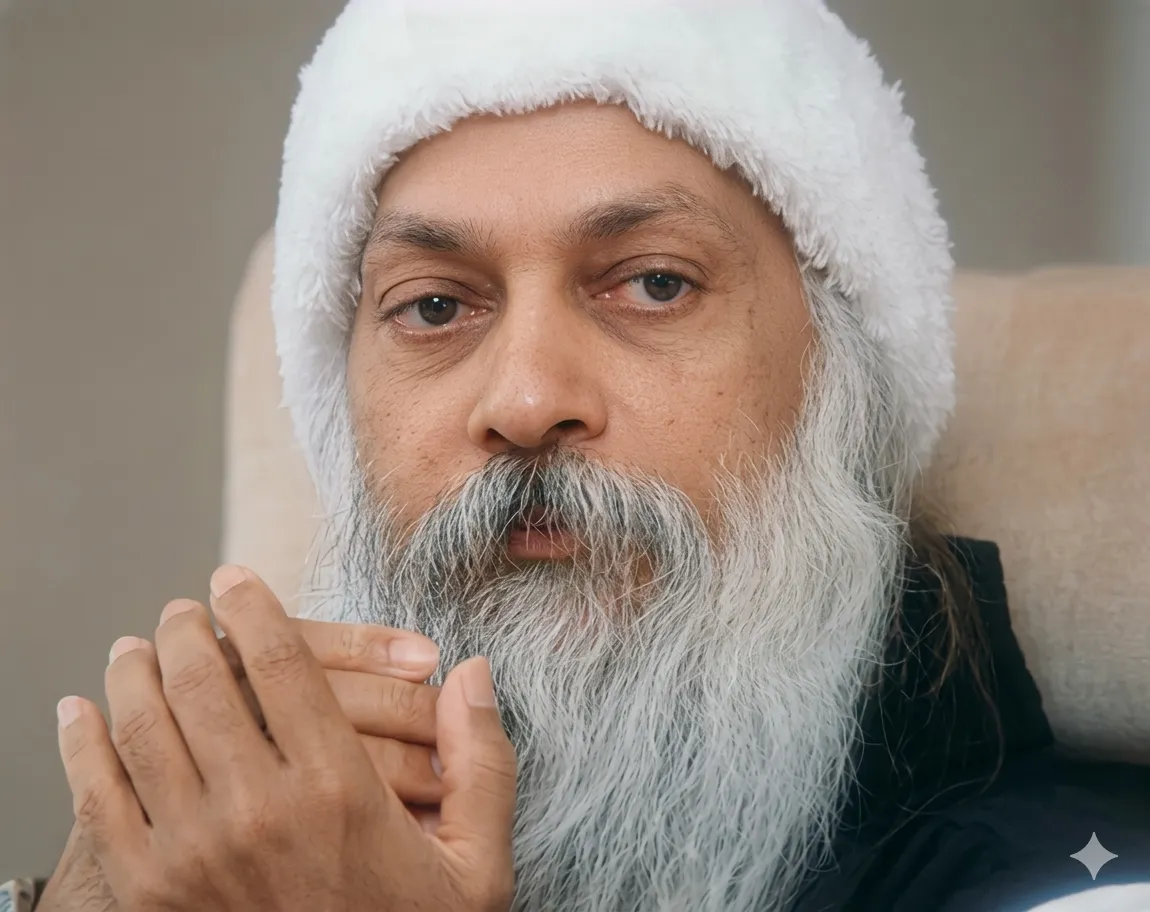
The crown opening is just the mind’s final fireworks; real awakening is when the mind completely stops and nothing can be said about it.
From the Discourses
Passages where Osho speaks to this question — each links to the complete discourse.
Question: does transcendence come with the opening of the sahasrar?
No, transcendence is beyond the opening. But enlightenment has two connotations. One, the dying mind - the ending mind, the mind that is going to die, the mind that has come to its peak, the mind that has come to its last - conceives of the enlightenment. But a barrier has come and now the mind will not go beyond this. The mind knows that it is ending, and with its ending the mind also knows the end of suffering; the mind also knows the end of division; the mind also knows the end of the conflict that was there. All this ends and the mind conceives of this as enlightenment, but it is still the mind that is conceiving of it. So this is enlightenment conceived of by the mind. When the mind has gone, then the real enlightenment comes. Now you have transcended, but you cannot talk about…
In the state of nirvichara samadhi, an object is experienced in its full perspective, because in this state knowledge is gained direct, without the use of the senses. The perception gained in nirvichara samadhi transcends all normal perceptions both in extent and intensity.
WHEN THIS CONTROLLING OF ALL OTHER CONTROLS IS TRANSCENDED, THE SEEDLESS SAMADHI IS ATTAINED, AND WITH IT, FREEDOM FROM LIFE AND DEATH. ... This is where all the paths culminate, all the Buddhas meet: Tantra and Yoga, Zen and Hassid, Sufi and Baul -- all the paths. Paths may be different -- they are -- but now this comes, the peak; here paths disappear. ... WHEN THIS CONTROLLING OF ALL OTHER CONTROLS IS TRANSCENDED... ... because Patanjali says that it is still a controlled state. Thoughts have disappeared: you can perceive now the existence, but still the perceiver and the perception, the object and the subject... With the body, the knowledge was indirect. Now it is direct, but still the knower is different from the known. The last barrier exists, the division. When even this is dropped, when this control is transcended, and the painter disappears in the painting and the lover disappears
The Western mind lives in time-consciousness, the Eastern approach is towards timelessness; hence our definition of truth is that which is beyond time. So unless you go beyond time you know nothing of truth. In time you only see a film on the screen -- it can be beautiful and for the moment you may become enchanted with it, but deep down you know that it is just a fiction. You may become engrossed in it, you may completely forget that it is just a fiction, you may start taking it for real -- and if it is a three-dimensional film it can give you the notion, the feeling, that it is real. But then the end comes, and the screen is left behind and then suddenly there is the realization that for the whole time only the screen was real and the film was just a projection.
Beloved Osho, a short time ago you said that spring has come and many sannyasins are ready to flower. Do "flowering," "awakening" and "self-realization" all mean enlightenment, the ultimate truth? Or is there a difference? And can a person, after attaining, fall back into identification with the mind?
From enlightenment, falling is simply impossible. You are gone -- and gone forever; not even a shadow or a trace of you is left behind. Up to self-realization the possibility remains -- it becomes less and less, but it remains. You can start being egoistic about your self-realization: "I have known, I am a realized person. I am a saint, I have encountered God" -- but that "I" is there, howsoever pious. Even its shadow is dangerous; it can pull you back. I have heard a very beautiful story about Jesus.... Jesus was walking through Jerusalem when he saw an angry crowd shouting and screaming at a woman. He came closer and heard the mob accusing the woman of adultery. Jesus strode to the front of the mob, held up his arms and said, "Let him who is without sin cast the first stone." The crowd fell silent, but one…
Osho, the samadhi you speak of—an attainment of which body is it?
In truth, there are many kinds of samadhi. One samadhi happens between the fourth and the fifth bodies. And remember, samadhi always occurs between two bodies; it is a twilight. Samadhi is never the event of a single body—it's an event between two bodies; it is the dusk. If someone asks, “Is dusk an event of the day or of the night?” we would say: dusk is neither of the day nor of the night; it is the happening between day and night. In the same way, one samadhi—the first—happens between the fourth and the fifth bodies. From the samadhi that happens between the fourth and the fifth, self-realization (atma-jnana) becomes available. Another samadhi happens between the fifth and the sixth bodies. From the samadhi between the fifth and the sixth, God-realization (brahma-jnana) becomes available. Another samadhi occurs between the sixth and the seventh. From what happens between the sixth…
प्रश्न: ओशो, जिसे आप समाधि कहते हैं, वह किस शरीर की उपलब्धि है?
असल में, बहुत तरह की समाधि हैं। इसलिए एक समाधि तो चौथे शरीर और पांचवें शरीर के बीच में घटेगी। और यह भी ध्यान रहे कि समाधि जो है, वह सदा दो शरीरों के बीच में घटती है; वह संध्याकाल है। समाधि जो है वह किसी एक शरीर की घटना नहीं है, दो शरीरों के बीच की घटना है; वह संध्याकाल है। जैसे अगर कोई पूछे कि संध्या, सांझ दिन की घटना है कि रात की? तो हम कहेंगे कि सांझ न दिन की घटना है, न रात की; रात और दिन के बीच की घटना है। ऐसे ही समाधि जो है, एक समाधि, पहली समाधि चौथे और पांचवें शरीर के बीच में घटती है। चौथे-पांचवें शरीर के बीच में जो समाधि घटती है, उसी से आत्मज्ञान उपलब्ध होता है। एक समाधि पांचवें और छठवें शरीर के बीच में घटती है। पांचवें और छठवें शरीर के बीच में जो समाधि घटती है, उससे ब्रह्मज्ञान उपलब्ध होता है। एक समाधि छठवें और सातवें के बीच में घटती है। छठवें और सातवें के बीच में जो घटती है, उससे निर्वाण उपलब्ध होता है। तो तीन समाधियां हैं साधारणतः। …