
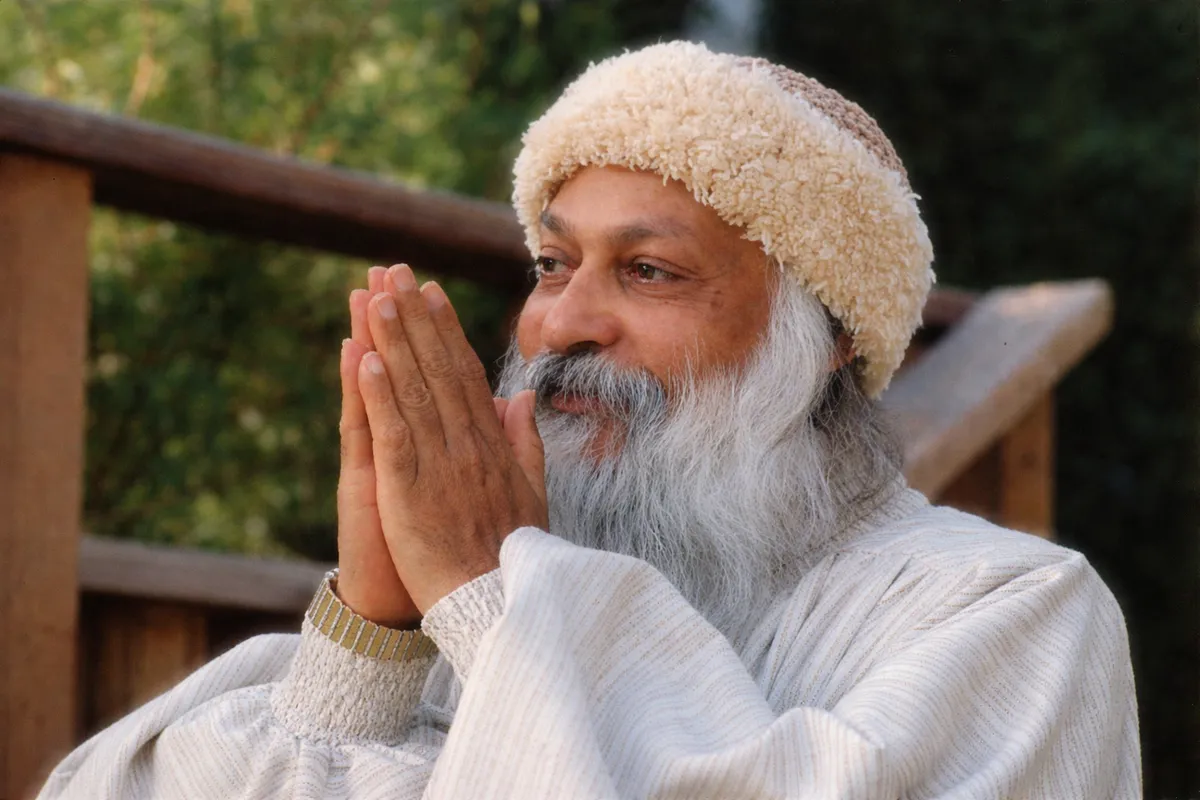
You don’t need a cave; you need a quiet mind—and you can find that anywhere.
From the Discourses
Passages where Osho speaks to this question — each links to the complete discourse.
Osho, caves were used for the practice of samadhi. But there the oxygen is scarce!
In truth, many factors underlie samadhi—many factors. And those who use caves for samadhi, if the other requirements are not in place, will not enter samadhi at all; they will fall into a swoon. What they will take to be samadhi will be only deep drowsiness, a state of fainting. A cave can be rightly used only by one who, through much pranayama, has oxygenated himself to such an extent that the cave’s thin air becomes inconsequential for him. If a man has done very deep pranayama, and every particle of his blood, every pore, every fiber has become oxygenated, then even if he is buried underground for eight days he will not die. That is the only reason. The body needs a certain quota of oxygen, and he carries an extra reserve. We carry no extra reserve. So if, without understanding pranayama, you go and sleep beside such a…
Questioner: many yogis make use of mountain caves which utterly lack oxygen. How do the caves help in attaining samadhi or unity with the absolute?
A seeker can project his vibes up to a particular limit of his space, and through experimentation he will learn for himself how much space he needs in order to safely do his sadhana. For instance, if he comes to know that he can fill an area of sixty four square feet with his own vibes, that much space will be considered safe for him, and he will find just that much space for himself. Then he will see to it that his cave has the least number of openings--perhaps one will be enough. And this single door should have a shape and size of its own; it should preserve the vibes of the seeker and at the same time keep off other unwanted vibes from entering the cave. If a number of seekers have used a particular cave for this sadhana, that cave acquires extraordinary significance, and new seekers…
Osho, to abide in oneself beyond the knower, knowledge, and the known—can one live in that state for an entire lifetime? Just as a lake is sometimes calm, sometimes playful, and sometimes stormy, does the self-realized one remain unaffected by worldly circumstances in the same way? Osho, dispel my ignorance!
Spring means harmony between season and mood. Meditation means harmony between you and the whole. You become harmonious. Whatever is, is perfectly okay—accepted. Nowhere any refusal, nowhere any opposition. Whatever is happening is auspicious. That is trust; that is meditation. Such meditation naturally takes you into an altogether new experience. Storms will rise; they will not stop because you meditate. Diseases will not stop coming to the body because you meditate. They will come. A thorn will sometimes pierce the foot. Raman had cancer; so did Ramakrishna—great storms came! Ramakrishna got cancer of the throat; he could neither eat nor drink. Vivekananda said to him, “What is not in your power! Why don’t you pray to the Lord at least to allow food and water to pass? We suffer watching you writhe.” Ramakrishna said, “Ah, it never even occurred to me to pray. How could it occur—to one whose prayer…
Osho, Buddha attained enlightenment under a tree. You say that on the day the event of enlightenment happened to Socrates, he was standing leaning against a tree. In Krishnamurti’s life too there is a similar mention, and you yourself, on the day of your enlightenment, left home and climbed a tree. So is there any esoteric relation between trees and enlightenment? And also explain: if enlightenment happens suddenly, how did you have prior intimation of it that day, so that you left home and climbed a tree?
If you go to England or America, you will meditate with the same ease—because what’s the point? That society isn’t yours. Those people are as good as non-existent. Whatever their eyes judge, what harm can it do you? But the eyes that know you, with whom you have dealings, business—those you fear. Your self-interest might suffer by offending them. And the image you have in their eyes—if that changes, you become restless. Because you have no understanding of yourself; what others think you are, that is what you think you are. If others say you are beautiful, you believe you are beautiful. If others say you are good and decent, you believe you are good and decent. And if others begin to think you are mad, it won’t be long before you start doubting yourself—and soon you will accept that you are mad. Psychologists say we stunt the intelligence of…
I am not saying to do anything. Meditation is not a doing at all, it is pure awareness. But a miracle happens, the greatest miracle in life. If you go on watching, tremendous and incredible things start happening. Your body becomes graceful, your body is no more restless, tense; your body starts becoming light, unburdened; you can see great weights, mountainous weights, falling from your body. Your body starts becoming pure of all kinds of toxins and poisons. You will see your mind is no more as active as before; its activity starts becoming less and less and gaps arise, gaps in which there are no thoughts. Those gaps are the most beautiful experiences because through those gaps you start seeing things as they are without any interference of the mind. Slowly slowly your moods start disappearing. You are no more very joyous and no more very sad.