
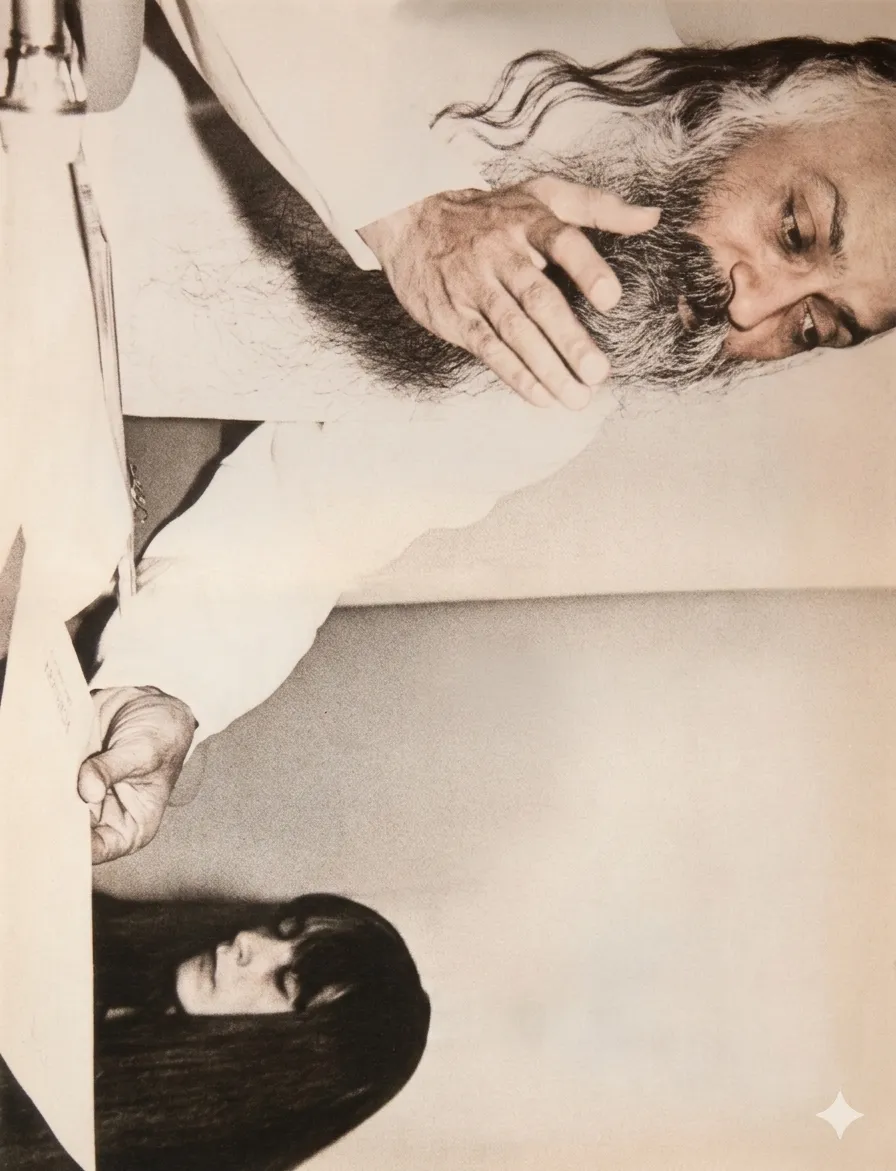
Many can wake up, but only a few can silently show others how—so the master chooses the one who understands without words to pass it on.
From the Discourses
Passages where Osho speaks to this question — each links to the complete discourse.
Beloved Osho, in many traditions the total transmission was passed from a master to only one disciple, such as from buddha to mahakashyapa, from bodhidharma to hui-ke, down to hui neng, whom you mentioned this morning. Do you have such a one right disciple to whom you plan to transfer total knowledge among your disciples? Is there a possibility that you will do this with a number of persons rather than only one? Why is it that the ultimate secret is usually transmitted to only one in many traditions?
Now, because this will be the last meeting, I would like to say something to you before you leave the campus. Firstly, this has been my observation -- that ninety percent of you, and this is a very great number, have been doing meditation very intensely. This is very hopeful but the intensity was more or less dependent on the group. It may be difficult for you to be so intense back at home. So do one thing: when you do the meditation at home, close your eyes first, feel me present just before you as I am here. Visualize me, visualize the group around you and then start meditation as you have been doing with the group. That will be very helpful. If you have a tape-recording, then put it on so that the whole atmosphere is created and you are not alone. It is very difficult to do…
Beloved Osho, the master speaks, and the disciples listen. What is it that happens, and remains unsaid?
Yoga Chinmaya, the master speaks, the disciple listens -- yet there is much which the master does not speak, and the disciple listens. In fact, that is the whole secret of disciplehood. If you only listen to that which is said, you are a student. You listen to the words, you miss the wordless. The moment you start listening to the wordless, you are initiated into disciplehood. The master is speaking. Naturally he has to use words, but he is also leaving gaps in between. He is also using wordlessness. He is saying something, and he is also meaning something which cannot be said -- but it can be heard. If the disciple is silent, he will hear the words and he will also hear the wordlessness; he will hear what is being said, and he will hear also what is not being said and yet is transferred. You are…
Question: Osho, what you have said about the bodiless soul makes it seem that we need to reflect on it again independently. The reason is that it raises many questions for us. Many of our beliefs and convictions seem to get shattered. And the biggest thing—the belief that gets shattered—is our trust in the Buddha. The Buddha undertook such immense discipline to know the mystery of life and death and to become fearless in the face of both. But that very Buddha, in the form of the Dalai Lama, comes here fleeing the clutches of the Chinese merely to save his life! The same Buddha who said “abhaya bhava” (be fearless), “appa dipo bhava” (be a light unto yourself)—that same Buddha, appearing as the Dalai Lama, comes before us as a coward!
Osho, that morning the Buddha bestowed the supreme treasure of silence upon Mahakashyapa by offering him the symbolic flower. A flower blooms in the morning and withers by evening. Yet the Zen tradition is alive to this day. Kindly explain the relation between the flower’s transience and the living vitality of Zen.
Seeing the meeting of these two lotuses, Mahakashyapa laughed—he blossomed. It was a unique event. Therefore the Buddha offered that lotus to Mahakashyapa and said to his monks, “What I could say in words, I have given you. What cannot be said in words and has not been said, I am giving to Mahakashyapa—wordlessly.” Thus, in the Zen tradition, from then on, one master has been giving to another in silence. One more story. In Mahakashyapa’s lineage there was Bodhidharma. Bodhidharma went to China, and from India the Zen tradition reached China. Bodhidharma was the twenty-eighth Indian patriarch. In China, Bodhidharma sat facing a wall for nine years. People came, but he would not look at them. He kept his back toward them. People asked, “We have seen many monks, many saints—but why do you keep your back to us?” Bodhidharma said, “When one worthy of falling within my eyes…
Beloved Osho, sitting in your presence is such a beautiful experience. We call it discourse. This word seems to me so poor next to what is happening here. Is there a word in any language that could point to, if not describe, what is happening between the master and the disciple?
I have talked about Zen: Mahakashyap was the first -- not Gautam Buddha -- to initiate the process which culminated in Zen, because it was his disciple, Bodhidharma, who took the message to China. And perhaps Gautam Buddha would not agree with everything Zen consists of, because the real master of Zen and its origin is Mahakashyap, who has a totally different personality from Gautam Buddha -- less serious, with a sense of humor, with no idea of holier-than-thou. The man who was finally the decisive factor was Bodhidharma; he comes in the fifth generation of disciples of Mahakashyap. He was very decisive in giving a certain character to Zen, which it still carries. Bodhidharma is farther away still from Mahakashyap. He has a great sense of humor, is very straightforward, knows no etiquette, no manners, is very simple and innocent, has no philosophical background, speaks in an ordinary way.…