
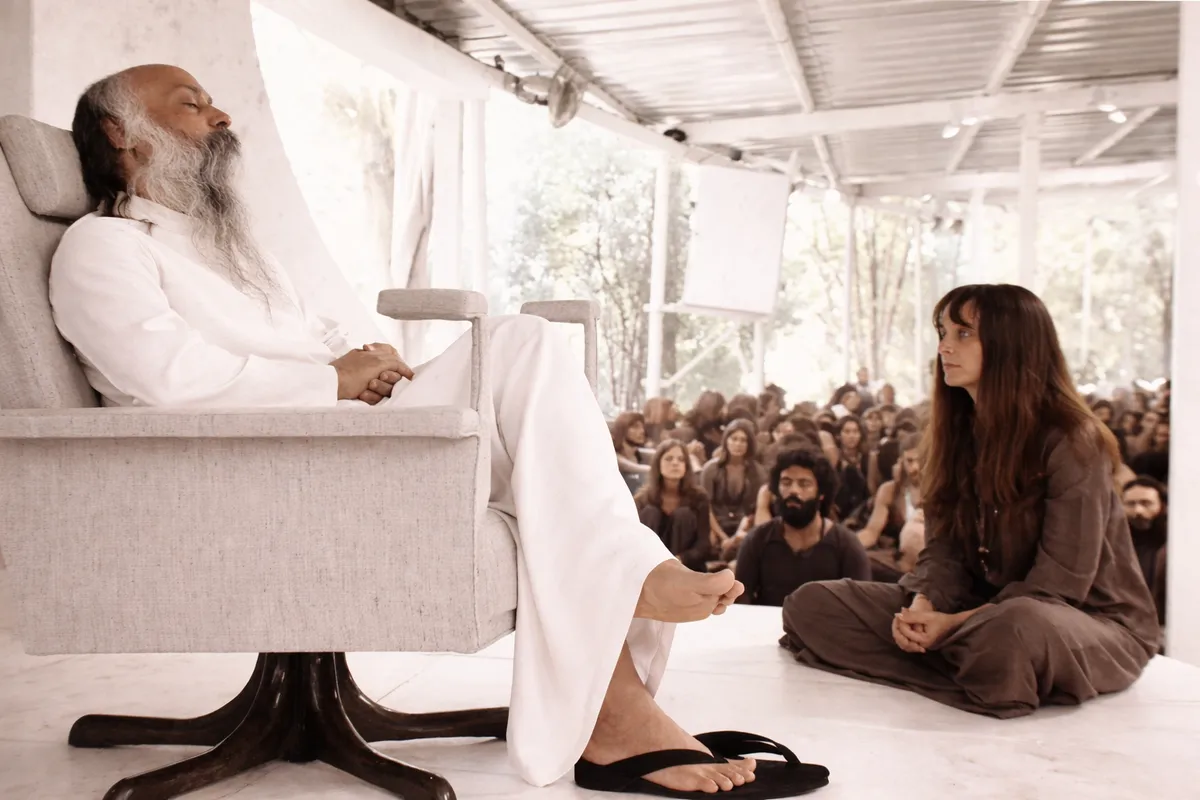
Lao Tzu isn’t something to talk about but something to become, and his spirit flows through everything Osho says.
From the Discourses
Passages where Osho speaks to this question — each links to the complete discourse.
Why can you not continue talking on lao tzu?
If you understand me I am always talking on Lao Tzu. If you don t understand me, even while I am talking on Lao Tzu it will be of no use. In fact I am never just to anybody else -- Patanjali. Jesus. Mahavir, Buddha. No, I am never just; I cannot be. The Lao Tzu goes on coming in. I am continuously talking on Lao Tzu. When I am talking on Lao Tzu, when I am talking on Patanjali, when I am talking on Buddha or Jesus; if you can understand me, Lao Tzu remains the continuous undercurrent. But if you don't understand me, then the question arises, "Why can you not continue talking on Lao Tzu?" Lao Tzu to me is not a subject matter; Patanjali is. When I speak on Patanjali I speak on Patanjali. When I speak on Lao Tzu I don t speak on Lao…
Osho, from the exposition of Lao Tzu’s nondual philosophy it is clear that he had attained supreme knowing. Then why is it that only a handful in the world have taken his vision of life as their guiding light? Is this very lack of acceptance not a harsh criticism of his standpoint? And does the wide adoption of Aristotle not prove the excellence of his science? Please throw light on this!
These statements of Lao Tzu are among the finest ever uttered by man. He stands on the last frontier where nothing more can be said—beyond is silence. On that ultimate boundary he says a few things. Only when someone reaches there can he understand; if he does not, he cannot. In that, there is no fault of Lao Tzu. And there are some things you will not know until they become part of your own experience. A small child—if you tell him things that are not part of his experience—will hear like a deaf person; he will forget. They will not even be imprinted on his memory, because only that is imprinted which matches experience. Our experience must resonate somewhere. What Lao Tzu says does not match our experience anywhere. That his book survives at all—is that not something! His words do not meet our experience anywhere. Lao Tzu says:…
Osho, please tell us: are not all of Lao Tzu’s teachings the teachings of a defeated, beaten man? At their root, isn’t there a negative attitude, a kind of escapism? Won’t this policy of tathata—of acceptance—end up encouraging exploitative systems? And finally, can we not call these teachings mere theoretical idealism? They are not practical, nor do they show any way to be free of doing or to be de-hypnotized.
No. If we understand life rightly, Lao Tzu is not running away from life; he is only stepping away from stupidity—from the fire, from the disease. He is going deeper into life. And we, thinking we are advancing in life, go on advancing into sheer stupidity and are deprived of life. What is the final criterion? Compare Lao Tzu’s face with ours. Lao Tzu, untroubled even while dying; we, anxious even while living. Lao Tzu joyously embraces death; we have never embraced life with joy. Lao Tzu laughs even in illness; we keep weeping even in health. What is the measure? Put thorns in Lao Tzu’s hands and he is grateful; put a flower in our hands and no gratitude arises. By what path shall we recognize? What standard? Lao Tzu is no escapist. And if he is, then everyone should be an escapist—then escapism is religion. Because by escaping…
Do they simply have to be endured? They do have to be endured. So his freedom is not license. There is a deep check upon it. He is free in that he can act contrary to nature. But whatever consequences arise from acting contrary—painful ones—he will have to endure them.
This kind of man is not what we ordinarily call a “seeker.” The seeker we speak of is usually a reaction to the householder. If the householder runs a shop, the seeker does not; if the householder earns wealth, the seeker renounces it; if the householder marries, the seeker does not. But his rules are derived from the householder—he is only a reaction. Lao Tzu says, “I am no one’s reaction. It does not matter what others do. I neither follow anyone to do as he does, nor go against anyone to do the opposite. I let happen what arises from within.” Allowing nature to happen means not imitating anyone, not copying anyone, not building one’s personality in opposition to anyone. Whatever can happen from within, whatever wants to happen—we allow it. No obstruction, no condemnation, no opposition, no struggle, no conflict. Let what happens, happen. This means dropping notions…
The very first discourse of yours I heard—the one about the prince, the sword, first a wooden sword and then an iron one—was a very fine instance, that first discourse. That utterly cat-like mind—what kind of awareness is that! Stay alert, or at any moment a blow can fall—every moment is awareness incarnate, every moment is alert. Even today the thread was the same; it was the same point.
...and Lao Tzu is sitting in a forest near a hill, sitting in the dust. Confucius came to meet him. Lao Tzu didn’t even say to Confucius, “Sit down.” So Confucius said, “At least keep this much courtesy—say to me that I should sit.” He said, “I thought you had grown old and come to your senses; but you are still wearing these gaudy clothes and playing the grandee.” Lao Tzu said to him, “I had thought that now you are old you would have gained some sense—and yet you still wear your ministerial attire and remain a child. So then why should I say anything? What is the point of telling such a man to sit?” Then that Confucius began to ask, “What do you think—what rules should there be?” So he said, “As long as there are rules, man will remain false. We want the man who has…