
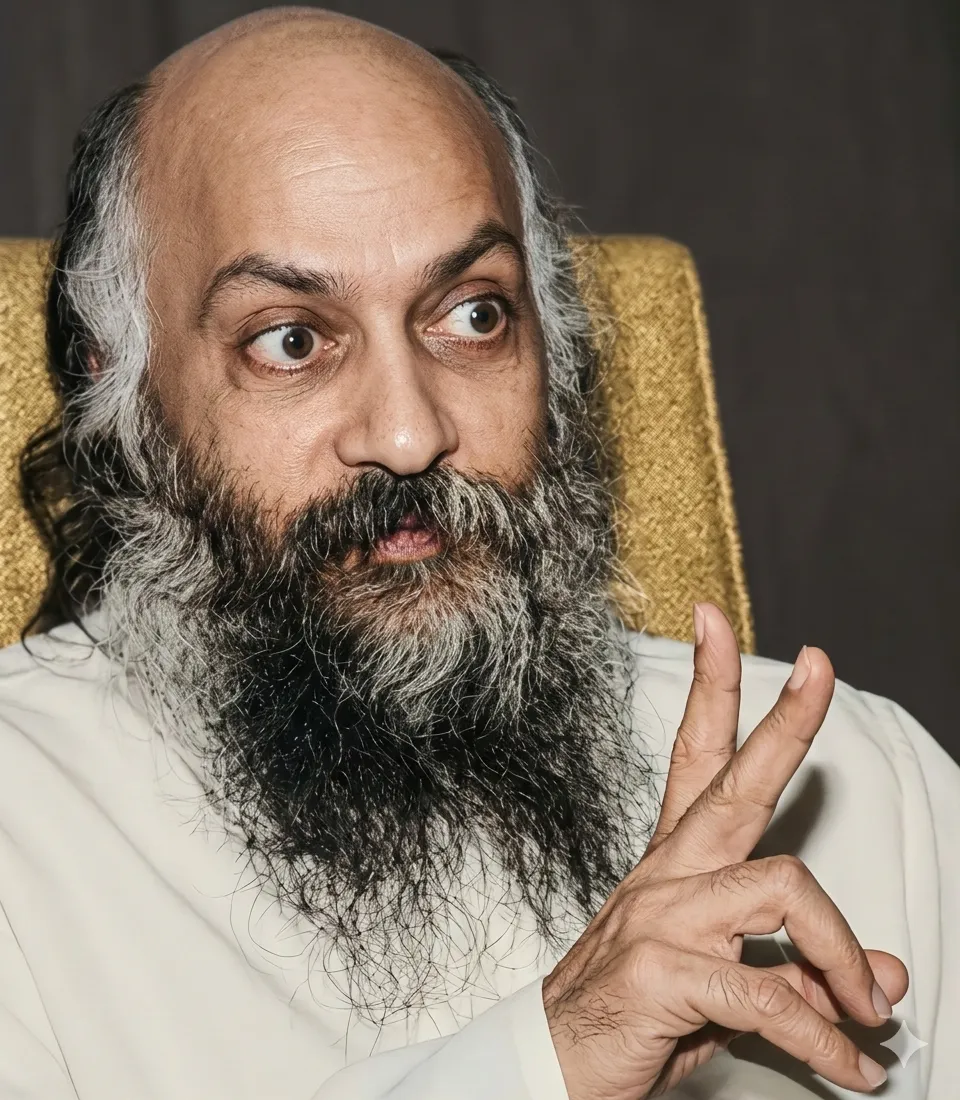
You can’t spot a knower of God from the outside—stop looking at others and find the truth inside by knowing yourself.
From the Discourses
Passages where Osho speaks to this question — each links to the complete discourse.
Osho, if one meets the Satguru—how does the seeker recognize him?
If you are a seeker, it won’t take even a moment. If you are not a seeker, there is no way to recognize. If you are thirsty and you find water—do you need to go ask someone about it? The very thirst becomes the recognition. The cooling of the throat is the proof. But if there is no thirst—if a lake is brimming and your throat has never known thirst—you will not recognize water. Water is known through thirst, not through definitions written in scriptures. If someone is a seeker—what does “seeker” mean? It means one who is searching, aspiring, filled with longing; one who is thirsty for truth. Out of a hundred, ninety-nine are not seekers, yet they descend into the world of sadhana. From this the whole confusion arises. You have never felt thirst, but someone who has known the pangs of thirst and the satisfaction of drinking…
Osho, kindly explain—what is the way to recognize enlightened ones?
If you go near an enlightened one, you will recognize. How could it be otherwise! It may be that a blind man cannot see the sun, but when the morning sun spreads its rays, he feels its touch. He experiences its warmth, its heat. He comes to know that night has gone. Birds have begun to sing, the morning hymn has begun. He knows that a moment ago all was silent, asleep, dead; now life has revived, a hum is there. The sun may not be seen, but its warmth is felt. Even the blind senses the sun. He knows when night has passed and day has come. Granted you do not yet have the inner eye—but if you go near an enlightened one, that gust from the Malaya will touch you. You will bathe in it. You will be freshened. That piece of moonlight will shower upon you. You…
It is said that unless one is in contact with one who is awakened, it is impossible to come out of one's ignorance or deep sleep. How to find out that one is awakened?
And the same happens with the follower of Krishna. He knows the flute, singing, dancing. He cannot believe for what Jesus was on the cross. If you ask him he will say, "He must have done some very wrong deeds in his past life. Otherwise, how is he crucified? Crucifixion happens only to great sinners. He must have done something great, a very great sin. That is why he is suffering -- because no Hindu AVATAR has ever suffered like this. This is not possible." Hindus have the theory of KARMA; whatsoever happens is your karma: Krishna is playing on the flute because he has beautiful KARMAS which sing in him, and Jesus must have been a sinner. It is not a question that others have forced him on the cross. Nobody can force anybody except your KARMAS. It is not that Judas has betrayed him; it is his own…
Osho, God does not appear to me anywhere. What should I do?
Anand! Open your eyes. You are trying to see with your eyes shut, trying to hear with your ears closed, with the doors of the heart barred—then it is impossible to see God. When the eye is open, there is light. The very opening of the eye is light. Keep the eye closed and even if not one but a thousand suns were to rise, there will still be darkness, a moonless night. But this is not only your mistake; it is almost everyone’s. When God does not appear, people conclude: perhaps there is no God—hence He is not seen. Rarely does someone wonder: perhaps my eyes are closed—hence I do not see. Those rare ones, sooner or later, become able to see the Divine. So the first and the last sutra is this: drop the search for God; learn the alchemy of opening your eyes. Eyes open in two…
Osho, what does realization feel like? How can a seeker know that something has truly happened? How can one distinguish reality from self-created imagination? How can others recognize the attainment of one who is realized?
You ask: “How can a seeker know that something has truly happened?” When you have a headache, how do you know you have a headache? When I was in school, I had a Muslim teacher—perhaps he is still alive—Rahamuddin, a lovely man, but very strict in one thing: it was almost impossible to get leave from him. He himself never took leave and would not grant it to students. I often needed leave. I would say my stomach hurts, or my head hurts. He said, “Listen, I accept fever; I do not accept stomachache or headache. If you have fever, I can at least take your hand and feel it. But how am I to know whether you truly have a stomachache or headache?” I said, “Since you ask, let me ask you—have you ever had a headache? A stomachache?” He said, “I have.” I said, “What proof can you…