
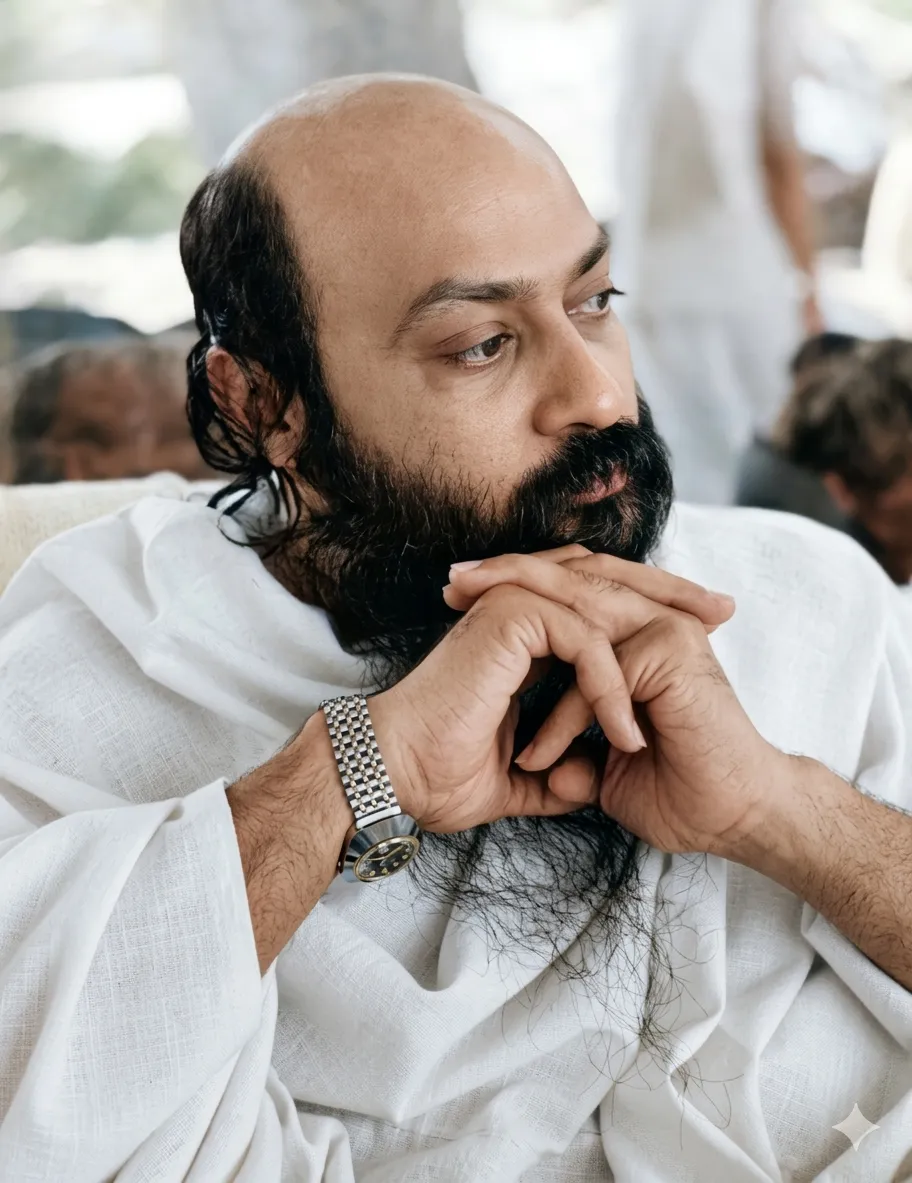
All holy books are different songs with the same tune; a simple heart listens to the tune and finds the same Truth.
From the Discourses
Passages where Osho speaks to this question — each links to the complete discourse.
Osho, you said that what the knowers have said is scripture, and the ignorant ought to follow it. But the problem is that scriptures are many and their utterances endless, and the ignorant is, after all, ignorant—then how is he to decide what is worthy for him to follow?
You are already overburdened by your own household; don’t take on the burden of this vast household. Whether someone made the world or not—is that the question of your life? What have you to do with that? And even if you learn that someone made it, how will that solve the questions of your life? And if no one made it, what difference will it make? You will remain you. These are futile questions. A meaningful question is always real. You ask, “Why am I restless?” You ask, “What is the way to be at peace?” You ask, “I am filled with sorrow; I have not known even a ray of bliss—how am I to know it? How to open a window? How to open the eyes? How to come out of the dark? I grope for the lamp, I find it—but how to light it? How to kindle the…
A friend has asked: Osho, when Krishna himself says that it is not in the scriptures, then what is the point of explaining the Gita? What will reading the Ramayana do? When Krishna himself says there is nothing in the Vedas, how can there be anything in the Gita?
He speaks rightly. The friend is asking well: if we accept Krishna’s own words, then what is there in the Gita either? But even if from the Gita you come to know this much—that “it is not in the Vedas”—that is already knowing a great deal. If reading the scriptures brings you to see that scriptures are useless, that is quite some knowing. Would you have discovered even this on your own! People come to me and say, “Krishnamurti says, don’t believe anyone; find out for yourself.” I ask them, “But you have come here believing Krishnamurti. And Krishnamurti has explained: don’t believe anyone. And you tell me, ‘Krishnamurti says don’t believe anyone; now we will not believe anyone.’ But you have already believed someone.” Krishnamurti says, “Nothing can be gained from a guru.” Then why did you go to Krishnamurti? And if you gained even that much, then at…
Osho, a question arises in my mind. Last night you said some things about the scriptures. It seemed to me that whatever you say could also be found in the scriptures. And what you are saying is itself gradually becoming a scripture. And what you say about the scriptures will apply verbatim to what you yourself have said as well. One who can see will see it here too; one who cannot see will not see it here either. And one who can see will also see it in the ancient scriptures, while the one who cannot see will not see it there either. Then there remains no purpose in criticizing them.
If this much becomes clear to us, then you will see I am not condemning scripture; I am stating the factual situation of scripture. And what you say is right: much of what I say will be found in the scriptures—not because it is there, but because you will have understood me. If my words have been understood by you, you will find them in the scriptures, because in scripture you will find only what your understanding is. Whatever your understanding is, that is what you will find—because we project our own understanding into scripture. Ordinarily we think that understanding comes out of scripture. It does not. We put our understanding into the scripture. That is why a thousand commentaries on the Gita are possible. If understanding came out of the Gita, how could there be a thousand commentaries? And if Krishna had a thousand meanings, then Krishna’s mind must…
Osho, regarding the Gita and the Ramayana, it is said about you that you have also refuted them—that you have criticized them. Or that you have said these books do not lead to knowledge, rather they increase ignorance. So please clarify what you mean by “ignorance” here.
One thing: I am not against the scriptures; I am against holding on to them—clinging. I am not saying, “Don’t read the Gita.” I am saying: don’t grab the Gita blindly. Our minds develop a clinging, a grip. That grip does not make us free; it makes us dependent, makes us prejudiced. The person who reads the Gita without clinging can also read the Quran with the same ease and joy. The one who clings to the Gita cannot read the Quran with the same joy. The one who clings to the Quran will not be able to read the Guru Granth with the same joy. My opposition is to clinging. I hold that in all the world’s scriptures, those who knew something have said something. Therefore, the person who clings to any one scripture is depriving himself of a vaster range of experience and moving toward ignorance. He needs…
Osho, “Contemplation of the essence (tattva) is supreme; contemplation of scripture is middling; preoccupation with tantra is inferior; and wandering among holy places is worse than the worst. Without direct experience, the dull-witted person vainly delights in Brahman—like one pleased by tasting the fruit only as it appears reflected at the tip of a branch in the shade.” Please be gracious and explain the purport of these two aphorisms from the Maitreyi Upanishad.
Someone explain what this color of the tavern is: the cup’s fame rises because of the cupbearer’s glance. O tellers of the candle’s heat, you have not yet seen the moth’s dance. Seek the company of the intoxicated. If you want to see the dance, watch the moth, not the lecture. Where a Buddha is present, the tavern is alive. There wine-springs burst forth; there the drinkers gather. Once they gathered at the Kaaba—not for the stone of the Kaaba but for Muhammad’s presence. In Muhammad’s presence, even the stone of Kaaba intoxicated. The cupbearer’s eye—and the cup got the name! Thus tirthas are born; and for centuries people wander among them. The sutra speaks truly: Adhamā tantra-cintā ca tīrtha-bhrānty adhamā-dhamā. Anubhūtiṁ vinā mūḍho vṛthā brahmaṇi modate, pratibimbit-śākhāgra-phalāsvādana-modavat. A lovely image: “As one might, under a tree, savor the fruit that appears only in its shadow, reflected…” Sit beneath a…