
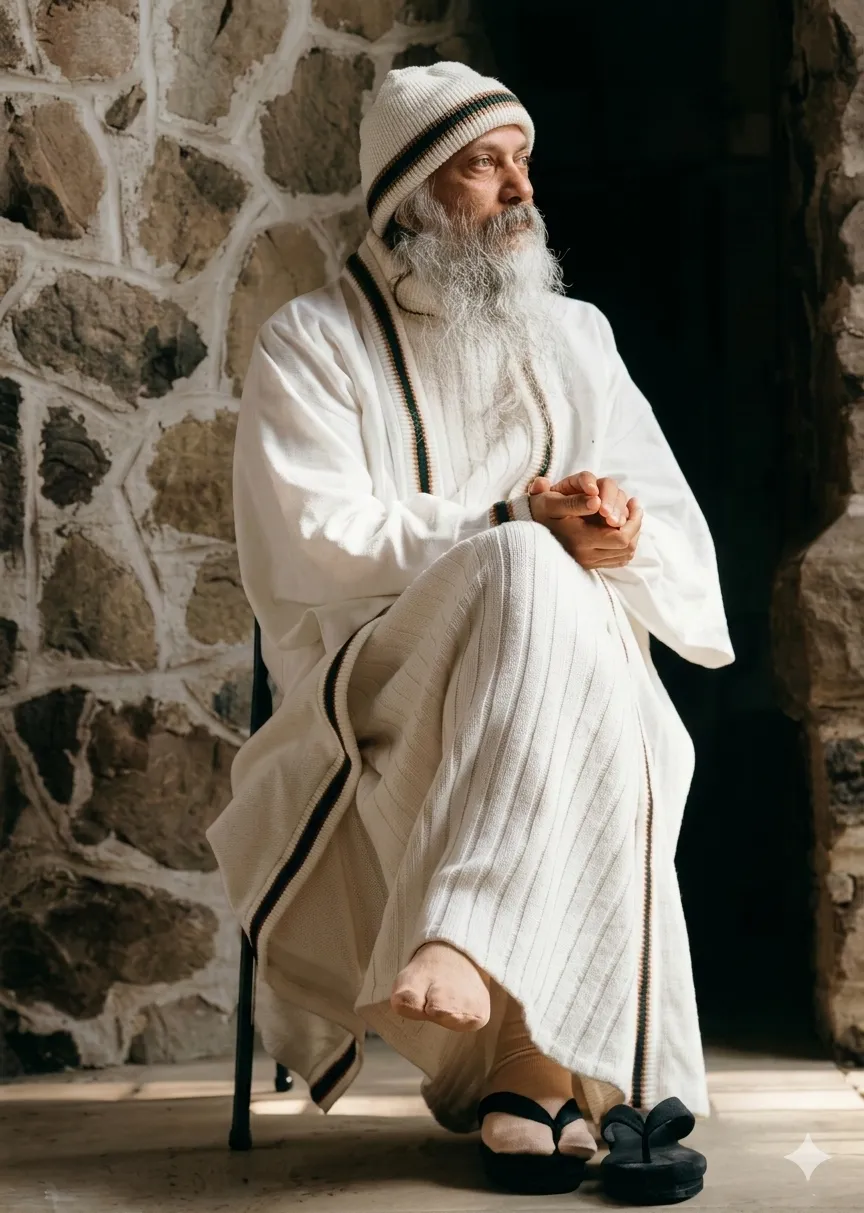
When you truly watch, the busy mind stops, and doing happens by itself—playful, free, and happy, without trying to get anything.
From the Discourses
Passages where Osho speaks to this question — each links to the complete discourse.
Beloved Osho, I have come to a dead end. I see the impotence of the mind and feel all action useless. Does the mind totally die only in samadhi? Please say something about mind and action in witnessing.
Vinod Bharti, you say, "I have come to a dead end" -- but I don't feel it so. Not yet, because when you really come to a dead end, a transformation immediately happens. You are coming closer to it, of that much I am certain. The dead end is not far away, but you have not come to it yet. Your whole question proves it. You are coming closer, you are feeling intuitively that it is not far away -- but it has not been reached yet. Still, there is hope. Still, deep down, you are dreaming that this is not going to be the dead end; hence the question arises. You say, "I see the impotence of the mind...." You have not seen it yet, you only think you have. Seeing and thinking are totally different, but one can get mixed up very easily. Thinking can pretend to be…
Osho, what is the definition of God?
Words are very small. If you say God is light, then what of darkness? The scriptures have said that God is light. Suppose we accept this as a definition—then what about darkness? Where will darkness go? Darkness is too; in fact it is far more than light. Light sometimes is and sometimes is not; darkness is always, eternal. Where will you place darkness? If you say God is light, darkness is left out. If you say God is darkness, then light is left out. If you say God is both darkness and light, a contradiction arises: they cannot be together. Try to have both darkness and light in the same room. If you bring in light, darkness disappears; if you preserve darkness, you cannot have light. Then how can both be together? That becomes an impossibility. So you cannot say “both” either. Then the fourth device is to say: it…
Someone has asked, “Is there an inner relationship between shraddha and witnessing?”
Certainly. Shraddha is the door; the witness—the image enthroned in the temple. Without shraddha no one has ever reached the witness, nor reached truth. Without shraddha you can be a pundit, not a knower. Without shraddha you can be a believer, not one who has experienced. So there are two kinds of wanderers in the world. One we call atheists; the other we call theists. Both wander. Both are filled with belief—one for, one against. Neither the atheist knows that God is, nor the theist knows that God is. That is why I place the religious apart from both; he is neither atheist nor theist. He has slowly attempted to see. Your notions are not needed at all for seeing. Your notions become obstacles; your prejudices bring hindrances. You set out having assumed something in advance; because of that, seeing does not remain pure. If you have already assumed, you…
Osho does witnessing always bring joy? The moments that I call witnessing sometimes feel distant -- almost cold in their neutrality. Other times it is like sprouting wings and soaring in joy over the open sea.
THE STATE OF WITNESSING IS NEITHER COLD NOR hot. It is neither happiness nor unhappiness. It is neither dark nor light. It is neither life nor death. The Upanishads say NETI NETI -- neither this nor that. If you feel joy you have already become identified; witnessing is gone. If you feel sad you are no more a witness; you have forgotten witnessing, you have become involved. You are colored by your psychology of the moment. Joy, sadness, all these qualities, are part of your psychology. And witnessing is a transcendence; it is not psychological. The whole art of meditation consists in witnessing. Then what does it bring? At the most we can say it brings total peace; it simply brings eternal silence. You cannot define it as joy. The moment you define it as joy you have fallen into the world of duality again. Then you have become part…
Osho, last night you said that the mind cannot do two things together -- that is, thinking and witnessing. It seems then that witnessing is a mental faculty and an act of the mind. Is it so? Please explain. Is there anything like partial witnessing and total witnessing?
WITNESSING is not a mental activity; thinking is a mental activity. Rather, it would be better to say that thinking is mind. When the mind is not, when the mind is absent, when the mind has disappeared, only then do you have witnessing. It is something behind the mind. Zen Buddhism uses mind in two ways: the ordinary mind means thinking; then Mind with a capital "M" means the Mind behind thinking. Consciousness is behind the mind; consciousness comes through the mind. If mind is in a state of thinking, it becomes opaque, non-transparent, just like a clouded sky -- you cannot see the sky. When the clouds are not, you can see the sky. When thinking is not there, then you can feel the witnessing. It is the pure sky behind. So when I said that you cannot do two things, I meant either you can think or you…