
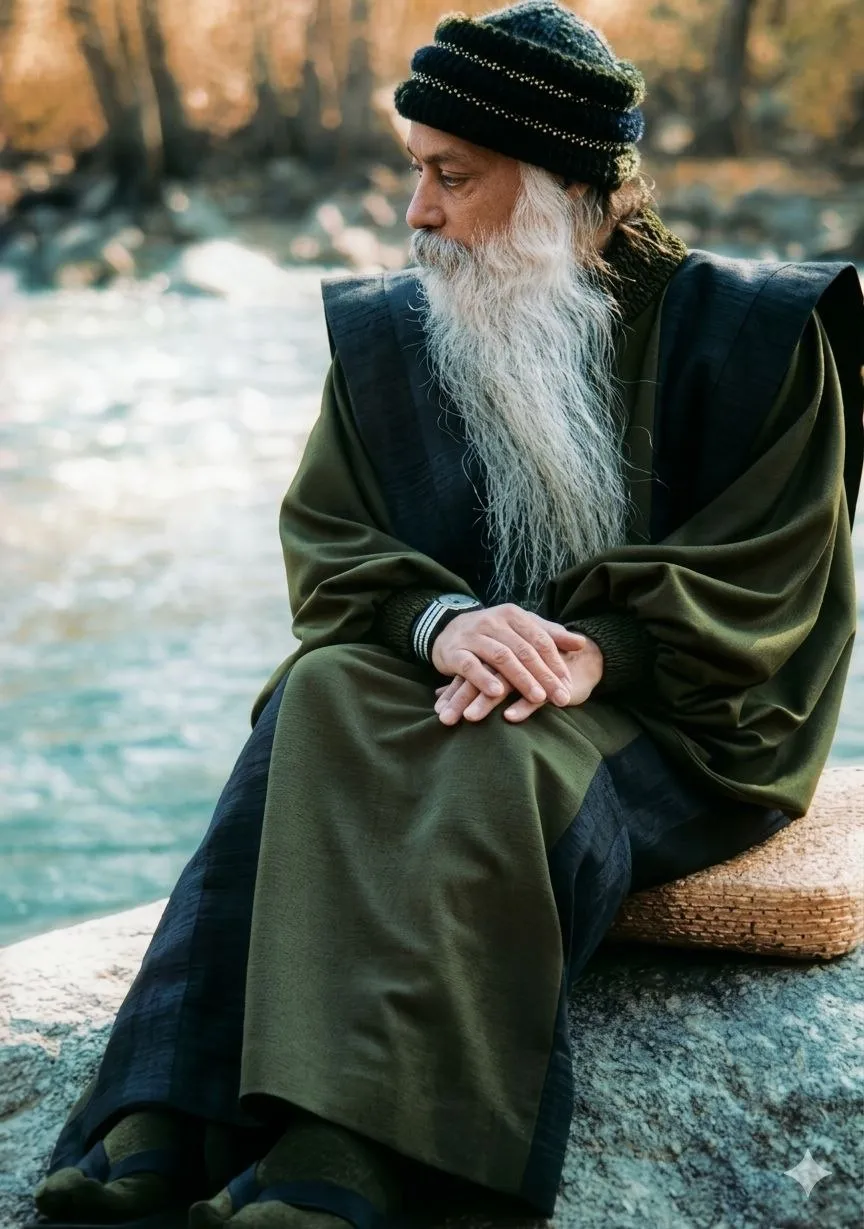
First comes the hidden plan, then the solid things appear on top of it—like building a house from an unseen blueprint.
From the Discourses
Passages where Osho speaks to this question — each links to the complete discourse.
Does that come first, and from it the gross manifests?
Yes, the subtle comes first; from it the gross is formed. That is the model, that is the framework. Upon it the rest of this whole expanse unfolds.
प्रश्न: वह पहले आता है उससे यह स्थूल बनता है?
हां, सूक्ष्म पहले आता है, उससे यह स्थूल बनता है। वही मॉडल है, वही ढांचा है। उसके ऊपर बाकी सारा यह फैलाव है।
Chapter 1: sutra 4 under these two aspects, it is really the same; but as development takes place, it receives the different names. Together we call them the mystery. Where the mystery is the deepest, is the gate of all that is subtle and wonderful.
They are not apart actually. It is our manner of looking that is wrong. The way we see things is like this. If I were to make a hole in the wall and look into this room then when I look at say A, I will see A only, then when I turn towards B, I shall see B only. A will be lost. From B when I turn to C, B will be lost. Then supposing there is no way of turning my back, what would I understand by this? I will naturally think that A and B are finished and only C remains. I cannot see D further ahead. Now if the wall were to break, I would see all A,B,C,D simultaneously. Then this would be a miracle. If I can see the birth of creation and its death, its annihilation simultaneously, it is a miracle. Lao Tzu…
Verse (Sanskrit): सर्वभूतानि कौन्तेय प्रकृतिं यान्ति मामिकाम्। कल्पक्षये पुनस्तानि कल्पादौ विसृजाम्यहम्।। 7।। प्रकृतिं स्वामवष्टभ्य विसृजामि पुनः पुनः। भूतग्राममिमं कृत्स्नमवशं प्रकृतेर्वशात्।। 8।। न च मां तानि कर्माणि निबध्नन्ति धनंजय। उदासीनवदासीनमसक्तं तेषु कर्मसु।। 9।। Transliteration: sarvabhūtāni kaunteya prakṛtiṃ yānti māmikām| kalpakṣaye punastāni kalpādau visṛjāmyaham|| 7|| prakṛtiṃ svāmavaṣṭabhya visṛjāmi punaḥ punaḥ| bhūtagrāmamimaṃ kṛtsnamavaśaṃ prakṛtervaśāt|| 8|| na ca māṃ tāni karmāṇi nibadhnanti dhanaṃjaya| udāsīnavadāsīnamasaktaṃ teṣu karmasu|| 9|| Translation: All beings, O Kaunteya, pass into My own Nature. At kalpa’s end; again, at kalpa’s dawn, I send them forth.।। 7।। Sustaining My own Nature, I send forth again and again this entire host of beings, helpless under Nature’s sway.।। 8।। Nor do those actions bind Me, O Dhananjaya. Seated aloof, as one indifferent, unattached to those deeds.।। 9।। To come near this sutra, let us travel by two or four pathways; it will be easier. This sutra concerns the most fundamental question in human thought.
इस सूत्र के निकट पहुंचने के लिए हम दो-चार मार्गों से यात्रा करें, तो आसान होगा। यह सूत्र, मनुष्य के चिंतन में जो मूलभूत प्रश्न है, उससे संबंधित है। आदमी ने निरंतर जानना चाहा है, कैसे यह सृष्टि निर्मित होती है? कैसे विलीन होती है? …
Osho, in yesterday’s talk you said that a seeker should first be concerned with becoming a vessel, and should not go about begging from place to place. But the very meaning of a seeker is that he has obstacles in practice. He doesn’t know how to become a vessel, how to prepare. So if he does not go asking, what should he do? How difficult it is to meet the right guide!
But searching and begging are two different things. In fact, the one who does not want to search is the one who begs. Searching and begging are not the same; they are opposites. He who wants to avoid searching begs; a seeker never begs. And the processes of searching and begging are entirely different. In begging you have to keep your attention on the other—the one who will give. In searching you have to keep your attention on yourself—the one who is to receive. It is true that there are obstacles on the path of the seeker. But if we understand rightly, saying there are obstacles on the path of the seeker means the obstacles are within the seeker; the path too is within. And to understand one’s obstacles is not very difficult. So we will have to speak a little more extensively on what the obstacles are and how…
प्रश्न: ओशो, कल की चर्चा में आपने कहा कि साधक को पात्र बनने की पहले फिकर करनी चाहिए, जगह-जगह मांगने नहीं जाना चाहिए। लेकिन साधक अर्थात खोजी का अर्थ ही है कि उसे साधना में बाधाएं हैं। उसे पता नहीं है कि कैसे पात्र बने, कैसे तैयारी करे। तो वह मांगने न जाए तो क्या करे? सही मार्गदर्शक से मिलना कितना मुश्किल से हो पाता है!
लेकिन खोजना और मांगना दो अलग बातें हैं। असल में, जो खोजना नहीं चाहता वही मांगता है। खोजना और मांगना एक तो हैं ही नहीं, विपरीत बातें हैं। खोजने से जो बचना चाहता है वह मांगता है, खोजी कभी नहीं मांगता। और खोज और मांगने की प्रक्रिया बिलकुल अलग है। मांगने में दूसरे पर ध्यान रखना पड़ेगा--जिससे मिलेगा। और खोजने में अपने पर ध्यान रखना पड़ेगा--जिसको मिलेगा। यह तो ठीक है कि साधक के मार्ग पर बाधाएं हैं। लेकिन साधक के मार्ग पर बाधाएं हैं, अगर हम ठीक से समझें तो इसका मतलब होता है कि साधक के भीतर बाधाएं हैं; मार्ग भी भीतर है। और अपनी बाधाओं को समझ लेना बहुत कठिन नहीं है। तो इस संबंध में थोड़ी सी विस्तीर्ण बात करनी पड़ेगी कि बाधाएं क्या हैं और साधक उन्हें कैसे दूर कर सकेगा।
Verse (Sanskrit): सम्भूतिं च विनाशं च यस्तद्वेदोभयं सह। विनाशेन मृत्युं तीर्त्वा सम्भूत्याऽमृतमश्नुते।।16।। Transliteration: sambhūtiṃ ca vināśaṃ ca yastadvedobhayaṃ saha| vināśena mṛtyuṃ tīrtvā sambhūtyā'mṛtamaśnute||16|| Translation: Manifestation and dissolution—he who knows them both together. By dissolution he crosses death; by manifestation he attains immortality. ।।16।। He who knows the Unmanifest and the effect-Brahman—both together; by the worship of the effect-Brahman he crosses over death, and through the Unmanifest he attains immortality. ।।16।। Draw a circle. Without a center, you cannot draw it. Around the center you trace the circumference. The farther the circumference goes from the center, the larger it becomes. If we take two points on the circumference, there will be a distance between them. If from those two points we draw two lines joining to the center, then as we move toward the center, the distance between them goes on decreasing. Exactly at the center the distance disappears.
एक वर्तुल खींचें हम, एक सर्किल बनाएं तो बिना केंद्र के नहीं बना सकेंगे। केंद्र के चारों ओर परिधि को खींचेंगे। केंद्र से परिधि जितनी दूर होती जाएगी उतनी बड़ी होती चली जाएगी। अगर परिधि पर हम दो बिंदुओं को लें तो उनमें फासला होगा। अगर दोनों बिंदुओं से दो रेखाएं खींचें, जो केंद्र को जोड़ती हों, तो जैसे-जैसे केंद्र की तरफ बढ़ेंगे, वैसे-वैसे फासला कम होता चला जाएगा। ठीक केंद्र पर आकर फासला समाप्त हो जाएगा। परिधि पर कितना ही फासला रहा हो दो बिंदुओं के बीच में, खींची गई रेखाएं वहां से केंद्र की ओर क्रमशः निकट आती चली जाएंगी। और केंद्र पर आकर बिलकुल ही दूरी समाप्त हो जाएगी। केंद्र पर एक हो जाएंगी। अगर परिधि की ओर उन रेखाओं को और आगे बढ़ाते चले जाएं, तो जितनी बड़ी परिधि होती चली जाएगी उतना ही दोनों रेखाओं के बीच का फासला बड़ा होता चला जाएगा। ज्यामिति के इस उदाहरण से दो-तीन बातें इस सूत्र को समझाने के लिए आपसे कहना चाहता हूं।