
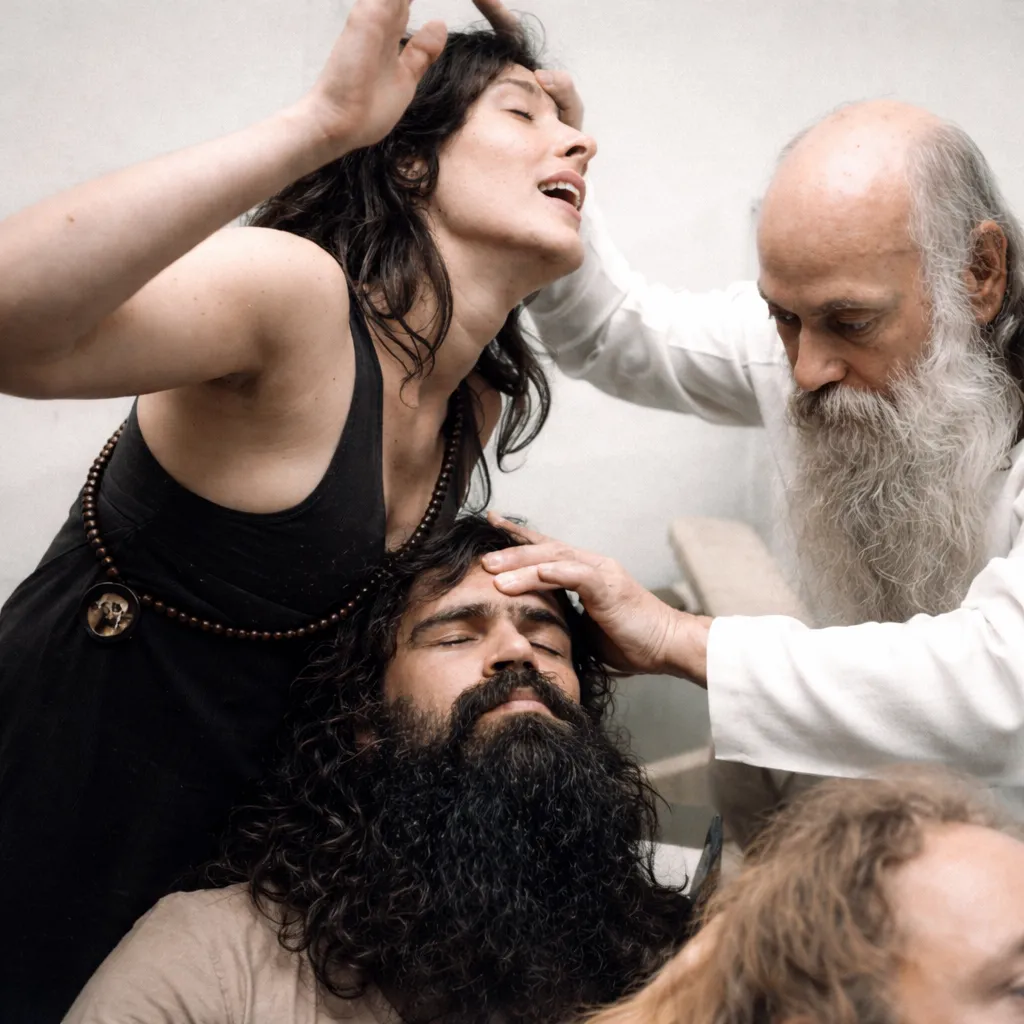
Practice watching yourself when things are calm and boring, then keep that same watching when life gets super exciting so you don’t get lost.
From the Discourses
Passages where Osho speaks to this question — each links to the complete discourse.
Beloved Osho, for me it's either high-energy excitement where life is wonderful and a joy to be alone; or very often these days there's a quietness that's dull and boring. In the one there's juice but no awareness, and in the other there's awareness but no juice. Is there a knack in bringing these two together?
It is a very simple thing. You say you have moments of great ecstasy, full of juice, but you become drowned in that juice; the ecstasy is so overwhelming you forget to be watchful. You become immersed in that ecstasy, the witness is not there. And then you say there are moments when you are sad, bored, but the witness is there. You just have to put things in their right place. Start from your boredom and sadness, because the witness is there and the witness is going to be the bridge. So when you are sad and bored, just watch it, as if it is something outside of you -- it is. You are always a witness -- now you are witnessing sadness and boredom. It is easy to witness sadness and boredom, because who wants to get immersed in boredom? But this is of tremendous importance because you…
Osho does witnessing always bring joy? The moments that I call witnessing sometimes feel distant -- almost cold in their neutrality. Other times it is like sprouting wings and soaring in joy over the open sea.
THE STATE OF WITNESSING IS NEITHER COLD NOR hot. It is neither happiness nor unhappiness. It is neither dark nor light. It is neither life nor death. The Upanishads say NETI NETI -- neither this nor that. If you feel joy you have already become identified; witnessing is gone. If you feel sad you are no more a witness; you have forgotten witnessing, you have become involved. You are colored by your psychology of the moment. Joy, sadness, all these qualities, are part of your psychology. And witnessing is a transcendence; it is not psychological. The whole art of meditation consists in witnessing. Then what does it bring? At the most we can say it brings total peace; it simply brings eternal silence. You cannot define it as joy. The moment you define it as joy you have fallen into the world of duality again. Then you have become part…
Someone has asked, “Is there an inner relationship between shraddha and witnessing?”
Certainly. Shraddha is the door; the witness—the image enthroned in the temple. Without shraddha no one has ever reached the witness, nor reached truth. Without shraddha you can be a pundit, not a knower. Without shraddha you can be a believer, not one who has experienced. So there are two kinds of wanderers in the world. One we call atheists; the other we call theists. Both wander. Both are filled with belief—one for, one against. Neither the atheist knows that God is, nor the theist knows that God is. That is why I place the religious apart from both; he is neither atheist nor theist. He has slowly attempted to see. Your notions are not needed at all for seeing. Your notions become obstacles; your prejudices bring hindrances. You set out having assumed something in advance; because of that, seeing does not remain pure. If you have already assumed, you…
Osho, in a lecture you spoke about non-identification, that one should become a witness. But in the west many people are alienated, they cannot get involved. They are simply indifferent to everything. That is also my experience. Please can you make clear the difference between non-identification and alienation?
The sannyas that teaches you how to live in the world and yet float above it like a lotus flower, like a lotus leaf, remaining in the water and yet untouched by the water, remaining in the world and yet not allowing the world to enter into you, being in the world yet not being OF the world, that is true renunciation. That true renunciation comes through witnessing; it is not indifference. Indifference will make you alienated, being alienated you will feel meaningless, joyless, accidental. Feeling accidental, the desire to commit suicide will arise, is bound to arise. Why go on living a meaningless life? Why go on repeating the same rut, the same routine, every day? If there is no meaning, why not end it all, why not be finished with it all? Hence many many more people are committing suicide every day, many many people are going mad…
For years I am most of the time witnessing and I feel it like a disease. So is it that there are two kinds of witnessing and mine is wrong? Tell me.
And only then can the third step be taken, which will bring you close to what Gurdjieff calls self-remembering, or Krishnamurti calls awareness, or the Upanishads call witnessing. But first the two steps have to be fulfilled; then the third comes easy. Don't start doing the third immediately. First the object, then the consciousness, then the subject. Once the object is dropped and the emphasis on the consciousness is no longer a strain, the subject is there but there is no subjectivity in it. You are there but there is no "I" in it, just being. You are, but there is no feeling that "I am." That confinement of "I" has disappeared; only amness exists. That amness is divine. Drop the "I" and just be that amness. And if you have been working too long on witnessing, then for a few months, at least for three months, drop it completely,…